
Reviewed · VESPA, FIAT 500 & GOLF CART TOURS
Golf Cart Tour Rome: Glide By Ancient Wonders & Hidden Gems
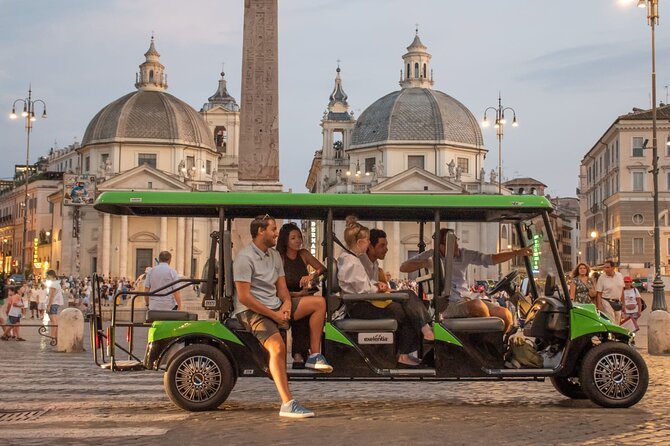
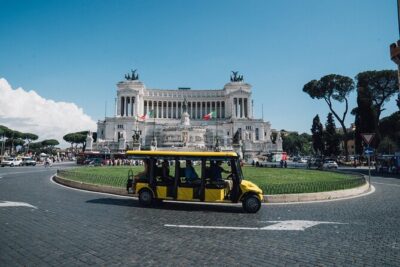
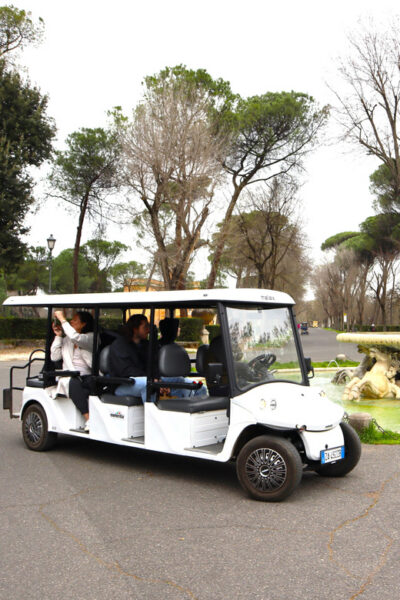
Rome is loud, hot, and spread out. This small-group golf cart tour makes the icons feel close, with wraparound views.
I especially like how the route hits the big names and then keeps things photo-friendly. I also like the tight cap of seven people, so the cart never feels like a noisy bus.
One possible drawback: you do see everything from the outside, so if you want long interior time inside major sites, this is not the style for that.
In This Review
- Key things to know before you ride
- Why Rome works best by golf cart (especially with a 7-person limit)
- The 2.5-hour flow: what you’ll actually experience
- Colosseum viewpoints and gladiator stories you can picture
- Drive-by segments that connect early Rome to the emperors’ power
- Circo Massimo: the chariot racing track and a hands-on fountain lesson
- The Roman theater and a smart answer about the windows
- Pantheon photo moment, then the no-rain explanation
- Trevi Fountain: wishing ritual, plus a traffic-dependent photo advantage
- Spanish Steps and Piazza Navona: people watching with a plan
- Finishing with a panoramic garden view
- Price and value: why $163.33 can make sense in Rome
- Who this tour fits best (and who might want something else)
- Should you book the Golf Cart Tour Rome?
- FAQ
- How long is the golf cart tour?
- Is the tour offered in English, and do I get a mobile ticket?
- What landmarks will I see during the tour?
- Does the tour include going inside the Pantheon?
- How many people are on the tour?
- Where does the tour start and end?
- Is tipping included in the price?
Key things to know before you ride
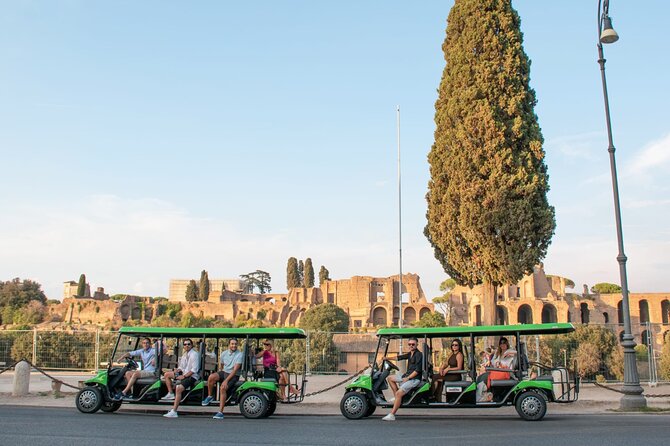
- Max 7 people keeps the pace relaxed and the photo stops actually usable
- Wraparound cart views let you grab shots without doing acrobatics in a crowd
- Colosseum storytelling from guides with roots there adds detail you usually miss
- Pantheon explained with a no-rain effect via a short private video
- Trevi timing depends on traffic, so the best photo moment may shift
- External stops only, then you move on fast to the next viewpoint
Why Rome works best by golf cart (especially with a 7-person limit)
Rome rewards patience, but it also punishes slow days. The roads are busy, the walking can stack up fast, and the best viewpoints often sit just out of reach when you try to DIY it all. A golf cart cuts through that problem. You get an easy ride with better vantage points than you’d have from a bus, and you can pause for pictures without turning your day into a stair workout.
The small group size matters. With a cap of seven, the guide can actually steer the flow. You are not stuck waiting for ten people to find their hats, and you are more likely to get time at the exact angle you want for photos. That cozier setup also makes it easier to ask questions when something catches your eye.
I like the fact that the tour lets you plan around your day. Since you choose a departure time, you can pair it with the rest of your schedule without losing the whole afternoon.
Filed beside this one, more Vespa, Fiat 500 and golf cart rides in Rome.
- Rome by Golf Cart Private Tour: Beyond the Landmarks
★ 5.0 · 4,361 reviews - Rome on a Golf Cart Semi-Private Tour Max 6 with Private Option
★ 5.0 · 2,502 reviews - Rome Highlights by Golf Cart Private Tour
★ 5.0 · 2,379 reviews - Vespa Sidecar Tour By Night with Pickup
★ 5.0 · 1,803 reviews
The 2.5-hour flow: what you’ll actually experience
This is an overview-style tour that moves through Rome at a comfortable, scenic pace. Expect quick, well-timed stops at major landmarks plus short drive-by segments where the guide points out what to notice. You will not have time for long museum-style wandering, but you will leave with strong orientation, a photo set you can build on, and a handful of stories that help the city make sense.
What makes this format smart is the mix of iconic sights and moments that feel more personal. The cart ride gives you continuity, and each stop adds a specific piece of the Roman puzzle: entertainment (gladiators, chariot racing), engineering (Pantheon’s design), religion and art (fountain culture), and everyday life (squares and streets).
The other practical win is comfort. You keep your legs for later. If your trip includes more walking days, you’ll feel the difference by day’s end.
Colosseum viewpoints and gladiator stories you can picture
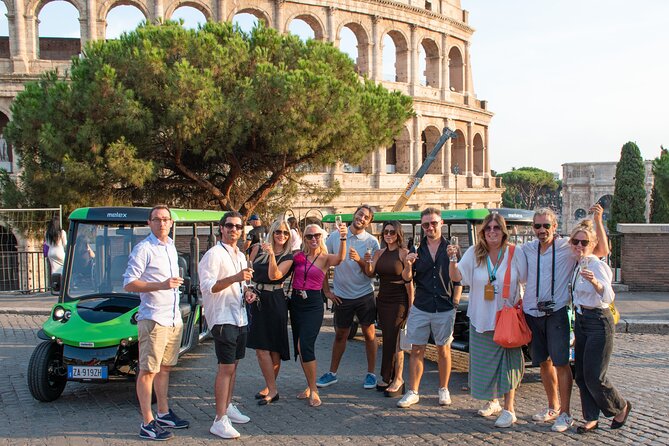
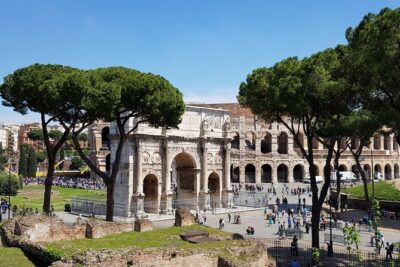
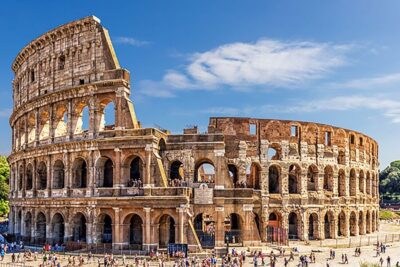
You start with a classic: the Colosseum from the outside, with a view that makes it easy to understand why this place still dominates Rome’s skyline. The stop is short, but it works because the guide gives you the story fast, then lets you frame your own photos.
Here’s what makes this opening more than a basic photo stop. The guides have roots in the Colosseum, so the talk carries that extra credibility. You hear about gladiators and the arena in a way that helps you visualize the crowds, the spectacle, and what it would have felt like when it was operating.
Practical note: since it is an external stop, do not plan on lingering. Bring your camera setup for a quick shot and then let the cart move you on.
Drive-by segments that connect early Rome to the emperors’ power
After the Colosseum, the tour shifts into perspective mode. You ride past the birthplace of Rome and get panoramic views that help you orient yourself across neighborhoods. The guide adds context about early Roman days and points out how power evolved into the grand palaces tied to emperors.
This part is useful on two levels. First, the city starts to look like more than a list of landmarks. Second, you get a feel for where things sit relative to each other, which helps you build plans for the rest of your trip without guessing.
If you are the type who likes to understand why a place looks the way it does, this is one of the better stretches. The cart gives you momentum, but you still get explanations rather than just “look over there.”
Circo Massimo: the chariot racing track and a hands-on fountain lesson
At Circo Massimo, you get to imagine the thrill of chariot racing along the ancient chariot track. This is the kind of stop where a quick pause turns into a clear mental picture, especially when the guide highlights where key action likely happened.
One detail I like here is the playful instruction about using a fountain in a Roman way. It is the sort of thing that makes a historic stop feel less like a lecture and more like a moment. Also, you get a fun photo stop that does not require a museum ticket.
Because the stop is brief, you should think in terms of: get one or two photos, listen to the point of interest, and then move on while the pace stays easy.
The Roman theater and a smart answer about the windows
You then get an up-close view of an ancient Roman theater. Instead of just admiring the architecture, the guide adds a question-and-answer kind of moment: why this building has windows.
That little curiosity hook is exactly what makes short stops feel worthwhile. You leave with a detail your brain actually keeps, and it changes the way you read Roman architecture when you see other buildings later.
If you like learning one strong fact per stop, you’ll probably enjoy how this tour parcels information out.
Pantheon photo moment, then the no-rain explanation
The Pantheon stop is built around a classic visual: the building from the outside with the famous oculus. You get time for a photo, and the guide follows up with a short story about how the Pantheon managed to last.
The tour does not take you inside. Instead, you get something that still feels like a mini lesson. The guide shares a private video explaining a phenomenon tied to why it never rains inside, often described with the “fireplace effect” idea the Romans mastered. Even if you have seen the Pantheon before, this kind of explanation helps you understand it as a piece of engineering, not just a famous dome.
One consideration: if you specifically want the inside experience with time to linger, plan to add a separate visit later. This tour’s Pantheon moment is a great primer, not a replacement.
Trevi Fountain: wishing ritual, plus a traffic-dependent photo advantage
Trevi Fountain is next, and yes, the ritual is part of why people come: toss a coin, make a wish, then enjoy the scene. The guide also shares the traditions around it, which turns the moment from just a snap into something you can explain to friends later.
There’s also a practical photography angle. The tour is set up so the guide can spot good angles and help you get unique shots of one of Rome’s most photographed landmarks. The catch is right in the plan: it depends on traffic, so the perfect timing for that extra photography may vary.
If you are picky about photos, try to stay flexible. Your best shot may happen at the moment the guide chooses, not when your instincts tell you.
Spanish Steps and Piazza Navona: people watching with a plan
At the Spanish Steps, the focus is on quick enjoyment and smart photo positioning. You can climb a few steps or just pause in the square, then you get short history and fun anecdotes, including how Hollywood and Roman life overlap in the story people tell about this area.
The guide points you toward good spots for pictures, which matters here because you want an angle that looks intentional, not accidental. Also, this part of the day works well if you want a taste of Roman daily energy without committing to a long stay.
Then you move to Piazza Navona, where you see Bernini-style fountain elegance and the energy of street performers. This is a good place for photos with movement in the frame, because the square naturally provides action. The guide also can recommend a spot for an authentic Italian lunch or dinner right in the heart of the square, which is handy if you do not want to hunt for food right after the tour.
In short: these two stops help you feel Rome as a lived-in city, not a theme park of monuments.
Finishing with a panoramic garden view
You end at a peaceful panoramic garden stop above the city. It is a calmer close after the busiest landmarks. You get a final window for photos and a chance to breathe before you re-enter streets and schedules.
This end section is more than scenic padding. It gives you time to mentally organize the day. When you step back and look out over Rome, the neighborhoods and sight connections start to click, and you can plan your next move with less guesswork.
Price and value: why $163.33 can make sense in Rome
At $163.33 per person for about 2.5 hours, you are paying for two things: transportation that saves your legs and a guide who compresses a lot of context into short stops.
Is it cheap? Not really. But Rome is one of those places where time has real value. If you only have a short stay, this tour can act like an efficient overview so you know what you want to return to on your own later. If your trip includes multiple crowded, high-demand sites, reducing your walking and getting a coherent route can be worth the premium.
The small group cap of seven also supports the price. This is not a big-group churn. It feels more like a guided circuit with room to breathe.
One value tip: if you book a departure time that fits your day, you can turn the remaining hours into more targeted exploring. That makes the tour cost easier to justify because it helps you spend the rest of your time with purpose.
Who this tour fits best (and who might want something else)
This is a great pick if you:
- want a fast Rome orientation with major landmarks from outside
- prefer comfort and photo stops over long walking hours
- want an expert guide with story-driven context at multiple stops
- are traveling as a couple, small family group, or a mixed-age group that appreciates saving legs
It may not fit as well if you want:
- long interior time at major sights
- a fully free-form route where you control every stop detail
- a deep museum day instead of an overview experience
If you are trying to balance first-time Rome excitement with physical energy, this route does that well.
Should you book the Golf Cart Tour Rome?
If you want the clearest “first pass” at Rome, I think this tour is an easy yes. The best reasons are the small group size, the wraparound cart viewpoints, and the guide-driven storytelling that turns brief stops into memorable takeaways. You’ll get the major names, plus enough specific details like the Pantheon no-rain explanation and the Trevi photo timing approach to feel like you learned something real, not just collected snapshots.
Only pass if your priority is interior access and long stays inside sites. Otherwise, this is a smart way to see a lot without burning your whole day.
FAQ
How long is the golf cart tour?
It runs for about 2 hours 30 minutes.
Is the tour offered in English, and do I get a mobile ticket?
Yes, it is offered in English. You receive a mobile ticket.
What landmarks will I see during the tour?
You will have external views and stops at major landmarks including the Colosseum, Circo Massimo, the Pantheon, Trevi Fountain, Spanish Steps, and Piazza Navona.
Does the tour include going inside the Pantheon?
No. You view the Pantheon from the outside, and the guide shares a short private video explanation instead of going inside.
How many people are on the tour?
The tour has a maximum of 7 travelers.
Where does the tour start and end?
It starts at Largo Gaetana Agnesi and ends at Piazza Campo de’ Fiori.
Is tipping included in the price?
No. Tips are not included.
Our Wider Tours File for Rome
Other Vespa, Fiat 500 and Golf Cart Rides in Rome From Our Notebook

Not quite the day you had in mind? The rest of our Rome write-ups sit below
- Rome: Guided Tour of St. Peter’s Dome Climb, Basilica & Vatacombs★ 5.0 · 167 reviews
- St. Peter’s Basilica Guided Tour with Reserved Entrance★ 4.0 · 168 reviews
- Golf Cart Driving Tour in Rome: 2.5 hrs Catacombs & Appian Way★ 5.0 · 168 reviews
- Rome: Trastevere Wine Tasting with Food Pairing and Gelato★ 4.9 · 168 reviews
- Guided Tour of the Colosseum Palatine Hill and Roman Forum★ 4.7 · 168 reviews
- Vatican Museums, Sistine Chapel & Saint Peter’s Semi-Private Tour★ 4.5 · 169 reviews
- Hidden Rome: Small Group E-Bike Tour with Street Food Stops★ 5.0 · 169 reviews
- Rome: Papal Audience with Pope Leo IV★ 3.9 · 169 reviews
- Rome Golf Cart Tour: Highlights & Must See★ 4.5 · 170 reviews
Vespa, Fiat 500 & Golf Cart Tours, top to bottom.
 ★ 5.0Rome by Golf Cart Private Tour: Beyond the LandmarksFrom $1804,361 reviews
 ★ 5.0Rome on a Golf Cart Semi-Private Tour Max 6 with Private OptionFrom $1682,502 reviews
 ★ 5.0Rome Highlights by Golf Cart Private TourFrom $1632,379 reviews
 ★ 4.5Golf Cart Tour to Fiesole Roman Theatre and MuseumFrom $952,039 reviews
 ★ 4.6Florence: Eco-Friendly Golf Cart City Tour with Audio GuideFrom $671,094 reviews
 ★ 5.0Rome Highlights City Tour by Golf Cart with GelatoFrom $1071,088 reviews
 ★ 5.0Golf Cart Small-Group Guided Tour: Rome City HighlightsFrom $104907 reviews
 ★ 4.8Rome: City Highlights Golf Cart TourFrom $45857 reviews
Filed under