
Reviewed · VESPA, FIAT 500 & GOLF CART TOURS
Rome Afternoon Sightseeing Vespa Sidecar Tour with Gourmet Gelato
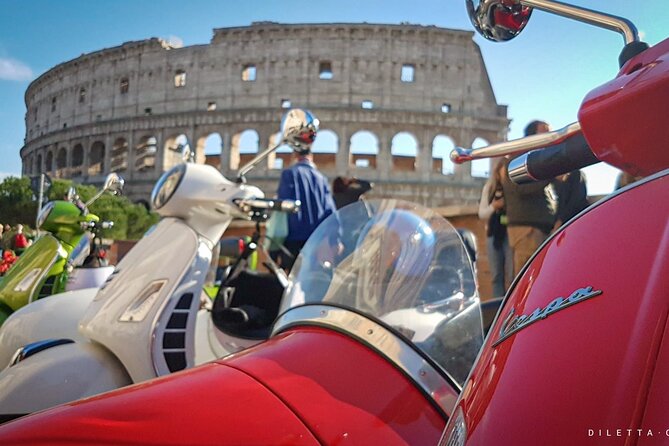
Four hours, zero driving, huge sights. This Rome Vespa sidecar tour feels like a “guided highlight reel” of the city, with a live English guide and a dedicated driver so you can just look, photograph, and enjoy. I especially like the built-in confidence of riding in a sidecar setup instead of balancing on two wheels.
What I like most is the combination of big-name sights and real context, like why Piazza della Repubblica was designed when Rome became the capital. Plus, you get a gourmet gelato stop that turns the ride into an actual break, not just more sightseeing.
One drawback to plan for: seat assignment can vary. If you book one seat, you may ride behind the driver while another guest sits in the sidecar, and kids must meet minimum age and height rules to sit in the sidecar.
In This Review
- Key points at a glance
- Why ride a Rome Vespa sidecar instead of a two-wheel Vespa
- Piazza della Repubblica start, then the Quirinal Palace area in the afternoon light
- Trevi Fountain size, history, and how to get your best photos fast
- The Pantheon oculus: the stop where Rome’s scale hits you
- Piazza Navona and St. Peter’s Square, switching from Roman to Vatican energy
- Terrazza del Gianicolo for views, then Trastevere for the Rome you remember
- Piazza Venezia and the Colosseum area, plus Santa Maria Maggiore
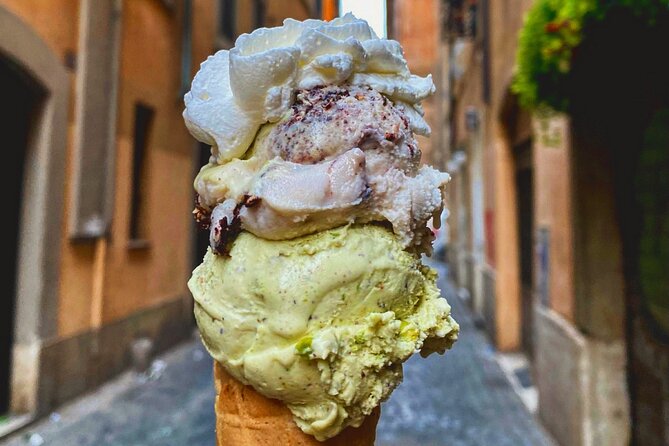
- Gelato in a historic alley, the planned pause your afternoon needs
- Safety and comfort: helmets, headsets, and sidecar seating rules
- Price and value: what $163.26 buys you in a 4-hour Rome overview
- Who should book this Vespa sidecar tour, and who should consider alternatives
- Should you book the Rome afternoon Vespa sidecar tour with gelato?
- FAQ
- Is this tour in English?
- Do I drive the Vespa sidecar?
- How long is the tour?
- What main stops are included?
- Is Pantheon admission included?
- Is gelato included?
- Are helmets and headsets provided?
- When can I cancel for a full refund?
- Is the tour dependent on weather?
Key points at a glance
- You do not drive. Each sidecar has its own motorcyclist, and you relax while the crew handles traffic.
- Small group size. Maximum 12 travelers makes it easier to hear the guide and move efficiently.
- Built-in audio. Headsets help you catch the commentary at busy stops and along the route.
- Pantheon ticket included. You get entry for one of Rome’s must-see interiors.
- Gourmet gelato stop. A planned break in a historic alley keeps the afternoon from feeling nonstop.
- Sidecar seating rules. If you book odd numbers, seats may swap at stops.
Why ride a Rome Vespa sidecar instead of a two-wheel Vespa
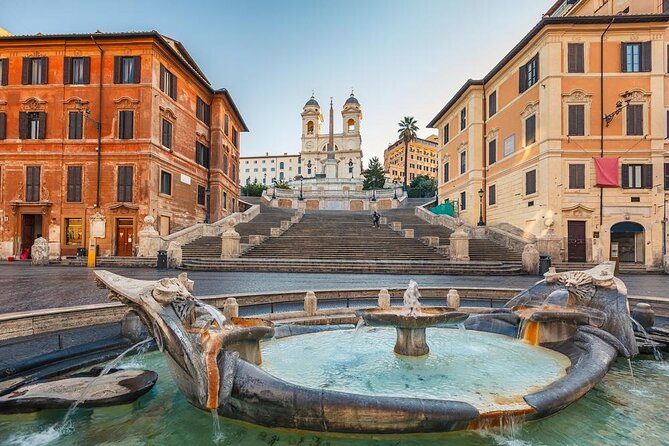
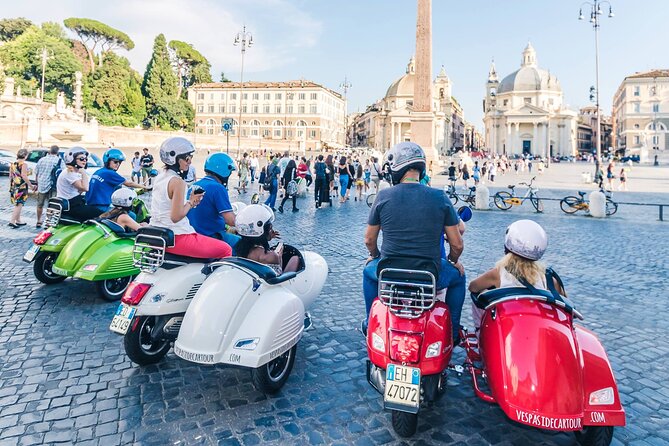
If Rome feels like one long maze of cobblestones, tight streets, and sudden turns, this is the way to avoid the whole stress part. The sidecar format is designed for stability, and the biggest win is that you are not expected to ride like a stunt performer. You sit on your seat, hold on, and let the driver do the driving.
The tour is also set up for clarity. You get CE helmets with sterilized disposable head covers, plus headsets so you can hear the guide’s narration. That matters because Rome’s streets are noisy, and it is easy to miss details when you are moving.
Finally, the small-group limit (maximum 12) changes the vibe. You are not getting shuffled like a herd. You can actually focus on the sights, and stops are built for short, meaningful time at each highlight.
Filed beside this one, more Vespa, Fiat 500 and golf cart rides in Rome.
- Rome by Golf Cart Private Tour: Beyond the Landmarks
★ 5.0 · 4,361 reviews - Rome on a Golf Cart Semi-Private Tour Max 6 with Private Option
★ 5.0 · 2,502 reviews - Rome Highlights by Golf Cart Private Tour
★ 5.0 · 2,379 reviews - Vespa Sidecar Tour By Night with Pickup
★ 5.0 · 1,803 reviews
Piazza della Repubblica start, then the Quirinal Palace area in the afternoon light
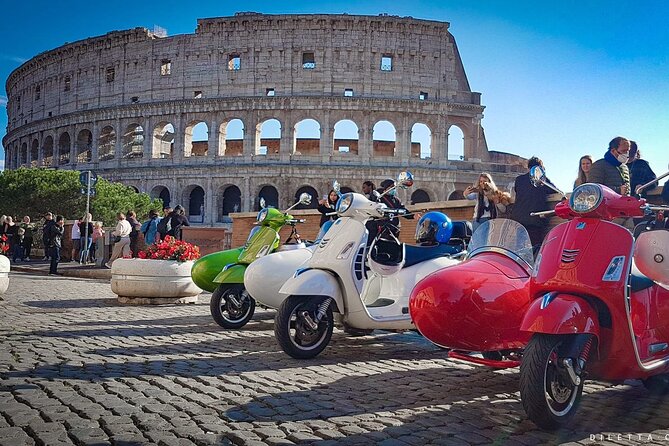
You start at Piazza della Repubblica, 41 around 2:30 pm, and the tour loops back to the same meeting point at the end. The afternoon timing is smart. It is warm enough that everyone is awake and ready to enjoy, but you still often get nicer viewing conditions than mid-day.
The first stop is Piazza della Repubblica, designed during Rome’s urban redevelopment when it became Italy’s capital. You can see the planning clearly: a wide, rounded layout, a striking fountain, and imposing buildings that give the square a grand, official feel.
Then you move to Palazzo del Quirinale, on the Quirinal Hill. This is one of the President’s official residences in Italy and it has housed leaders through many eras, including Popes and kings, plus the heads of the Italian Republic. Even in a brief stop, it helps to know you are not looking at just another palace. It is part of the country’s living political history.
Practical tip: These early stops are short, so I would treat them like photo and orientation moments. The guide’s context is what makes the minutes feel worthwhile.
Trevi Fountain size, history, and how to get your best photos fast
Trevi Fountain is the kind of place where you feel the crowd before you even arrive. It is also one of the most important fountains in Rome. It stretches roughly 20 meters wide by 26 meters high, and the origins connect back to ancient water infrastructure tied to the Aqua Virgo aqueduct.
The fountain name has an old-school logic too. It comes from Tre Vie, meaning three ways, because the fountain sits where three streets meet. And then you have the dramatic timeline: early versions grew out of Renaissance work, and the final look you recognize today dates from the 1700s, when the finishing works were completed.
You get about 30 minutes here. That is enough time to take multiple angles if you are organized. The best strategy is simple:
- pick a couple of viewpoints quickly
- then move to a spot that lets you include the fountain without getting trapped in the densest cluster
Also, bring patience. Trevi is famous for a reason, so expect people. The tour format helps because you are not losing the whole afternoon waiting for your turn to view it.
The Pantheon oculus: the stop where Rome’s scale hits you
Next comes the Pantheon, one of the best-preserved ancient buildings in Rome. It was completed in 126 AD, and it still works the way you want it to work: you walk in, and the space does the talking.
The standout feature is the oculus, a circular opening that serves as the main source of natural light. In practice, it makes the interior feel alive. Even when the crowd is thick, the light changes how you see the walls, columns, and floor patterns.
This stop has an additional value layer because entrance is included. That means you are not stopping your tour to pay for tickets and figure out timing. You get the ticket covered, and the guide helps you make the most of the time you have.
Heads up for comfort: This is an indoor stop, so it can feel cooler. If you have headphones on, you will likely hear the guide more clearly here than outside, where traffic noise competes.
Piazza Navona and St. Peter’s Square, switching from Roman to Vatican energy
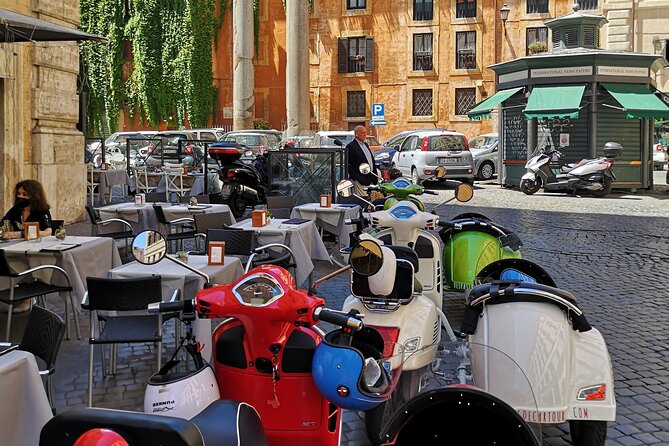
From the Pantheon area, the tour continues into two major mood shifts.
Piazza Navona is built on the footprint of an ancient Roman stadium site, and you feel that long-ago geometry even while the square is all Baroque flourishes. It is known for lively architecture and its fountains, including Bernini’s Fountain of the Four Rivers. Even if you only have limited time, Navona is a place where you can see art and atmosphere at the same time.
Then comes St. Peter’s Square at Vatican City. This is one of the world’s most recognizable squares, and it is designed on a monumental scale. Bernini shaped the square in the 1600s, and it is sized to hold over 300,000 people. That fact helps you understand why it can feel both overwhelming and awe-inducing, even when you are just standing near the edges.
Practical note: You can expect walking. The sidecar is how you travel between places, but these are places where you will want to stand back, look up, and take in the layout. Build in a little stamina for the big-sight zones.
Terrazza del Gianicolo for views, then Trastevere for the Rome you remember
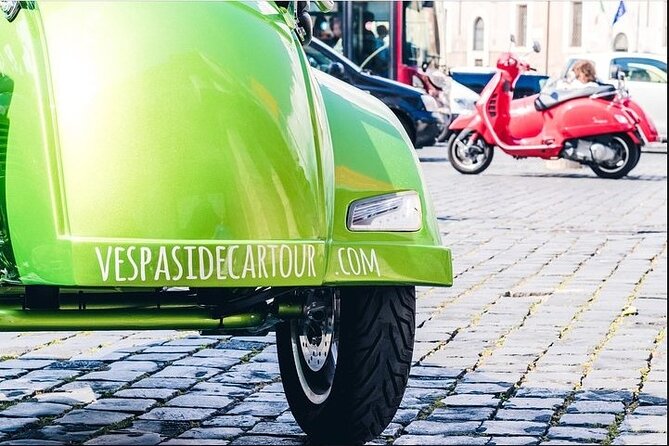
One of the best additions on this route is Terrazza del Gianicolo on Janiculum Hill. You get about 15 minutes here, and that short time is exactly what viewpoints should be. It is peaceful compared to the center, and the panorama helps your brain sort out the city.
Janiculum is linked to defense and rebellion stories. The paths are dotted with sculptures of heroes, including Giuseppe Garibaldi, and the hill became important during battles connected to the defense of Rome. It is an easy stop to enjoy because you are not staring at a single landmark. You are looking at the city as a whole.
Then you roll into Trastevere. This is where Rome starts feeling less like a postcard and more like a lived-in neighborhood. The drive takes you through narrow alleys and past the atmosphere of trattorias. The route also passes by the Jewish Ghetto area, which adds a sobering layer to the scenery without turning it into a lecture.
Practical tip: Trastevere can feel like it has its own rhythm. If you want a quick bite after the tour, this is the part of town where it is often easiest to find a place that feels local.
A short passeggiata through our other tiramisu and gelato classes in Rome.


Piazza Venezia and the Colosseum area, plus Santa Maria Maggiore
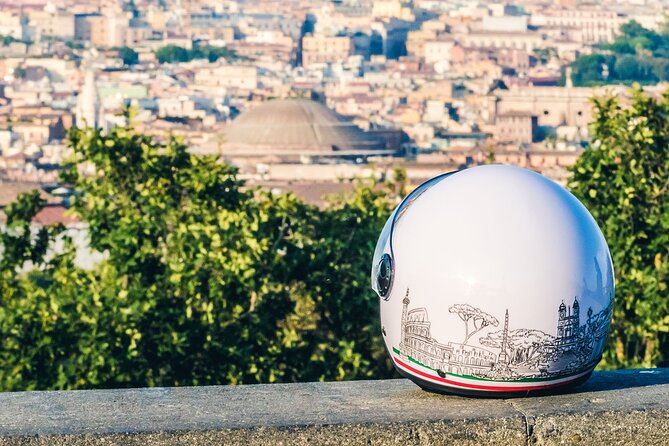
The tour heads to Piazza Venezia, centered on the huge monument dedicated to Victor Emmanuel II. The Altare della Patria complex was inaugurated in 1911 to honor the first king of unified Italy.
Inside, there is a museum focus on the Risorgimento, plus the monument area holds the tomb of the unknown soldier, marked by an eternal flame guarded by two soldiers. Even if you do not go inside, the exterior footprint and views over Rome give you a sense of the capital’s political gravity.
Next comes the Colosseum area, the Flavian Amphitheatre. It is Rome’s main symbol, and it is hard to overstate how central it is. Every year, millions visit it, and it is one of those structures that makes ancient life feel real because the size is so physical.
Then you finish with Basilica di Santa Maria Maggiore, one of Rome’s major basilicas and considered the largest basilica dedicated to the Virgin Mary in Rome. It is also one of the city’s four major basilicas, which is exactly the kind of detail that makes a finishing stop feel earned instead of random.
Gelato in a historic alley, the planned pause your afternoon needs
A well-run afternoon tour needs a break that is actually enjoyable. Here, the gourmet gelato stop is part of the plan, not an afterthought you have to hunt down. It is also timed like a reset button. When you are doing multiple big sights in one go, a cold, sweet intermission helps you keep your energy for the later stops.
Also, gelato is a “group-friendly” activity. You can get moving quickly, sit for a moment if needed, and then rejoin without feeling like you missed something.
If you are picky about flavor, ask for your preferred option at the counter, but do not treat this like a museum ticket. The goal is a smooth recharge.
Safety and comfort: helmets, headsets, and sidecar seating rules
This is the section where you should pay attention, because the sidecar experience comes with clear constraints.
You get homologated CE helmets and disposable head covers. That is a real comfort and hygiene detail, not just a checklist item.
Seating rules are important:
- Each two-seater sidecar has its own designated motorcyclist.
- If you book one seat only, you may share the vehicle with another guest. One person rides in the sidecar and the other rides behind the driver, and you can swap seats during stops.
- For odd-number bookings, you may need to alternate seats at any stop.
There are also limits:
- Maximum weight for riding on the back is 118 kg / 260 lb.
- Sidecar can hold up to 110 kg / 242 lb.
- Maximum height for the sidecar area is 1.90 m.
- Children must be at least 5 years old, and they can sit behind the driver only if taller than 150 cm. Otherwise, they may have to seat in the sidecar.
Not allowed for:
- pregnant travelers
Also allowed:
- service animals
Sound can be a factor. Even with headsets, moving streets can make the commentary a little harder at times, so I would keep expectations realistic. The guide’s job is to get you the key points even when the environment is loud.
Price and value: what $163.26 buys you in a 4-hour Rome overview
At about $163.26 per person for around 4 hours, you are paying for more than transportation. You are buying a bundle:
- a licensed guide with live commentary in English
- professional drivers who handle navigation through traffic
- helmets and headsets
- Pantheon entry included
- a gourmet gelato stop
In practice, that bundle can beat the “piece-by-piece” approach. If you try to do all of this on your own, you spend time figuring out tickets, timing, and how to move efficiently between far-flung areas like the Vatican zone and Janiculum Hill. Here, the driving is handled for you, and the stops are sequenced so you keep moving.
Value also comes from the fact that you are not stuck in one mode. You are riding between sights in a way that lets you cover ground fast, then stepping off at the places where you need to stand still and look closely.
Who should book this Vespa sidecar tour, and who should consider alternatives
This tour is ideal if you:
- want a high-impact afternoon with major landmarks
- do not want the hassle of driving or parking in central Rome
- like guided context, not just a list of buildings
- enjoy photo stops, especially at famous fountains and monumental squares
It may not be the best fit if you:
- strongly prefer quiet, slow strolling with lots of free time at each stop
- need a very strict seating setup for children, since sidecar versus behind-driver seating depends on rules and group composition
- are traveling with constraints that conflict with the tour’s pregnancy and height or weight requirements
The sidecar format is also a practical choice for first-timers. It can give you a mental map of Rome so your later, self-guided time feels smoother.
Should you book the Rome afternoon Vespa sidecar tour with gelato?
If your goal is to see the “greatest hits” of Rome in one afternoon without driving stress, I think this is a strong pick. The combination of professional drivers, live English narration, Pantheon ticket included, and a planned gelato break makes the experience feel complete for the money.
Book it if you can handle a busy, moving route with short stops. Skip it if you want long stays at only one or two places, or if your group needs special seating that might not match the sidecar rules.
If you want a fun way to get your bearings fast, this is the kind of tour that does the job.
FAQ
Is this tour in English?
Yes. The tour is offered in English, and you also get headsets to hear the guide clearly.
Do I drive the Vespa sidecar?
No. Professional drivers handle the Vespa. You just sit on board and relax, while the driver takes care of the route.
How long is the tour?
The duration is about 4 hours.
What main stops are included?
The tour includes stops at Piazza della Repubblica, Palazzo del Quirinale, Trevi Fountain, the Pantheon, Piazza Navona, St. Peter’s Square, Terrazza del Gianicolo, Trastevere (including a drive through the Jewish Ghetto area), Piazza Venezia, the Colosseum area, and Basilica di Santa Maria Maggiore.
Is Pantheon admission included?
Yes. Entrance fee to the Pantheon is included.
Is gelato included?
Yes. There is a gourmet gelato stop during the tour.
Are helmets and headsets provided?
Yes. You receive homologated CE helmets with sterilized disposable head covers, plus headsets to hear the guide clearly.
When can I cancel for a full refund?
You can cancel up to 24 hours in advance for a full refund.
Is the tour dependent on weather?
Yes. It requires good weather, and if it is canceled due to poor weather you will be offered a different date or a full refund.
Further Tiramisu and Gelato Classes We Cover in Rome

Other Vespa, Fiat 500 and Golf Cart Rides in Rome From Our Notebook

Not quite the day you had in mind? The rest of our Rome write-ups sit below
- Rome: Guided Tour of St. Peter’s Dome Climb, Basilica & Vatacombs★ 5.0 · 167 reviews
- St. Peter’s Basilica Guided Tour with Reserved Entrance★ 4.0 · 168 reviews
- Golf Cart Driving Tour in Rome: 2.5 hrs Catacombs & Appian Way★ 5.0 · 168 reviews
- Rome: Trastevere Wine Tasting with Food Pairing and Gelato★ 4.9 · 168 reviews
- Guided Tour of the Colosseum Palatine Hill and Roman Forum★ 4.7 · 168 reviews
- Vatican Museums, Sistine Chapel & Saint Peter’s Semi-Private Tour★ 4.5 · 169 reviews
- Hidden Rome: Small Group E-Bike Tour with Street Food Stops★ 5.0 · 169 reviews
- Rome: Papal Audience with Pope Leo IV★ 3.9 · 169 reviews
- Rome Golf Cart Tour: Highlights & Must See★ 4.5 · 170 reviews
Vespa, Fiat 500 & Golf Cart Tours, top to bottom.
 ★ 5.0Rome by Golf Cart Private Tour: Beyond the LandmarksFrom $1804,361 reviews
 ★ 5.0Rome on a Golf Cart Semi-Private Tour Max 6 with Private OptionFrom $1682,502 reviews
 ★ 5.0Rome Highlights by Golf Cart Private TourFrom $1632,379 reviews
 ★ 4.5Golf Cart Tour to Fiesole Roman Theatre and MuseumFrom $952,039 reviews
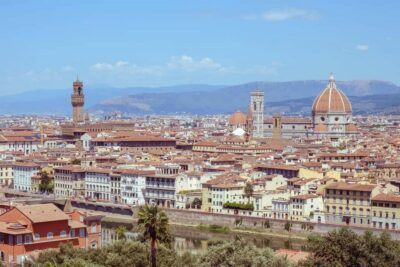 ★ 4.6Florence: Eco-Friendly Golf Cart City Tour with Audio GuideFrom $671,094 reviews
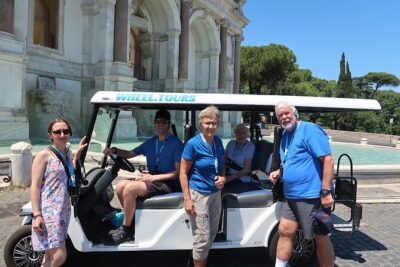 ★ 5.0Rome Highlights City Tour by Golf Cart with GelatoFrom $1071,088 reviews
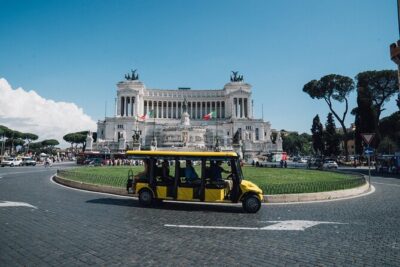 ★ 5.0Golf Cart Small-Group Guided Tour: Rome City HighlightsFrom $104907 reviews
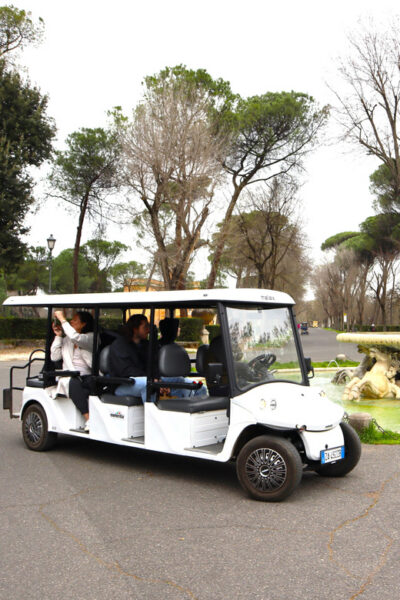 ★ 4.8Rome: City Highlights Golf Cart TourFrom $45857 reviews