
Reviewed · VESPA, FIAT 500 & GOLF CART TOURS
The ORIGINAL Fiat 500 Tour of Rome’s 7 Hidden Gems
A vintage Fiat makes Rome feel personal. In about three hours, you zip between iconic sights and lesser-seen corners, with a guide who talks, drives, and helps with photos in one smooth package.
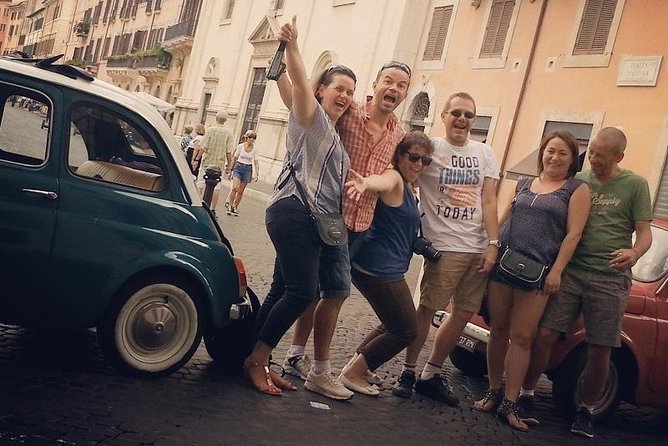
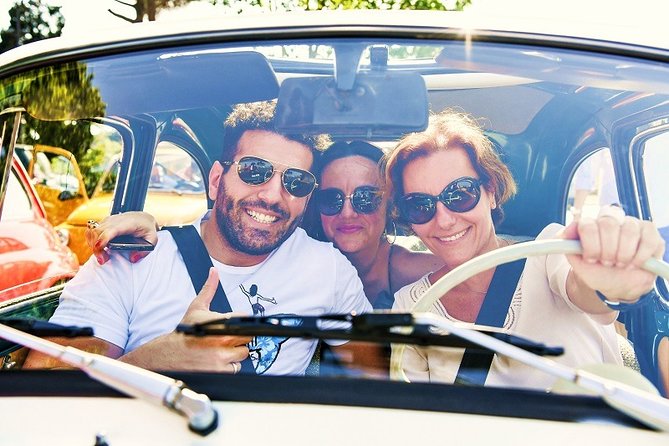
I love the small, shared convoy vibe, with up to 20 people total, so it feels social without turning into a cattle line. I also love that you get free photo shooting using your own phone or camera, which means you are not hunting for a stranger to take your picture.
One possible drawback: the car is very simple, with no safety belts in the back seats and no air bags, and it is not suitable for passengers over 100 kg.
Vintage Fiat 500 convoy in a shared group: up to 20 people, designed to keep things moving.
Photo help included: your driver and guide can take pics with your device.
A tight route with multiple quick stops: Caracalla, keyhole view at Piazza dei Cavalieri di Malta, Parco Savello, Trastevere, Garibaldi terrace, Circus Maximus, Porta San Paolo, Colosseum, and Via Galvani.
Morning or afternoon departures: pick the timing that matches your energy level.
Guides bring the details with humor: names you may hear include Francesco, Alexis, Max, Giorgio, Marco, Mike, and Emmanuelle.
In This Review
- Why a vintage Fiat 500 convoy feels different in Rome
- Price and what you actually get for about $205.67
- Meeting at Via Labicana and the 3-hour ride rhythm
- Your route through Roman baths, keyhole views, orange gardens and arenas
- Caracalla, the ancient city-scale bath complex
- Piazza dei Cavalieri di Malta, the famous keyhole view
- Parco Savello, Garden of Oranges with an optical illusion
- Trastevere by Fiat 500, cobblestones and close-up street life
- Piazzale Giuseppe Garibaldi, a panorama with layers
- Circus Maximus, echoes of chariot energy and modern concerts
- Porta San Paolo, an Egyptian pyramid connection
- Colosseum, a quick close-up and a big story
- Via Galvani, the hill made from broken vases
- Guides and the photo moment that makes this worth it
- Who should book this Fiat 500 tour, and who should skip it
- Should you book this Fiat 500 tour of Rome’s 7 tucked-away stops?
- FAQ
- How long is the Fiat 500 tour of Rome?
- What is included in the tour price?
- Does the tour run in English?
- Where do I meet, and where does the tour end?
- How big is the group?
- Is it suitable for everyone in the car?
- Can I cancel for a full refund?
Why a vintage Fiat 500 convoy feels different in Rome
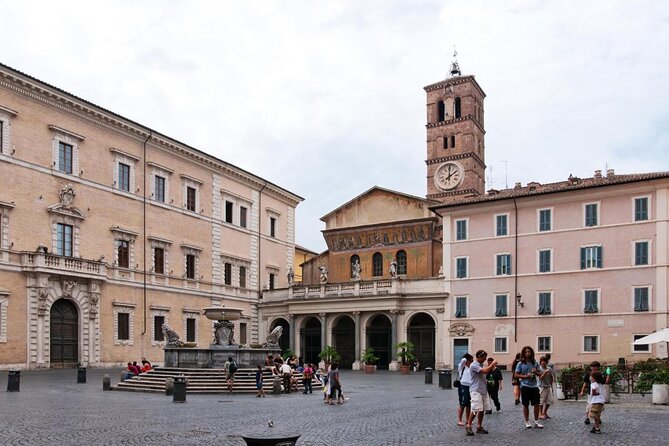
Rome has a way of making you feel like you are always walking, always queueing, always stuck behind the same tour bus crowd. This tour changes the rhythm fast. Instead of a big bus, you ride in a classic Fiat 500 and travel between stops in a convoy, which lets you cover more ground without losing the street-level feel.
And yes, driving a compact car through Rome is part of the fun. You get those narrow, cobblestoned lanes where larger vehicles just cannot comfortably go. It is the kind of city viewing that makes you notice textures, street layouts, and viewpoints you might miss on foot, especially when you are seeing the city for the first time.
What also matters is the role split. The driver is not just a chauffeur, and the guide is not just someone standing there with a microphone. Several people highlighted that the driver and guide team adds personality, and that they can act as a photographer too, so you get good angles without pausing your day.
Price and what you actually get for about $205.67
At around $205.67 per person for roughly 3 hours, this is not a budget add-on. But for Rome, the value comes from what is included and how efficient the format is.
Here is how the price makes sense on the ground:
You are paying for transportation in a vintage vehicle, guided storytelling, light refreshments, and photo support. Plus, the stop planning is built around quick visits where admission tickets are listed as free for the main points on the route. That means you are not spending your limited time figuring out ticket counters or waiting through separate museum entries.
You also get a small-group approach inside a shared experience. The maximum group size for the whole tour is 20 travelers, but the tour format suggests small booking clusters (with a maximum of 3 people per booking). Practically, that tends to feel more personal than a typical big group sightseeing bus.
Where the price can feel less perfect is expectations. This tour moves fast. If what you want is a long sit-down museum level experience, you may feel like each stop is a taste rather than a meal. But if you want a smart orientation plus memorable viewpoints, it can feel like a good way to spend a short trip.
Filed beside this one, more Vespa, Fiat 500 and golf cart rides in Rome.
- Rome by Golf Cart Private Tour: Beyond the Landmarks
★ 5.0 · 4,361 reviews - Rome on a Golf Cart Semi-Private Tour Max 6 with Private Option
★ 5.0 · 2,502 reviews - Rome Highlights by Golf Cart Private Tour
★ 5.0 · 2,379 reviews - Vespa Sidecar Tour By Night with Pickup
★ 5.0 · 1,803 reviews
Meeting at Via Labicana and the 3-hour ride rhythm
You start and end at Via Labicana, 125, 00184 Roma RM. That is helpful because you are not stitching together multiple pickup points, and you end back where you began.
Departures run morning or afternoon, so you can match it to your sightseeing plan. Average booking timing is about 67 days in advance, which is a clue this is popular and can sell out for certain dates.
Two practical things to plan before you go:
1) Bring a charged phone. Photo time is part of the experience, and the tour uses your own cellphone or camera for the free photo shooting.
2) Wear comfortable shoes. Even when stops are brief, Rome sidewalks and steps still add up.
Now, one more logistics detail you should take seriously: the car is set up for comfort and style, not modern safety tech. The information says no air bags and no safety belts in the back seats. It also says it is not suitable for passengers over 100 kg. If that affects you, you should plan around it before booking, and if possible, ask how seating is handled for your group.
Your route through Roman baths, keyhole views, orange gardens and arenas
This tour is designed as a sequence of short, high-impact pauses. You do not linger for hours. Instead, each stop gives you a specific story hook and a chance to take photos or look closely, then you roll to the next viewpoint.
Caracalla, the ancient city-scale bath complex
You start at Caracalla, known as one of the largest and most sophisticated Roman bath complexes. The tour information describes it as huge, on the scale of 15 football pitches, and it was more than a quick soak. It was a major health center, with cold and hot baths, plus spaces that echo a blend of education and social life, including Greek and Roman libraries, gyms, a theatre, seminar rooms, gardens, and fountains.
What makes this stop special is the way it reframes what you think you know about Roman baths. It is not just bathing. It is architecture built for daily life, learning, and public gathering. Even if you only have a short stop, it can give you a powerful mental picture for later Roman sites.
Piazza dei Cavalieri di Malta, the famous keyhole view
Next you get the keyhole viewpoint at Piazza dei Cavalieri di Malta. The whole idea is wonderfully Roman, a big view hidden inside a small opening. The tour sets you up to wonder why St. Peter’s church, with its massive presence, is framed by a keyhole. Through it, you are meant to line up a perspective that can show three countries in one line.
This is one of those moments where timing and positioning matter. You stand where you need to stand, you look through the keyhole, and suddenly the city makes sense in a playful optical way. If you are into selfies and photos, this is also a natural stop because it is built for framing.
Parco Savello, Garden of Oranges with an optical illusion
Then it is Parco Savello, often nicknamed the Garden of the Oranges and also associated with romance as the Garden of the Lovers. The big story here is the optical illusion effect connected to St. Peter’s, where the viewpoint can make the church appear in a surprising way.
The practical win is that this is a scenic break. Even with limited time, you get that elevated Rome feeling, with wide views and a clear “you are here” sense of where the city’s big landmarks sit.
Trastevere by Fiat 500, cobblestones and close-up street life
Now comes the fun driving part: Trastevere. This is where you feel the magic of riding in a Fiat 500. The tour format emphasizes that you can move through tiny streets and angles where bigger cars cannot quite do the same.
What you get here is not a single monument. It is the street fabric. You see tight lanes, storefront rhythm, and the kind of Rome texture that makes photos look better than they do on a straight-on bus stop.
Piazzale Giuseppe Garibaldi, a panorama with layers
At Piazzale Giuseppe Garibaldi, you are aiming for one of the best panoramic views of Rome. The tour highlights the view line that can include the Colosseum, the Pantheon, Altare della Patria, and what it describes as the many domes across the city.
This stop is valuable because it acts like a map you can feel. After seeing the keyhole and orange garden viewpoints, this terrace view helps you reconnect the landmarks into one bigger picture. It is a great “reset” moment if your day has started to blur together.
Circus Maximus, echoes of chariot energy and modern concerts
Next is Circo Massimo, with a story linked to ancient racing. The tour description brings up echoes from the idea of 250,000 spectators at Ben Hur-style chariot races, and it notes that it was built 400 years before the Colosseum.
What makes this more than trivia is how you feel the scale, even if the remains are not presented like a fully enclosed arena. Plus, the tour information adds a modern twist: the area is sometimes used for rock concerts, and names like the Rolling Stones, Roger Waters, and Bruce Springsteen are mentioned in the tour narrative. That connection helps you picture the space as part of modern Rome, not only an ancient relic.
Porta San Paolo, an Egyptian pyramid connection
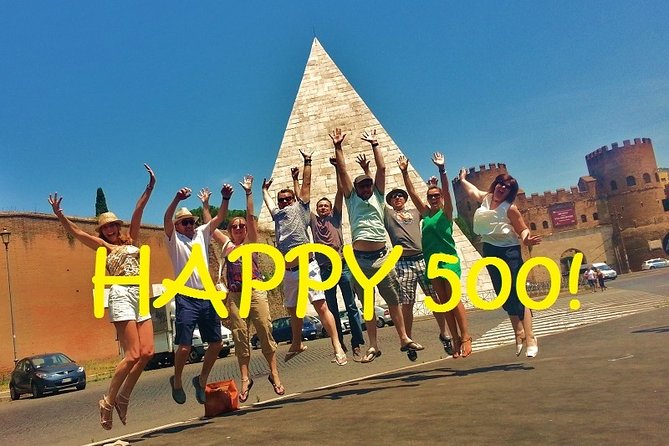
At Porta San Paolo, the story turns fascinating in a different direction. The tour information points out that Rome has a very large ancient Egyptian pyramid footprint. It is described as the 4th biggest Egyptian pyramid in Rome, built in 18 BCE and meant to be the tomb of Gaius Cestius.
This is a stop that can surprise even people who think they know Rome’s tourist list. The pyramid angle also gives you a useful mental anchor for Rome’s long timeline of imports, influences, and reused symbols.
Colosseum, a quick close-up and a big story
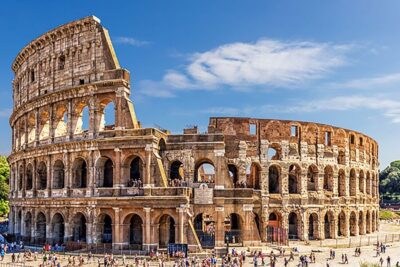
Then you roll to the Colosseum. The tour description frames it as built around 80 CE, the stage for gladiator fights, executions, and even references to naval combats. It also mentions the staggering death toll figure associated with the arena’s use.
Here is the key practical reality: because the tour is only around three hours total, the Colosseum stop is not a full visit day. It is a brief encounter designed to give you context and a sense of scale. One caution based on the experience format: do not plan this as your only Colosseum visit if you want deep time inside. If you were hoping for a long stop right at the arena itself, keep expectations flexible.
Via Galvani, the hill made from broken vases
Last is Via Galvani, also known for what the tour calls the hill of broken vases. The story is unusual: Romans created an artificial hill from pieces of vessels used to transport items like olive oil, fish sauce, and wine. Over centuries, a dump became a structure.
The tour details it as about 40 meters high and 700 meters in circumference, made from terracotta fragments estimated at around 50 million vases.
This is the kind of stop you remember because it is not the usual postcard. Even when your time is brief, the idea itself is a strong mental image. It shows how everyday life can become architecture over time.
Guides and the photo moment that makes this worth it
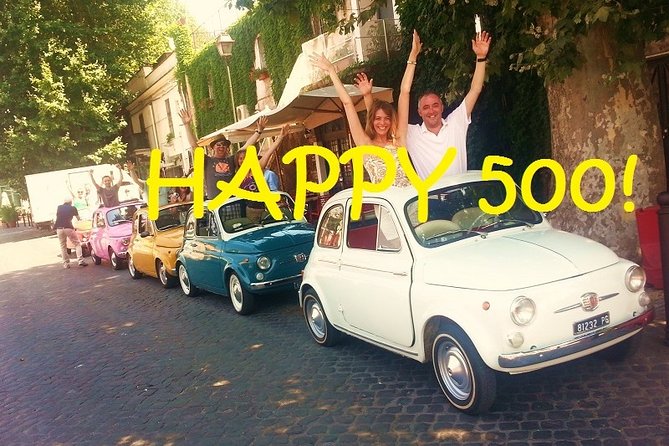
If there is one theme that keeps showing up in how people talk about this tour, it is that the guides bring the right energy. Names you might hear include Francesco, Alexis, Alexi, Giorgio, Max, Marco, Mike, and Emmanuelle. What matters is the delivery style: funny when it should be, organized enough that you do not feel lost, and interactive enough that you can steer the conversation.
The other standout is photography. The tour is set up so your guide and driver can take photos for you with your own phone or camera. That sounds small, but it solves a real travel problem. In Rome, the best viewpoints are often crowded or hard to position for selfies. Having someone who knows where to stand for a clean shot is a real convenience.
I also like that the route is structured as a loop with multiple short looks. It is a good fit if you are not trying to see every site in full, but you want an accurate sense of where major landmarks sit relative to each other.
Who should book this Fiat 500 tour, and who should skip it
This tour fits best if you want:
- A fast way to see a lot of Rome in a short trip window
- A change of pace from walking and big bus groups
- Photo moments built into the plan, using your own device
- A guided route that mixes major sights with less obvious stops
It might not fit if you:
- Want long time inside major sites, especially if the Colosseum is a top priority for you
- Are sensitive to vehicle safety limitations, because the info states no safety belts in the back seats and no air bags
- Need extra accessibility support based on the 100 kg max weight limit
One more “fit” note: the car is compact. If you are on the larger side or just not comfortable in small spaces, you should consider that before you book. Even if you are within the weight limit, the car design affects how you get in and sit.
Should you book this Fiat 500 tour of Rome’s 7 tucked-away stops?
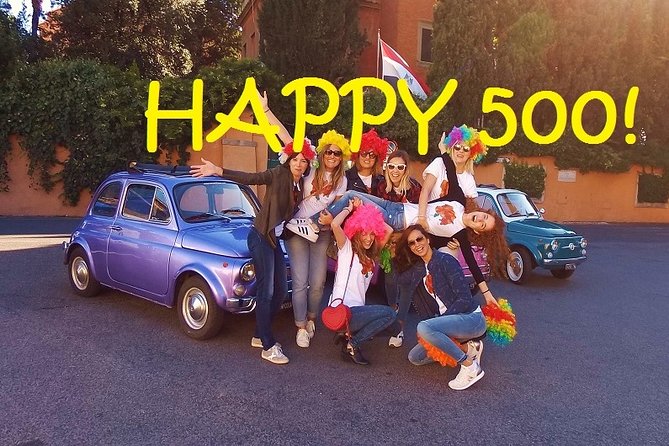
If your goal is to get oriented quickly, see Rome from multiple viewpoint angles, and enjoy a distinctive transport experience, I think this is an easy yes. The mix of Caracalla, keyhole framing at Piazza dei Cavalieri di Malta, Parco Savello, Trastevere streets, Garibaldi terrace panoramas, and the arena story at the Colosseum makes for a tight, memorable sweep.
I would not treat it as a replacement for a full Colosseum visit, and I would go in knowing the stops are brief by design. But as a three-hour plan that feels like Rome and not just a checklist, it is a strong value.
FAQ
How long is the Fiat 500 tour of Rome?
It is about 3 hours.
What is included in the tour price?
It includes the driver/guide, a convoy tour format, light refreshments, and free photo shooting using your cell phone or camera.
Does the tour run in English?
Yes, it is offered in English.
Where do I meet, and where does the tour end?
You meet at Via Labicana, 125, 00184 Roma RM, Italy. The tour ends back at the same meeting point.
How big is the group?
The tour has a maximum of 20 travelers.
Is it suitable for everyone in the car?
The tour information says it is not suitable for passengers weighting more than 100 kg. It also notes there are no safety belts installed in the back seats of the cars and no air bags in the car.
Can I cancel for a full refund?
Yes. You can cancel up to 24 hours in advance for a full refund. If you cancel less than 24 hours before the start time, the amount paid is not refunded.
Our Wider Tours File for Rome
Other Vespa, Fiat 500 and Golf Cart Rides in Rome From Our Notebook

Not quite the day you had in mind? The rest of our Rome write-ups sit below
- Rome: Guided Tour of St. Peter’s Dome Climb, Basilica & Vatacombs★ 5.0 · 167 reviews
- St. Peter’s Basilica Guided Tour with Reserved Entrance★ 4.0 · 168 reviews
- Golf Cart Driving Tour in Rome: 2.5 hrs Catacombs & Appian Way★ 5.0 · 168 reviews
- Rome: Trastevere Wine Tasting with Food Pairing and Gelato★ 4.9 · 168 reviews
- Guided Tour of the Colosseum Palatine Hill and Roman Forum★ 4.7 · 168 reviews
- Vatican Museums, Sistine Chapel & Saint Peter’s Semi-Private Tour★ 4.5 · 169 reviews
- Hidden Rome: Small Group E-Bike Tour with Street Food Stops★ 5.0 · 169 reviews
- Rome: Papal Audience with Pope Leo IV★ 3.9 · 169 reviews
- Rome Golf Cart Tour: Highlights & Must See★ 4.5 · 170 reviews
Vespa, Fiat 500 & Golf Cart Tours, top to bottom.
 ★ 5.0Rome by Golf Cart Private Tour: Beyond the LandmarksFrom $1804,361 reviews
 ★ 5.0Rome on a Golf Cart Semi-Private Tour Max 6 with Private OptionFrom $1682,502 reviews
 ★ 5.0Rome Highlights by Golf Cart Private TourFrom $1632,379 reviews
 ★ 4.5Golf Cart Tour to Fiesole Roman Theatre and MuseumFrom $952,039 reviews
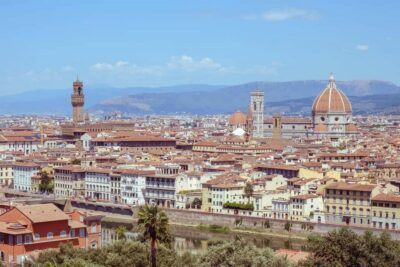 ★ 4.6Florence: Eco-Friendly Golf Cart City Tour with Audio GuideFrom $671,094 reviews
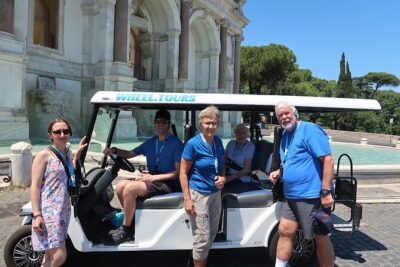 ★ 5.0Rome Highlights City Tour by Golf Cart with GelatoFrom $1071,088 reviews
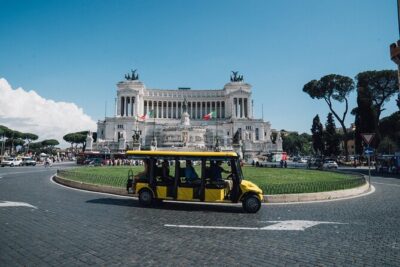 ★ 5.0Golf Cart Small-Group Guided Tour: Rome City HighlightsFrom $104907 reviews
 ★ 4.8Rome: City Highlights Golf Cart TourFrom $45857 reviews
Filed under