
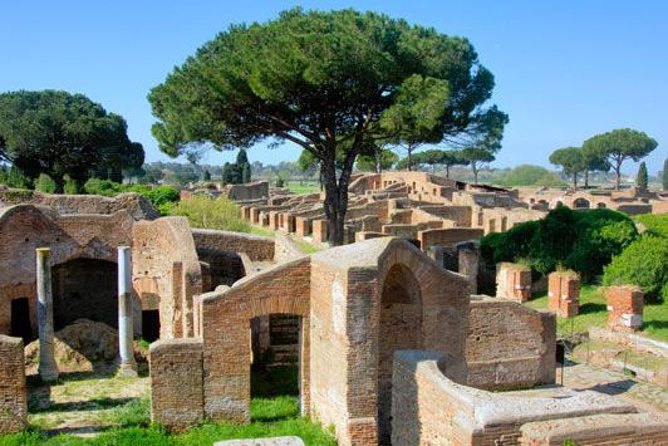
Reviewed · ROME DAY TRIPS & THE CASTELLI ROMANI
Ancient Ostia Antica Semi-Private Day Trip from Rome by Train with Guide
Ostia feels like an ancient city you can walk. I like this tour because it takes the stress out of getting out of Rome, with round-trip train tickets handled for you and a guide leading the way. You still get the fun of a half-day adventure, just with fewer moving parts and no guessing where to start.
What I also like is how the guide turns a big site into a clear route, so you are not stuck staring at stone and hoping it makes sense. You follow the main street, Decumanus Maximus, then hit standout stops like the Baths of Neptune and the amphitheater, with stories that connect each ruin to how people actually lived. One real consideration is that this is a walking tour, and the ground can be uneven with stairs plus train transitions, so plan for some physical effort.
In This Review
- Key Things I’d Circle Before You Go
- Getting to Ostia Antica by train without losing time
- Meeting point, what to expect on arrival, and what to bring
- A semi-private half-day rhythm that keeps Ostia from feeling overwhelming
- Following Decumanus Maximus, the Roman main street you can actually picture
- Baths of Neptune and the amphitheater, two stops built for spectacle
- Forum of the Corporations, temples, taverns, and public baths
- Shops and living quarters, where the city feels real
- A guide can make or break the story, and this tour draws strong ones
- Time on site, staying longer, and what to do after your guided walk
- Value and price: what you get for about $59.26
- Who should book this Ostia Antica train tour
- Should you book this Ancient Ostia Antica tour by train?
- FAQ
- How long is the Ancient Ostia Antica semi-private day trip?
- Where do I meet the guide in Rome?
- How many people are in the group?
- Is the tour guided in English?
- Are train tickets included?
- Are Ostia Antica entrance tickets included?
- Do I need hotel pickup or drop-off?
- What kind of fitness level do I need?
- Is a mobile ticket used?
- Do children need ID?
- Is the tour dependent on weather?
Key Things I’d Circle Before You Go
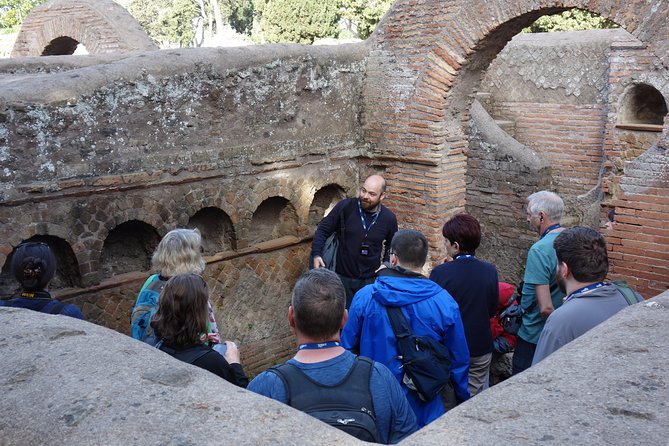
- Train to Ostia and your return handled, so your day stays on track
- Small group max 12, which usually means more questions and an easier pace
- Decumanus Maximus as the backbone, so you learn the site in a logical order
- The amphitheater stop is a highlight, including its size and what it says about public life
- Semi-structured time on site, so you get the big pieces without feeling lost
Getting to Ostia Antica by train without losing time
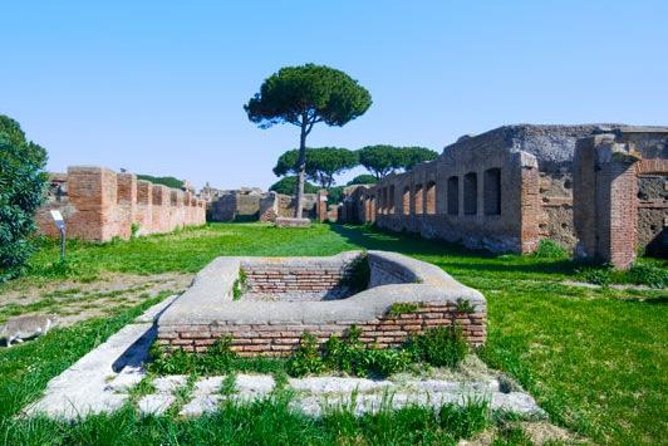
Rome to Ostia Antica is one of those trips that feels harder in theory than in practice. You meet your guide in central Rome near public transportation, and then you head out by train together with your group. Because the train tickets are included, you avoid the usual half-day math of schedules, lineups, and buying the right ticket.
The tour’s timing is built around the reality that Ostia is spread out. You spend about 2.5 hours walking through the park with your guide, then you go back to Rome by train. That balance works well if you want an ancient site day that does not swallow your whole itinerary.
Kept in the same folder as this one, Castelli Romani day trips in Rome.
- Pasta Making & Wine Tasting with Dinner in Frascati from Rome
★ 5.0 · 1,326 reviews - From Rome: Bagnoregio & Orvieto Day Trip with Wines & Lunch
★ 4.6 · 1,075 reviews - Rome: Pasta Making with Wine Tasting and Dinner in Frascati
★ 4.9 · 979 reviews - Castel Gandolfo Lake Kayak and Swim Tour
★ 5.0 · 661 reviews
Meeting point, what to expect on arrival, and what to bring
Your start point is listed as P.za Ostiense 11, 00154 Roma RM, and the meeting is described as near the Piramide metro station area. Either way, give yourself a small buffer, because you want to look for your guide before train boarding starts and before the group gets pulled along by momentum.
Bring basic essentials you might not think about until you are outside: water, sun protection, and comfortable shoes. The park involves uneven ground and stairs, and more than one review notes that getting around can be a challenge if you have mobility limits. If you know you need slower pacing or extra time at each stop, it is worth telling your guide at the start so expectations stay fair for everyone.
One extra note for families: if children under 18 are in your group, they might be asked to show ID at the entrance, so have it on hand.
A semi-private half-day rhythm that keeps Ostia from feeling overwhelming
Ostia Antica gets called little Pompeii by some people, but that nickname can trick you. The site is large, with a lot of preserved structure, and it is easier when someone gives it a tour route instead of letting you roam blindly.
In your walk, the guide generally takes you through the major public and everyday areas, then ties them together with stories about how the port city worked. You are not just looking at ruins in isolation, you are learning how the place functioned as part of ancient Rome.
The small-group size, up to 12, matters here. With fewer people, you get more chances to ask questions and to hear the guide clearly without shouting over a crowd funnel. It also tends to make the pace feel more human, which helps because you are doing real walking on a real archaeological site.
Following Decumanus Maximus, the Roman main street you can actually picture
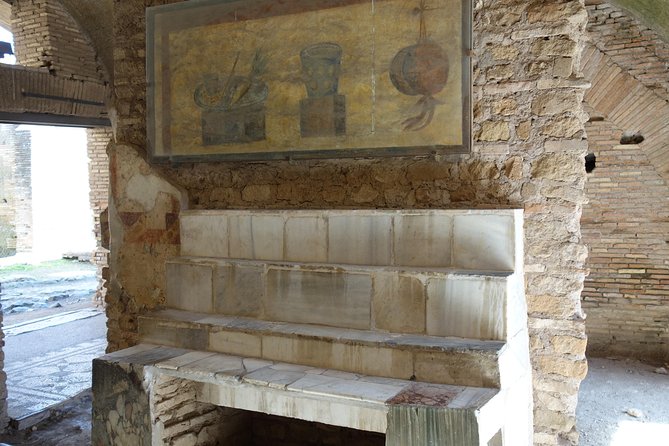
You start your on-site experience by walking the Decumanus Maximus, Ostia’s main road. This matters because roads like this were the organizing spine of daily life, not just decoration. Seeing it as a walk, with buildings on both sides, makes the city feel readable.
As you move along, you get a sense of the layers of life in a working port town. Ostia dates back to the 4th century BC for the city’s history, and at its peak it supported more than 100,000 people. That scale is hard to grasp without guidance, but the guide’s stops help your brain grab what matters.
You also see Roman statues along the walkways. They may not look like much at first glance, but when the guide explains what they represent and where they fit into the city’s space, they become part of the story instead of random artifacts.
Baths of Neptune and the amphitheater, two stops built for spectacle
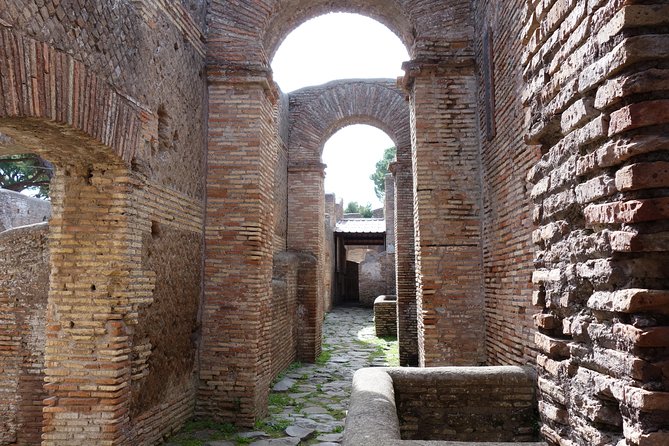
Two of the most memorable anchors are the Baths of Neptune and the amphitheater. You will not just pass them, you will get time to understand why they were so central to Roman culture.
At the Baths of Neptune, you see the mosaic decoration connected to the sea god, with Neptune shown behind a four-horse chariot. Baths were not only about hygiene. They were social spaces, conversation spaces, and status spaces, so the guide’s framing helps you imagine people using the complex in real life, not just touring it.
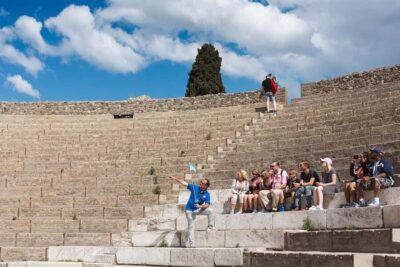
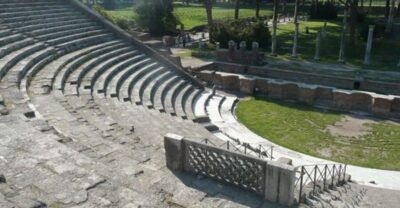
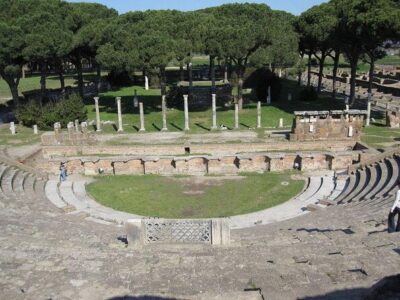
Then comes the amphitheater. This is one of those places where, even if you already know it was for entertainment, you can still be struck by how massive it is. The amphitheater dates back to 12 BC and could hold about 3,500 spectators. Sitting there gives you a quick reality check on how big public events were in a city like Ostia, far from Rome but still firmly plugged into Roman identity.
If you enjoy photos, this is a strong place to pause. You get viewpoints that are easier than trying to angle your camera while everyone is moving.
Forum of the Corporations, temples, taverns, and public baths
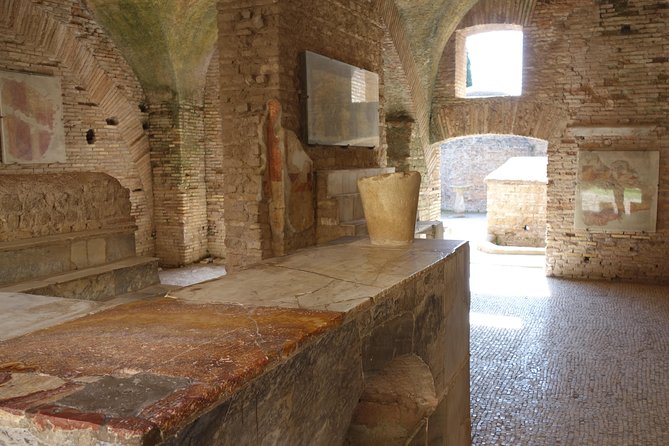
Ostia is fascinating because it includes both big public spaces and the places where ordinary people ate, shopped, worked, and relaxed. Your guided walk includes stops that reflect that mix, including the Forum of the Corporations, the Collegiate Temple, and areas described as taverns and public baths.
The value of these stops is that they give context. A forum tells you where commerce and community intersect. A temple tells you how religion blended into civic life. Taverns and baths show you leisure and daily rhythm.
If you have ever felt that Rome ruins become too focused on emperors and dramatic moments, Ostia often gives you a different feeling. Here, you are learning a port city that depended on trade, arrivals, and the systems that kept goods and people moving.
Filed beside this one, more one-day tours in Rome.




Shops and living quarters, where the city feels real
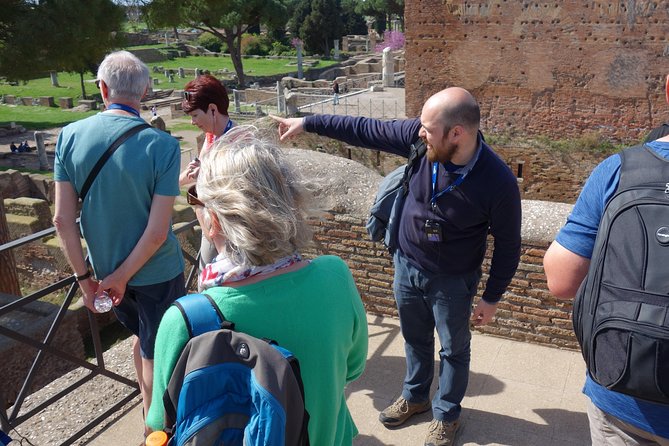
One of Ostia’s strengths is how much of the town layout survives. You can walk past ruined shops and living quarters, and you start to understand how people lived in and around the same spaces used for work and entertainment.
The guide helps you interpret these smaller buildings without turning it into a lecture. You get a sense of where commerce likely happened, how streets connected different needs, and how the city’s function shaped its buildings.
Even if you are not an archaeology nerd, this part tends to click. It is the closest you get to walking inside a city block that once held real routines, not just monumental ruins.
A guide can make or break the story, and this tour draws strong ones
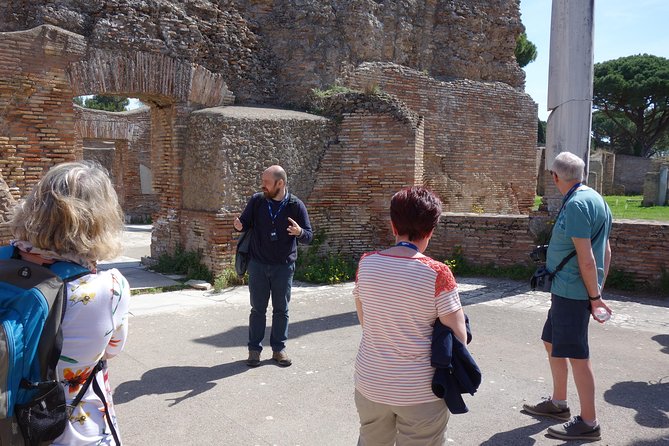
The biggest variable in any guided tour is the guide. In this case, the reviews you are likely to see point to a consistent theme: excellent storytelling and patient explanations.
Names that come up again and again include Alberto, Laura Luongo, Cat, Eduardo, Roberto, and Caterina. People highlight guides who keep the history clear without drowning you in detail, and who can shift to the group’s energy level. One guide, Laura Luongo, gets praise for helping the group navigate crowds and adjusting when needed. Another, Alberto, is repeatedly described as funny in small doses, organized, and attentive to the group’s pace.
I also like that a good guide here tends to do practical things. One person mentions getting shade on hot ground and guidance on where to refill water bottles. If you are visiting in warm weather, that kind of help can genuinely improve the day.
If you happen to prefer solo learning, you might choose to use an audio guide for your own rhythm. Just know this tour is designed so the guide provides the structure and the context.
Time on site, staying longer, and what to do after your guided walk
Your guided walking time is about 2.5 hours in the archaeological park, and then you return to Rome by train with your guide. That timing is meant to give you the best-known parts without leaving you exhausted.
One detail I find useful from people who have done this before: at the end of the guided portion, some groups were able to choose whether to leave immediately or continue exploring the grounds further, including the on-site museum. If you finish early in a good mood, ask your guide what time you have and whether it still makes sense for you to wander a bit more.
Once you are back in Rome, you still have room in the day for dinner, a gelato lap, and one more neighborhood walk. That is a big part of the value of a half-day format.
Value and price: what you get for about $59.26
At $59.26 per person, this tour is not trying to compete with the cheapest option. But it is priced for convenience and context, not just transport.
Here is what you effectively get bundled:
- an English speaking guide
- round-trip train ticket from Rome to Ostia Antica and back
- entry ticket to Ostia Antica included
- a semi-private group capped at 12
When you price out train tickets plus entry plus a guide, the number starts to make sense, especially if you do not want to figure out schedules and logistics on a tight trip. For me, the guide is the main reason to pay. Ostia rewards understanding, not just sightseeing.
Who should book this Ostia Antica train tour
This tour fits best if you:
- want a less crowded alternative to bigger ancient sites, while still seeing the important stuff
- like learning how everyday Roman life worked in a place built around shipping and trade
- prefer small-group pacing over a large bus tour
- are comfortable with walking for a few hours on uneven ground and steps
It may be less ideal if you:
- need a very slow, step-by-step pace due to mobility issues
- do not like guided groups at all and would rather learn fully on your own
If you fall into a gray area, I would still book, but plan carefully. Tell the guide early if you need to slow down, and wear shoes you trust on rough surfaces.
Should you book this Ancient Ostia Antica tour by train?
I think you should book if you want an easy half-day out of Rome with the best parts of Ostia guided in a sensible order. The included train + entry tickets remove the common friction points, and the ruins are strong enough that a good guide can make them feel personal instead of confusing.
If you are excited by Roman daily life, port-city details, and architecture that is still standing in recognizable ways, this will likely be a highlight. Just go in knowing it is a walk, not a sit-and-watch.
FAQ
How long is the Ancient Ostia Antica semi-private day trip?
The tour runs about 4 hours total, with roughly 2.5 hours spent walking through Ostia Antica.
Where do I meet the guide in Rome?
You meet at P.za Ostiense, 11, 00154 Roma RM, Italy, near public transportation. The tour description also notes meeting near the Piramide metro station area.
How many people are in the group?
The tour is semi-private with a maximum group size of 12 travelers.
Is the tour guided in English?
Yes, the tour is offered with an English speaking guide.
Are train tickets included?
Yes. Train tickets to and from Rome are included.
Are Ostia Antica entrance tickets included?
Yes. Entrance tickets for Ostia Antica are included.
Do I need hotel pickup or drop-off?
No. Hotel pickup and drop-off are not included.
What kind of fitness level do I need?
Moderate physical fitness is recommended. Expect walking on site and some stairs and uneven ground based on how the park can be navigated.
Is a mobile ticket used?
Yes, the tour includes a mobile ticket.
Do children need ID?
Children under 18 might be requested to show an ID card at the entrance, so bring it with you.
Is the tour dependent on weather?
Yes. The experience requires good weather, and if it is canceled due to poor weather you will be offered a different date or a full refund.
Other One-day Tours in Rome From Our Notebook

Castelli Romani Day Trips in Rome That Made the Same Shortlist
Not quite the day you had in mind? The rest of our Rome write-ups sit below
- Rome: Guided Tour of St. Peter’s Dome Climb, Basilica & Vatacombs★ 5.0 · 167 reviews
- St. Peter’s Basilica Guided Tour with Reserved Entrance★ 4.0 · 168 reviews
- Golf Cart Driving Tour in Rome: 2.5 hrs Catacombs & Appian Way★ 5.0 · 168 reviews
- Rome: Trastevere Wine Tasting with Food Pairing and Gelato★ 4.9 · 168 reviews
- Guided Tour of the Colosseum Palatine Hill and Roman Forum★ 4.7 · 168 reviews
- Vatican Museums, Sistine Chapel & Saint Peter’s Semi-Private Tour★ 4.5 · 169 reviews
- Hidden Rome: Small Group E-Bike Tour with Street Food Stops★ 5.0 · 169 reviews
- Rome: Papal Audience with Pope Leo IV★ 3.9 · 169 reviews
- Rome Golf Cart Tour: Highlights & Must See★ 4.5 · 170 reviews
Rome Day Trips & the Castelli Romani, top to bottom.
 ★ 5.0Pasta Making & Wine Tasting with Dinner in Frascati from RomeFrom $451,326 reviews
 ★ 4.6From Rome: Bagnoregio & Orvieto Day Trip with Wines & LunchFrom $931,075 reviews
 ★ 4.9Rome: Pasta Making with Wine Tasting and Dinner in FrascatiFrom $35979 reviews
 ★ 5.0Castel Gandolfo Lake Kayak and Swim TourFrom $50661 reviews
 ★ 4.8From Rome: Ostia Antica Guided Half-Day Trip by TrainFrom $58486 reviews
 ★ 4.9From Rome: Half-Day Frascati Wine Tour with Farmhouse LunchFrom $99372 reviews
 ★ 4.2Castel Gandolfo: Papal Apartments and Secret Garden TicketFrom $30277 reviews
 ★ 4.5Horse Sanctuary & Trail Ride in Ostia AnticaFrom $106276 reviews