
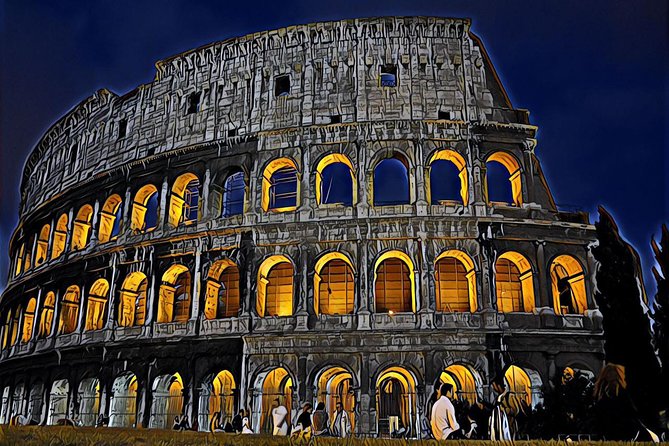
Reviewed · WALKING TOURS
Rome by Night Private Walking Tour
Rome looks different after dark. This private Rome by Night walk gives you a calmer way to understand the big-ticket landmarks, with your guide turning ruins and monuments into a clear story. I especially loved the night-lit perspective on the Roman Forum and the fact that the history doesn’t feel like a lecture, it feels like you’re walking through cause and effect.
The main thing to consider is simple: it’s an evening 2 hours 30 minutes walk starting at 8:30 pm, so you’ll want comfortable shoes and a moderate fitness level. In past runs, guides like Vincent and Barbara have kept families engaged, and you should expect the pace to match the questions you ask, sometimes running a bit longer than planned.
In This Review
- Key Highlights You’ll Notice Fast
- Why Rome by Night Feels More Like Understanding Than Sightseeing
- Price and Logistics: What You’re Paying For (and What You Don’t Get)
- Starting at Piazza del Colosseo at 8:30 pm, Then Walking It Like a Story
- Roman Forum at Night: From Romulus to the Fall of the Empire
- Trajan’s Column: Imperial Ambition in Stone
- Piazza del Campidoglio by Michelangelo: Renaissance Planning Plus a Night View
- The Place of Julius Caesar’s Murder: Why It Happened, Not Just What Happened
- The Pantheon: Why It’s Still Standing and Still Makes Sense
- Piazza Navona at Night: Baroque Art and Street Life You Can Talk About
- Guides That Turn Questions Into Momentum (Barbara and Vincent)
- Who This Private Rome by Night Tour Is Best For
- Should You Book Rome by Night Private Walking Tour?
Key Highlights You’ll Notice Fast
- A night route that helps you dodge the heaviest crowds, with monuments looking better under evening lights
- Roman Forum history from Romulus to the Empire’s fall, explained while you’re standing in the right place
- Trajan’s Column and imperial storytelling tied to what you can actually see
- Michelangelo’s Piazza del Campidoglio plus an unforgettable view over the Forum at night
- Pantheon visit for architecture, engineering, and religion, not just a quick photo stop
- Piazza Navona’s Baroque art talk, including references to Bernini and Borromini
Why Rome by Night Feels More Like Understanding Than Sightseeing
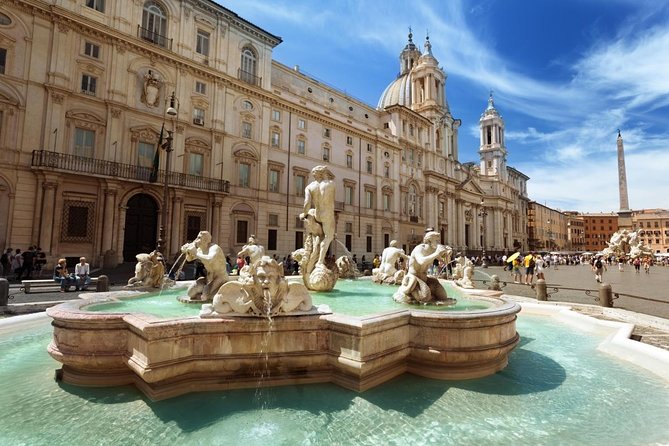
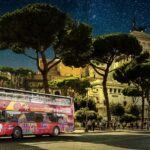
Daytime Rome can feel like a sprint: you arrive, you scan, you photograph, you move on. At night, the city slows down. The streets are calmer, the monuments glow, and your guide can point out details that get lost in the daylight crowds.
This is a private walking tour, so you’re not stuck in a big group rhythm. It’s built around the landmarks people recognize, but the focus is on the “how it all connects” part. The route lines up Rome’s political power (Forum, emperors, Caesar) with the engineering and belief system that made the empire last (Pantheon), then finishes with the Baroque art and street energy around Piazza Navona.
Filed beside this one, more walking tours in Rome.
- Rome: Trastevere & Campo de Fiori Street Food Walking Tour
★ 4.9 · 2,768 reviews - Rome: Paranormal Night Walking Tour & Secret Backstreets
★ 4.9 · 1,921 reviews - Rome by Night Walking Tour – Legends & Criminal Stories
★ 4.5 · 1,003 reviews - Rome: Guided City Center Evening Sightseeing Walking Tour
★ 4.4 · 953 reviews
Price and Logistics: What You’re Paying For (and What You Don’t Get)
The cost is $157.28 per person for roughly 2 hours 30 minutes, and that price matters because you’re buying two guided brains, not just one voice. The tour includes a professional guide and a local guide, and you get a mobile ticket for a smooth start.
What’s not included is equally important. There’s no hotel pickup and no private transportation, so you’ll meet at Piazza del Colosseo, 21 (00184 Roma RM) and finish at Piazza Navona (00186 Roma RM). The good news is that the meeting area is close to public transport, and there are taxi stations near the start.
If you’re weighing value, here’s the practical way I think about it: you’re paying for (1) a guided path through several major sites in one sitting, and (2) the storytelling that makes those sites easier to remember later. If you like history with context, this price usually feels fair. If you only want a quick photo walk, you’ll feel the time and cost more.
Also, this tour is popular. On average, it’s booked about 98 days in advance, so plan ahead if your dates are fixed.
Starting at Piazza del Colosseo at 8:30 pm, Then Walking It Like a Story
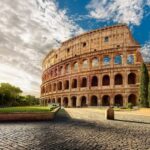
The tour begins at 8:30 pm at Piazza del Colosseo, 21. You’ll find the area convenient because it’s right by the Colosseum side of town, and there are two taxi stations close to the square. You’ll end at Piazza Navona, which is a great finish spot because it’s well known and easy to connect to after the walk.
Because it’s an evening tour, you’ll want to think about your own comfort:
- Bring a light layer, Rome nights can feel cool when you stop moving.
- Wear shoes that are stable on uneven pavement.
- If you get motion slowdowns, ask questions, and the guide will usually work with the group.
One detail that came through strongly from real experiences: guides can keep going when people are curious. For one family tour, the experience ran 30 to 45 minutes longer than scheduled. That’s a good sign, but it also means your evening plans should have some wiggle room.
Roman Forum at Night: From Romulus to the Fall of the Empire
This is the core stop for understanding the city. You’re walking by the ruins of the Roman Forum, and the guide connects what you see to the big timeline. Expect the story to start from Rome’s mythological foundations, including Romulus, then move through the building of power, major figures, and finally the decline that led to the fall of the Roman Empire.
Why this works at night: the Forum is already dramatic in daylight, but at night you get a different kind of atmosphere. The shadows make scale feel bigger, and your guide’s explanations help you see the places as roles in a political drama rather than as scattered stones.
A possible drawback: ruins are not the easiest material for everyone to read visually in the dark. If you like to study stone by stone, you might want to arrive with basic curiosity and let the guide do the pointing. This tour is designed for that, and it pays off.
Trajan’s Column: Imperial Ambition in Stone
Next up is Trajan’s Column, a landmark tied to an emperor who expanded Rome’s reach. Your guide explains why Trajan mattered and what his victories meant for the empire’s size and confidence.
The column is also a smart choice for an evening tour. It’s a fixed, clear focal point. You can pause, take in the shape, and the guide can connect the political meaning to what you’re seeing. This is one of those stops where the history lands because it’s not abstract.
If you’re the type who likes to understand “power language,” this stop will click. Rome kept records in stone, and columns like this were part of how leaders presented themselves. You’ll walk away knowing that the empire didn’t just fight wars, it also shaped public memory.
Piazza del Campidoglio by Michelangelo: Renaissance Planning Plus a Night View
Then comes Piazza del Campidoglio, described as one of the best Renaissance architecture examples you’ll see on this route. This square was designed by Michelangelo, and your guide focuses on how the master’s planning affects how you experience the space.
What I think makes this stop valuable for you: the guide doesn’t treat the square as a pretty break. You’ll understand it as design, and that design changes your perspective on the sites around you. After that, you get an incredible view over the Roman Forum with night lights making the ruins look almost staged.
The downside to keep in mind is straightforward: viewpoints work best when you have a moment to stop and look. If your group is the type that rushes for photos, you might miss some of the spatial explanation. If you’re with people who can slow down for 10 minutes, this will be a highlight.
Filed beside this one, more evening experiences in Rome.

The Place of Julius Caesar’s Murder: Why It Happened, Not Just What Happened
Walking through the archaeological area connected to the murder of Julius Caesar, you’ll get more than the headline. The tour explains the reasons behind Caesar and why the event mattered so much in Roman politics.
This is the stop where your guide’s job is hardest, because you’re dealing with one of the most famous moments in ancient history. The value here is that it isn’t only drama. It’s context. Who held power, why change was feared, and why Caesar’s story became a pivot point.
A small practical note: because you’re outdoors and the lighting changes, you may want to orient yourself at the start of this stop. Listen for the landmarks your guide uses to anchor the explanation, and don’t worry if you miss every detail on the first pass. The guide usually repeats the core logic as you move.
The Pantheon: Why It’s Still Standing and Still Makes Sense
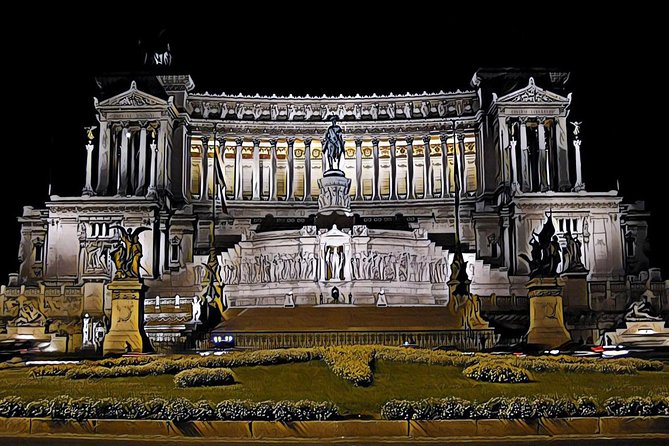
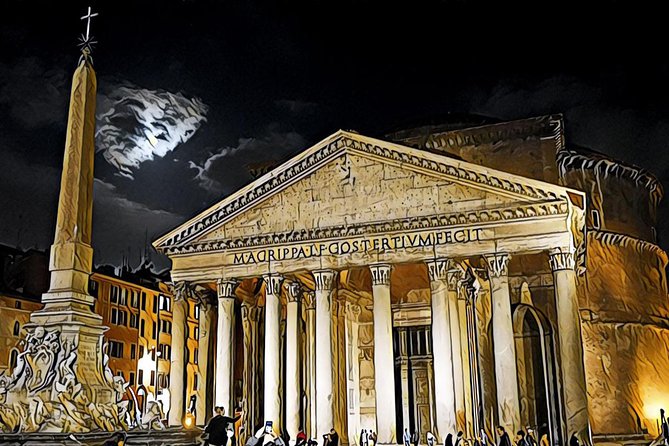
Next is the Pantheon, often seen as the best-preserved example of ancient Rome on many itineraries. On this tour, the Pantheon is used as a teaching moment for Roman engineering, architecture, and religion.
Here’s what you’ll likely appreciate most: the guide connects the building’s design to how Romans thought and worshiped. You’re not just hearing trivia about domes or columns. You’re learning how and why it was built to work, and how that engineering supported the religious and cultural purpose.
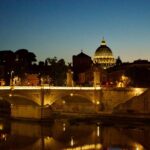
Night helps again. The Pantheon’s presence feels strong in the evening. When you’re walking in Rome’s history, it’s one of the places that makes the story feel real, not distant.
Potential drawback: it’s a major landmark, so keep expectations realistic. Even at night, you might not have the place to yourself. The tour’s goal is to help you understand what you’re looking at while you share space with other visitors.
Piazza Navona at Night: Baroque Art and Street Life You Can Talk About
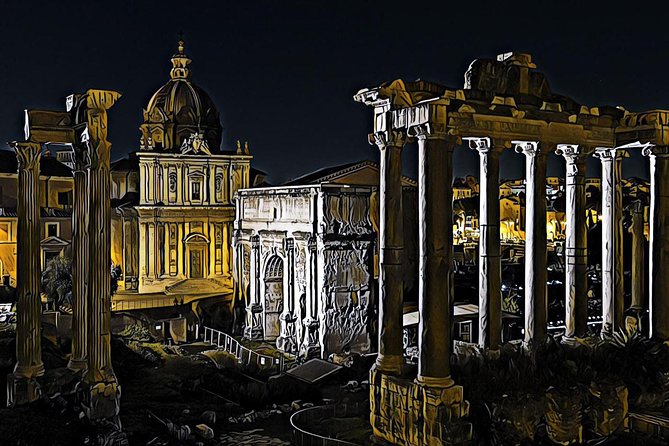
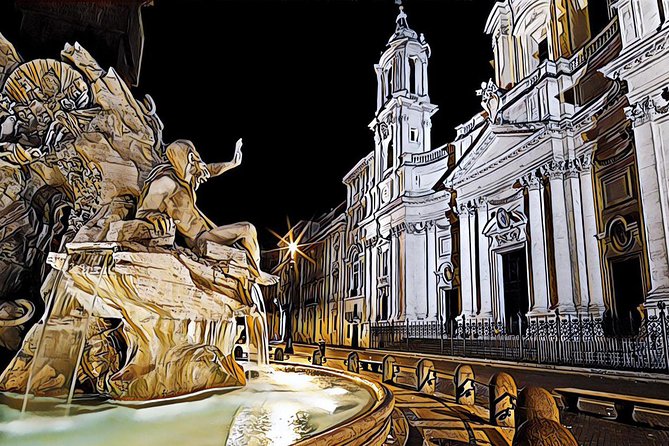
The tour ends with Piazza Navona, where you’ll explore the Baroque Roman style with references to top artists including Bernini and Borromini.
This is a smart finale because it shifts you from ancient structures to later artistic expression, without losing the Rome theme. Your guide talks art history in a way that connects to life in Rome at the time. You’ll see why Baroque wasn’t just decoration, it was persuasion and theater in stone and sculpture.
And Piazza Navona is naturally lively. Even if you don’t stick around for a long time, it gives you a satisfying “end scene,” where you can grab a drink or plan your next stop without walking far.
Guides That Turn Questions Into Momentum (Barbara and Vincent)
One thing that showed up clearly in real experiences: the best tours are guided conversations. People who are naturally curious tend to get pulled in, and people who are less into history still tend to stay with it.
For example, Vincent was praised for engaging the whole family, answering questions while also asking questions back. That matters. When the guide asks you a question, you start paying attention differently. Your brain stops waiting to be told and starts looking for meaning.
Another name that came up was Barbara, who was described as extremely informative, connecting multiple major sights across the evening. In one case, she even led guests to a gelato restaurant when asked, plus offered practical advice about getting outstanding tiramisu. That kind of local guidance is not guaranteed, but it’s a sign that the guides take interest seriously, including your food priorities.
If you want this tour to feel personal, don’t be shy with your questions. The structure supports it, and some groups end up staying longer because the conversation doesn’t want to stop.
Who This Private Rome by Night Tour Is Best For
This fits best if you:
- Want a history-focused evening walk through Rome’s top ancient sites
- Like learning while walking, not standing around reading panels
- Enjoy a calmer experience than you get in the middle of the day
- Travel with family or mixed interests, since the guide can pull different people into the story
It may be less ideal if you:
- Hate night walking or get uncomfortable in dark, uneven streets
- Prefer totally flexible roaming without scheduled stops
- Want only quick “what to see” photography, with no explanations
Also note: the tour expects a moderate physical fitness level. You’ll be on your feet for the full route, so plan accordingly.
Should You Book Rome by Night Private Walking Tour?
I’d book this if you want Rome at night with real guidance, not just a lineup of monuments. The standout value for me is the way the route connects big moments: Roman Forum power shifts, Trajan’s imperial message, Michelangelo’s Renaissance framing, Caesar’s political turning point, and the Pantheon’s practical genius. Add night lighting and fewer crowds, and you get an evening that feels both calm and meaningful.
If your idea of a perfect Rome evening is short, easy, and mostly independent, you might choose a different format. But if you like to understand what you’re seeing, and you’re happy to walk for about 2.5 hours, this one is a strong pick.
If you do book, treat it like a conversation. Ask questions, take in the views from Piazza del Campidoglio, and be ready to enjoy the Pantheon as more than a photo stop.
Other Walking Tours in Rome From Our Notebook
Our Wider Tours File for Rome
Not quite the day you had in mind? The rest of our Rome write-ups sit below
- Rome: Guided Tour of St. Peter’s Dome Climb, Basilica & Vatacombs★ 5.0 · 167 reviews
- St. Peter’s Basilica Guided Tour with Reserved Entrance★ 4.0 · 168 reviews
- Golf Cart Driving Tour in Rome: 2.5 hrs Catacombs & Appian Way★ 5.0 · 168 reviews
- Rome: Trastevere Wine Tasting with Food Pairing and Gelato★ 4.9 · 168 reviews
- Guided Tour of the Colosseum Palatine Hill and Roman Forum★ 4.7 · 168 reviews
- Vatican Museums, Sistine Chapel & Saint Peter’s Semi-Private Tour★ 4.5 · 169 reviews
- Hidden Rome: Small Group E-Bike Tour with Street Food Stops★ 5.0 · 169 reviews
- Rome: Papal Audience with Pope Leo IV★ 3.9 · 169 reviews
- Rome Golf Cart Tour: Highlights & Must See★ 4.5 · 170 reviews
Walking Tours, top to bottom.
 ★ 4.7Milan: Guided Walking Tour & Last Supper Visit with TicketFrom $1015,409 reviews
 ★ 4.8Naples: Street Food Walking Tour with Local GuideFrom $474,256 reviews
 ★ 3.5Venice Walking Tour and Gondola RideFrom $723,630 reviews
 ★ 4.2Venice: Rialto Bridge & Offbeat Unusual Venice Walking TourFrom $283,538 reviews
 ★ 4.5Bologna: City Center Walking TourFrom $263,478 reviews
 ★ 4.0Private 3 hrs Venice Tour: St Mark’s, Walking tour & Boat tourFrom $4803,372 reviews
 ★ 4.5Florence: Guided Walking TourFrom $313,334 reviews
 ★ 4.5Skip the line: Uffizi and Accademia Small Group Walking TourFrom $1483,135 reviews
Filed under