

Reviewed · ACCADEMIA & MICHELANGELO’S DAVID
Skip-the-Line Accademia Tour – See Michelangelo’s David!
If Florence has a must-see sculpture, it is David. This fast-track Accademia tour turns a crowded museum into a guided hit list of the works that shaped the Renaissance.
I especially love the skip-the-line entry, because it saves you the tedious wait and gets you into the museum with momentum. And I like how the tour is built around the stuff that matters most, starting with the David experience up close.
The main drawback to keep in mind is that it is short, just 1 hour total. If you like to wander slowly or read every label, you might feel a bit rushed through the highlights.
In This Review
- Key things that make this tour worth your hour
- Arriving for the Accademia, meeting point and mindset
- Fast-track entry at the Accademia, what it changes for your day
- Accademia in one hour: how the guided route actually feels
- David up close: why the tour is more than a photo stop
- Hall of Prisoners: seeing Michelangelo’s process, not just the finished look
- Musical Instruments Museum and Medici treasures, the surprise you will probably remember
- Byzantine-inspired paintings and altarpieces: connecting the art periods in plain terms
- Small group of max 9: the comfort advantage in a crowded museum
- Guides and storytelling: what you are really paying for
- Price and value: is $70 per person fair for 1 hour?
- Practical tips to get the most from this hour
- Who should book this David tour, and who might not
- Should you book Skip-the-Line Accademia Tour for David?
Key things that make this tour worth your hour
- Skip-the-line access with a separate entrance so you do not burn time in the crush
- A professional English-speaking guide with audio equipment (so you can hear details clearly)
- Michelangelo’s David and the related Hall of Prisoners focus, not just a quick stare from afar
- A smart add-on inside the museum: the Musical Instruments Museum and Medici collection pieces
- A guided path through Byzantine-inspired paintings and major altarpieces, so you connect medieval to Renaissance styles
- Small group size (max 9), which helps you stay together and ask questions
Arriving for the Accademia, meeting point and mindset
You meet at Florence Tours – Enjoy Biking, then you walk about 5 minutes on foot to the Accademia Gallery. That short transfer matters because it keeps the tour feeling tight and focused. You are not dealing with long bus rides or complicated navigation once you arrive in Florence.
The meeting point is very specific: via Cavour 21 red, the red number is between 11 black and 13 black. In practice, that helps you avoid the classic Florence problem, showing up at the right street but the wrong doorway. If you are the type who hates being late, I recommend arriving a little early, just to settle your bearings before check-in.
Also, think of this as a timed museum experience. You are going to see a lot, but not everything. In a place like the Accademia, that is a feature, not a bug, because the best moments land fast when you have a guide pointing them out.
A short passeggiata through our other Accademia and David tours in Florence.
- Florence: Timed Entrance Ticket to Michelangelo’s David
★ 4.6 · 16,983 reviews - Florence: Michelangelo’s David Skip-the-Line Entry Ticket
★ 4.5 · 12,764 reviews - Florence Accademia Gallery Tour with Entrance Ticket Included
★ 4.5 · 6,148 reviews - Florence: Accademia Gallery Guided Tour
★ 4.6 · 4,156 reviews
Fast-track entry at the Accademia, what it changes for your day
The biggest value is the skip-the-line setup. Instead of standing around while everyone queues, you enter through a separate entrance and move into the museum flow sooner. Multiple guides and repeat visitors talk about how chaotic the outdoor queue can feel near the Accademia, and this is exactly where fast-track helps.
The other thing I appreciate is the pacing. With a 1-hour guided format, your tour time is not wasted on slow-moving lines. That also helps you plan the rest of your Florence day, especially if you want to see the Duomo area, cross the river, or squeeze in another ticketed stop afterward.
That said, do not assume this always means zero waiting. One person reported a small delay before museum entry. So, I treat skip-the-line as “less waiting,” not “no waiting forever.”
Accademia in one hour: how the guided route actually feels
The tour gives you a photo stop and then a guided visit that runs about 55 minutes inside the Accademia. In that hour, you will hit the main rooms that visitors come for, plus the sections that most people overlook unless someone points them out.
The guided path is structured around understanding. You start with Michelangelo’s unfinished sculptures in the Hall of Prisoners. Then you move into the big centerpiece, David. After that, you shift gears into the Musical Instruments Museum. Finally, you continue through the Byzantine-inspired paintings and notable altarpieces, which helps you see how Florence’s art evolved across periods.
One underrated benefit of this kind of structure is that it keeps you from getting stuck in “David mode” only. If you only see the statue and leave, you miss the story of the work and the artistic world surrounding it. Here, you get just enough context without turning your visit into a full day of museum homework.
David up close: why the tour is more than a photo stop
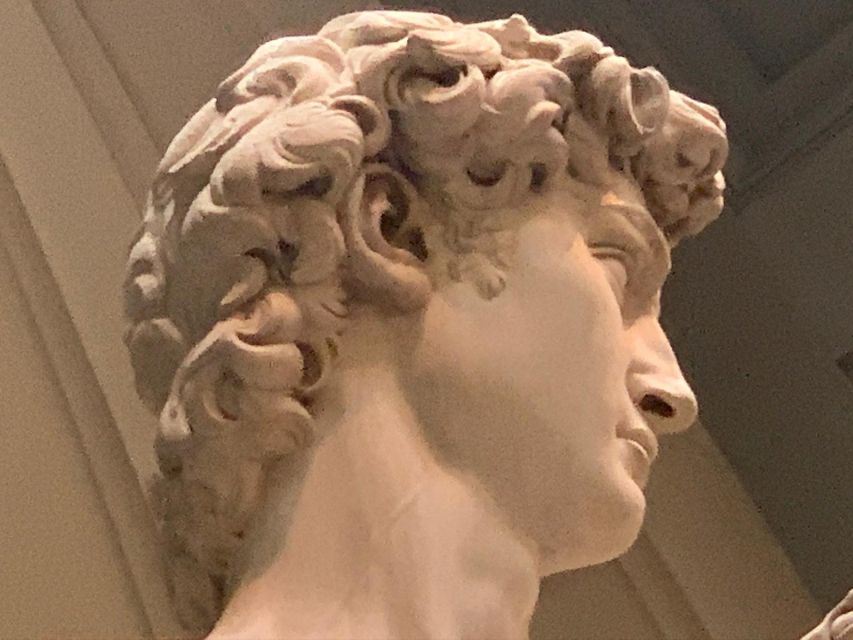
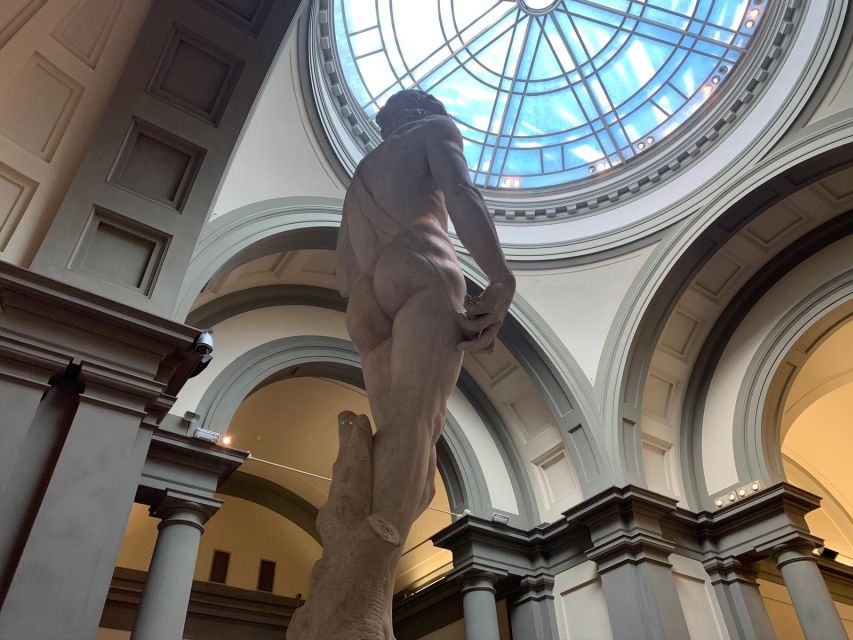
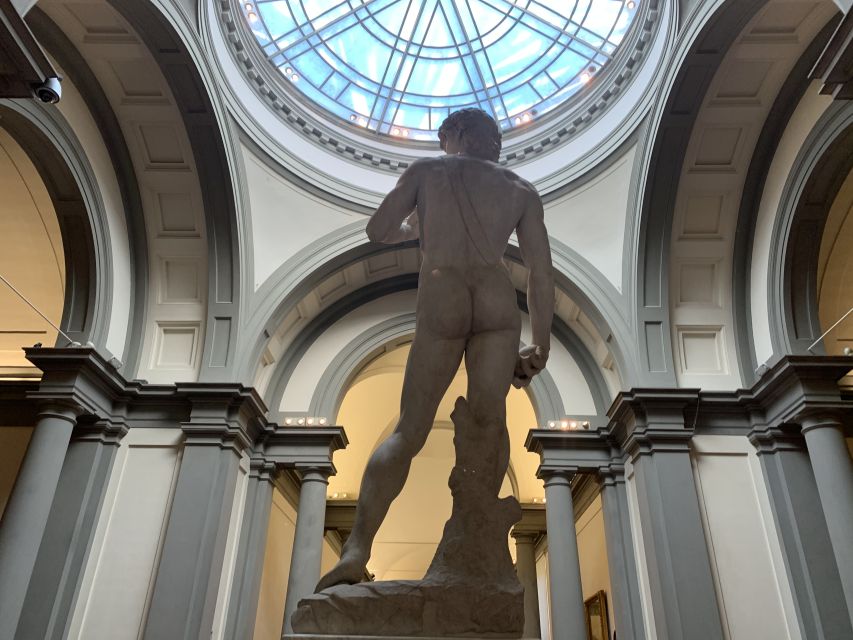
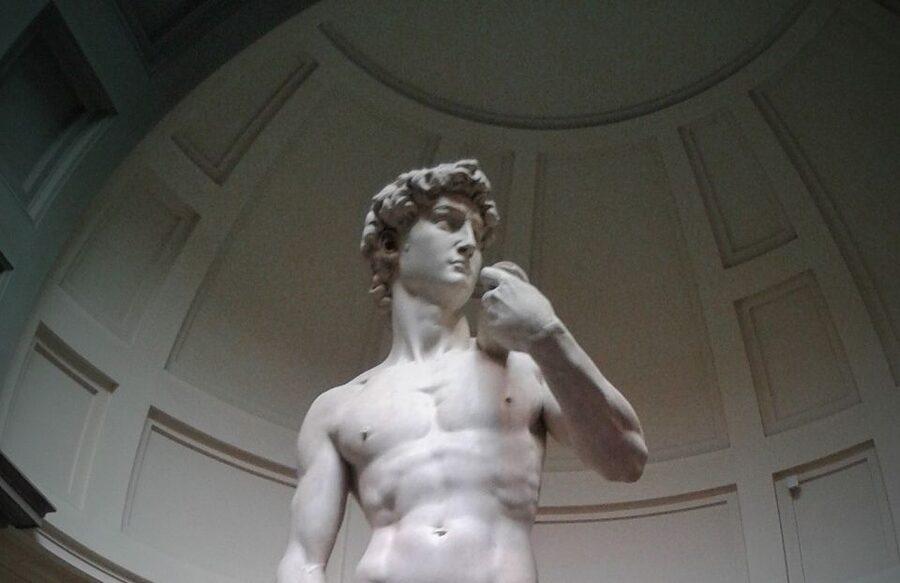
You go to Michelangelo’s David to see it properly: up close, at scale, and with clear explanations about what you are looking at. David is impressive on its own, but what makes it hit harder in a guided setting is learning the symbolism and why the sculpture mattered in Florence’s cultural story.
This is also where audio equipment becomes more than a nice extra. Inside crowded museum rooms, it is easy to miss the best details if you rely on overhearing. With the included audio devices, you can focus on the sculpture and still catch what your guide is connecting to history and technique.
I will be honest about one thing: the Accademia rooms can be tight, and the tour keeps moving. If your personal goal is to stare at David for 20 minutes straight and capture every angle, an hour can feel like a sprint. But if your goal is to leave feeling like you actually understand what you saw, this time box works.
Hall of Prisoners: seeing Michelangelo’s process, not just the finished look
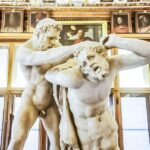
Before David, you visit the Hall of Prisoners. This matters because these are not polished masterpieces in the way tourists sometimes expect. They are unfinished sculptures, and the room is basically a window into how Michelangelo thought and worked.
I love this stop because it changes your viewing. Once you understand that these figures were still in progress, David stops being just a single icon. You begin to see it as the peak of a longer creative process, with decisions, experiments, and transitions you can almost feel in the stone.
This is also where you learn why the “unfinished” part is not a disappointment. It is the point. Michelangelo’s choices become visible. You start noticing what he wanted the figures to express, and how motion and emotion were built into the roughness and forms.
Musical Instruments Museum and Medici treasures, the surprise you will probably remember
After the sculpture-focused rooms, the tour moves into the Musical Instruments Museum. This is one of those sections people skip unless someone makes it part of the plan. Here, you see rare pieces from the Medici collection, including Stradivari violins and ancient pianos.
What I like about this shift is variety. You go from marble bodies and religious and political symbolism to objects made for sound and performance. It helps you understand that Renaissance culture was not only painting and sculpture. It was also craft, patronage, and musical prestige.
Even if you are not a “music person,” you still get something out of it. You get the cultural context: who owned these instruments, what they signaled, and how Medici power played out through art and luxury. It is an unexpected way to broaden your Florence perspective without adding time.
If the dates do not line up, these skip-the-line tickets in Florence are reviewed too.


Byzantine-inspired paintings and altarpieces: connecting the art periods in plain terms
The final part of the tour takes you through Byzantine-inspired paintings and stunning altarpieces. This is where your guide helps you connect dots across time instead of treating the museum like a random collection of famous works.
If you have ever felt lost in museums full of “important paintings,” this is the fix. The tour frames what you are seeing and points out how styles evolved. You get a sense of how medieval visual language fed into Renaissance approaches.
One consideration: the Accademia is not a huge “everything is different” museum. One review noted that besides the main highlights, religious paintings can feel thematically repetitive. That is not a dealbreaker, but it helps you calibrate expectations. Your best strategy is to let the guide pick the moments that matter most to the bigger story, so you are not stuck hunting for variety on your own.
Small group of max 9: the comfort advantage in a crowded museum
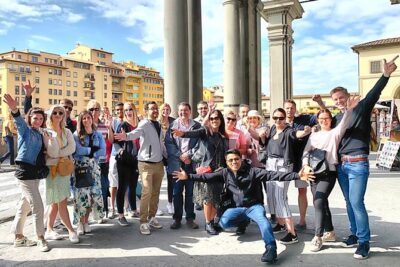
This tour is limited to 9 participants, which changes the feel of your visit. In big tours, you lose the human part, because everyone is just trying to keep up. In a small group, you can actually hear the guide, ask quick questions, and notice details you would otherwise walk past.
You also benefit from the group staying together while navigating busy rooms. That matters in the Accademia because the museum can feel squeezed by crowd movement.
The included audio equipment also supports this. It reduces the “where is the guide, I missed that line” problem. One person did mention occasional interference with the tech, so if you are sensitive to sound issues, it is worth paying attention to how clear the audio is once you get your device.
Guides and storytelling: what you are really paying for
The real engine here is the guide. The tour is designed so you do not just see David, you understand why David mattered and how to look at it. In recent visits, guides have included people like Julia, Elizabeth, Francesca, Elia, and Irina, and the common thread is strong storytelling and detailed explanations of sculptures and paintings.
That matters because Florence art can be dense. Without a guide, you might see famous names and still feel like you are missing the “so what.” With a good guide, you start making connections: political context, workshop process, and symbolism, all tied back to what is in front of you.
Some guides also lead with practical museum rhythm, helping the group through chaos and keeping the visit controlled. That is not glamorous, but it makes a difference in a tight museum.
Price and value: is $70 per person fair for 1 hour?
At $70 per person for a 1-hour experience, the value comes from four things that are bundled together:
1) Skip-the-line entry, which can save a frustrating chunk of time
2) A professional guide, which turns “famous objects” into meaningful viewing
3) Access to the major highlights, including David, the Hall of Prisoners, and sections beyond the statue
4) Audio equipment, so you can actually hear and follow the story
If you already have museum entry tickets and you are hoping this is just a cheaper shortcut, it may feel less like a bargain. One review mentioned that on days when the museum ticket is free (first Sunday of the month), there was no discount on the tour price. So if you are booking around a free-entry date, you should be aware that you are paying for the guided experience, not just the admission.
Still, for most visitors, paying $70 to avoid long queues and to get a focused explanation of David plus other key rooms is a solid use of time. In Florence, time is the currency you spend fastest.
Practical tips to get the most from this hour
Here’s how I’d make this tour work for you:
- Wear comfortable shoes. Even a short walk to the museum adds up when you are moving room to room.
- Bring your photo mindset, not your perfectionist mindset. There’s a photo stop, but the real value is what you learn while you are viewing.
- Use the audio equipment from the start. If something sounds off, tell your guide right away so you can adjust.
- Plan for a museum rhythm. Accademia is busy and smaller than the hype suggests for some areas, so expect tight spacing and crowd flow.
- If your schedule is tight, build in a buffer. One report described a situation where entry issues affected timing, which is rare but a reminder that old-ticketing systems can sometimes glitch.
Who should book this David tour, and who might not
I think this is a great fit if you:
- Want David without wasting half your day in lines
- Like art with context, not just a checklist of “famous things”
- Appreciate when someone connects sculptures to history, symbolism, and technique
- Prefer a small group where you can hear and stay together
You might want a different option if you:
- Need lots of independent time to wander and read everything slowly
- Are visiting mainly for variety across an entire museum and not specific anchor rooms
In other words, this is a “high-impact highlights” tour. It is not a slow, deep museum day.
Should you book Skip-the-Line Accademia Tour for David?
Yes, I’d book it if your priority is seeing Michelangelo’s David in a way that makes you leave with understanding, not just photos. The combination of skip-the-line entry, a focused route through the Hall of Prisoners, the Medici-side detour into Stradivari violins and ancient pianos, and the walk through Byzantine-inspired paintings and altarpieces gives you more than the statue alone.
If $70 feels steep, check your visit dates and your tolerance for time pressure. On free-entry days, you may still pay for the guided portion. But for most people, the hour is well spent, especially with audio support and a small group size that keeps the experience from turning into a noisy blur.
If Florence is your one-shot chance for David, this is the kind of ticket I would happily choose.
Our Wider Tours File for Florence


Further Accademia and David Tours We Cover in Florence
Not quite the day you had in mind? The rest of our Florence write-ups sit below
- David & Accademia Gallery: 1-Hour Small Group Tour★ 4.5 · 169 reviews
- Cinque Terre & Pisa Premium Tour from Florence★ 5.0 · 170 reviews
- Chianti Wine Tastings Day Trip at Sunset from Florence★ 4.5 · 171 reviews
- Private Transfer from Florence Airport to your Hotel in Florence★ 4.5 · 172 reviews
- Private Uffizi Gallery Tour with Reserved Entry★ 5.0 · 174 reviews
- Tasty Florence Street Food with Guided Walking of the City★ 5.0 · 174 reviews
- Uffizi Gallery Timed Tickets with Audio guide★ 4.0 · 174 reviews
- Florence: Tuscany Bike Tour with Wine & Olive Oil★ 4.9 · 174 reviews
- Florence: Small Group Guided Walking Tour★ 4.7 · 176 reviews
Accademia & Michelangelo’s David, top to bottom.
 ★ 4.6Florence: Timed Entrance Ticket to Michelangelo’s DavidFrom $2616,983 reviews
 ★ 4.5Florence: Michelangelo’s David Skip-the-Line Entry TicketFrom $4512,764 reviews
 ★ 4.4Florence: Michelangelo’s David Priority Ticket & Audio AppFrom $236,812 reviews
 ★ 4.5Florence Accademia Gallery Tour with Entrance Ticket IncludedFrom $456,148 reviews
 ★ 4.7Rome: St. Peter’s Basilica, La Pietà, Papal Tombs and DomeFrom $174,610 reviews
 ★ 4.6Florence: Accademia Gallery Guided TourFrom $534,156 reviews
 ★ 4.6Florence: Timed Entry Ticket to Michelangelo’s David & eBookFrom $374,049 reviews
 ★ 4.5Florence: Reserved Entrance Ticket to the Medici ChapelFrom $203,615 reviews
Filed under