
Reviewed · SELF-GUIDED TOURS
Get-On Get-Off Bus Tour in Rome + FREE APP
Rome is easier when you ride first.
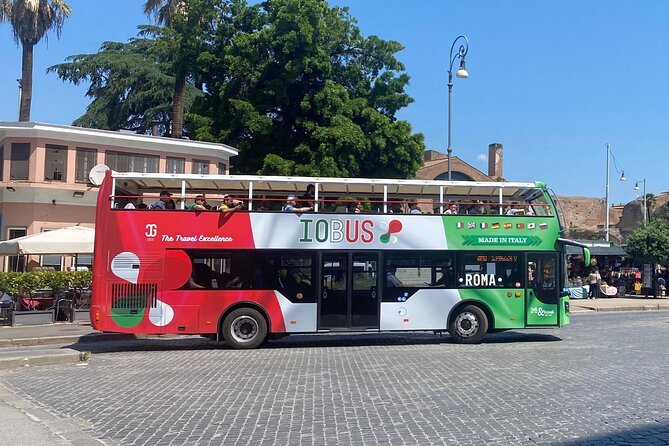
This Get-On Get-Off bus tour is a practical way to preview the big sights and then hop off when something grabs your attention. You get a route lined with key stops near the Colosseum area, Circus Maximus, Piazza Venezia, the Imperial Forums, and Renaissance Rome, plus handy onboard features like real-time bus info.
What I like most is the mix of transportation and brains. The free app lets you listen to the commentary on your mobile phone in 8 languages, and you can also use 6 free walking tours to turn bus views into actual on-foot exploring. The possible drawback is that a few people reported audio issues or trouble finding the correct pickup point, so you’ll want to confirm exactly where you should redeem and where to board.
In This Review
- Key things to know before you go
- What this Rome bus tour gives you, beyond the ride
- Price and value: how $20.74 makes sense (or not)
- Finding your way: redemption point and nine stops that matter
- Riding the route: Colosseum to Ponte Sant’Angelo without the guesswork
- Stop-by-stop what you can do
- The free app: audio that guides you, walking tours that extend the day
- Audio quality and the onboard devices: what to watch for
- Crowds, boarding lines, and doing it in a smart order
- Accessibility and who this tour suits best
- Should you book the Get-On Get-Off bus in Rome?
- FAQ
- Where do I redeem my ticket?
- How long is the tour?
- How many stops are on the route?
- What major sights does the bus cover?
- What is included with the price?
- Are entrance tickets included for attractions and museums?
- Do I need a hotel pickup?
- Is the audio guide available in multiple languages?
- Can I cancel for a full refund?
Key things to know before you go
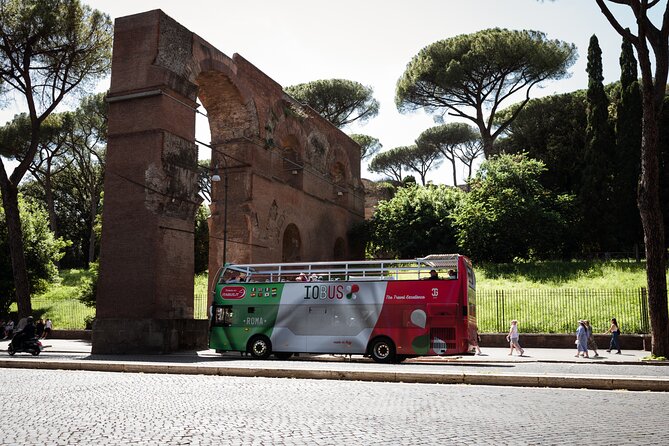
- 9 hop-on, hop-off stops along a route built around Rome’s major landmarks
- Free app audio in 8 languages you can use from your phone
- Onboard Wi-Fi and real-time bus info, which helps you plan your next hop
- 6 free walking tours you can use to go deeper on the neighborhoods you pass
- A small group setup (max 15 travelers) that often feels less chaotic than mega tours
- Entrance tickets are not included, so you still need to book museum and landmark entry separately
What this Rome bus tour gives you, beyond the ride
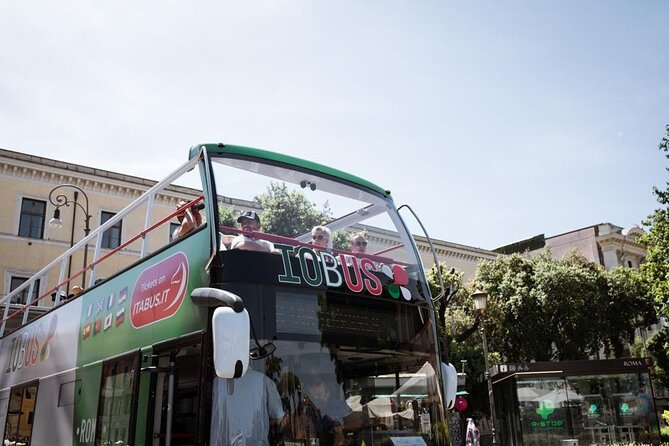
This is not just a sit-and-stare sightseeing bus. It is set up so you can move around Rome with flexibility, get context through audio, and then choose how far you want to go on foot.
Here is the practical combo you get:
- Hop on and hop off at 9 stops spread along the route.
- Use the free app to listen to commentary from your phone. This is useful because it means you are not tied to one audio device at one exact moment.
- Enjoy Wi-Fi on board and real-time updates about the buses.
- Listen in 8 languages, with children’s commentary too.
- Add 6 free walking tours from the app when you want more than bus windows.
One day on a route like this works best as a “map in motion.” You see a lot quickly, you learn what is near what, and you can plan a second day around specific entries. If you are the type who hates guessing, this format helps you make better choices fast.
If the dates do not line up, these self-guided tours in Rome are reviewed too.
- Rome: Colosseum & Forum with Audio Guide App -Optional Arena
★ 4.2 · 24,770 reviews - Rome: St. Peter’s Basilica & Dome Entry Ticket & Audio Tour
★ 4.2 · 7,537 reviews - Vatican & Sistine Chapel Ticket with Optional Audio Guide
★ 4.1 · 5,405 reviews - Rome: Colosseum, Forum, & Palatine Hill with Audio Guide
★ 4.3 · 4,591 reviews
Price and value: how $20.74 makes sense (or not)
At $20.74 per person, this tour is priced like a solid “first-day tool.” The value comes from two places.
First, you are paying for time-saving transportation plus interpretation. Rome rewards planning, and hop-on hop-off bus routes can cut down how much backtracking you do, especially when you are moving between big zones like the Colosseum area and central viewpoints.
Second, you get extras that cost money elsewhere: onboard Wi-Fi, real-time info, audio in 8 languages, and 6 walking tours. Even if you only use part of the walking tour set, you are still extracting value out of the pass.
The main reason it might not feel like a win is simple: entrance tickets are not included. If your goal is to walk straight into the Colosseum, museums, or major sites every stop, you’ll still need separate ticket planning and time slots. In that case, think of the bus as the guide to where you should spend your real ticket money.
Finding your way: redemption point and nine stops that matter
The ticket redemption point is listed as Piazza Papa Pio XII, 5, 00193 Roma. This matters because multiple people in the real world say they struggled with finding the correct starting point at first. Do not assume that the closest stop to your hotel is always where you redeem.
Once you have your ticket, the hop-on stops are clearly defined, and they follow Rome’s pattern of being near landmarks, museums, monuments, and major crossings:
- Stop 1: Rome 5 Marsala Str, opposite the Royal Santina hotel
- Stop 2: Largo di Villa Peretti, 70, in front of the National Roman Museum
- Stop 3: P.za dell’Esquilino, 11, in front of Bar Felici
- Stop 4: VFPQ+CP Rome, about 50 meters after the entrance to Palatine Park
- Stop 5: Big Bus Tours Rome, in front of the Giuseppe Mazzini Monument
- Stop 6: Stop 5 – Hop on, Hop off: Rome, in front of the Marcello Theater
- Stop 7: Lungotevere Tor di Nona, 7, in front of Ponte Sant’Angelo
- Stop 7 – Hop on, Hop off: Rome, in front of house number 48
- Stop 9: Via Barberini, 2, next to the Cinema Barberini
Here is my practical advice: when you are planning your first hop, pick one “anchor” stop. For example, if you want to explore around Ponte Sant’Angelo, plan your day so that stop 7 lines up with your first on-foot time block. The bus route then becomes the connector, not the whole plan.
Also, many people find boarding gets crowded. So you will have an easier time if you avoid peak times and start with one early loop, then hop off for longer walks.
Riding the route: Colosseum to Ponte Sant’Angelo without the guesswork
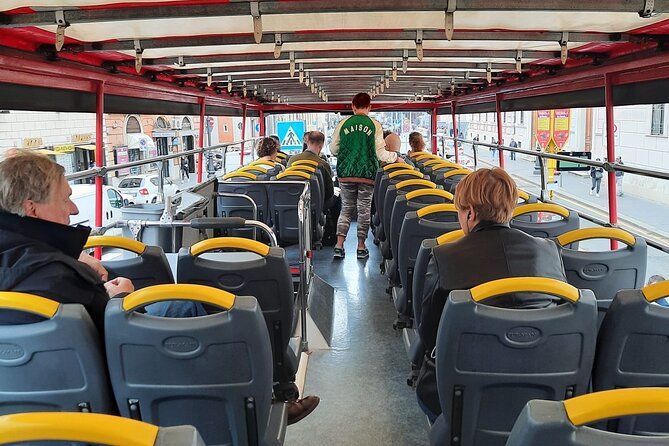
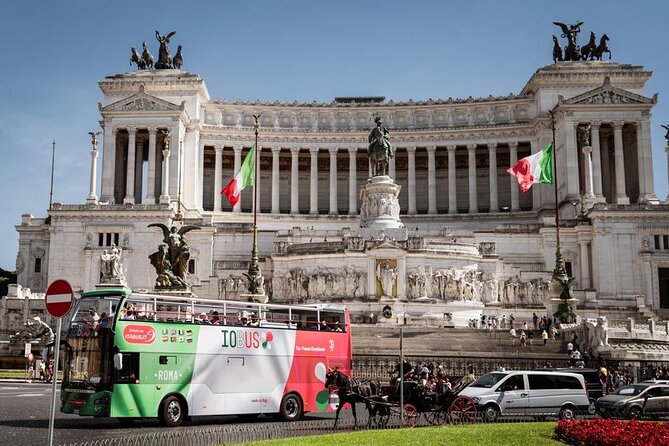
The overview highlights the big winners: the Colosseum, Circus Maximus, Piazza Venezia with its War Memorial, the Imperial Forums, and Renaissance Rome. What you get while riding is basically the “Rome wow factor” from the street level, plus commentary so the scenes have names.
Think about the route like this: you move from ancient Rome landmarks near the center-east side, then across to major central viewpoints and bridges, ending up toward the Via Barberini area.
Stop-by-stop what you can do
Stop 1 (Royal Santina area, Via Marsala)
This is a decent starting point if you are trying to get oriented before you commit to a big site. The main value here is convenience to start, then get your bearings before you hop deeper toward the historical core.
Stop 2 (National Roman Museum area)
This stop is timed for the museum-adjacent crowd. Even if you are not entering the museum that day, it helps to see where it sits so you can decide later. It is also a good spot to jump on if you want a smoother transition between central attractions.
Stop 3 (Esquilino, in front of Bar Felici)
Esquilino is where you can feel Rome as a living city, not only a photo set. This stop is useful if you want to layer in a coffee break or treat it as a neighborhood waypoint before heading toward the major ancient zones.
Stop 4 (after the entrance to Palatine Park)
This is one of the most “directly useful” stops because it is tied to Palatine Park. If you want the Palatine area, this stop can help cut the stress of figuring out access. The drawback is that it is still close to a major pedestrian zone, so you should expect crowds depending on the hour.
Stop 5 (Giuseppe Mazzini Monument, Big Bus Tours Rome)
This works well as a transition stop. You are in a central area with lots of moving parts, so it is a good place to hop off briefly, check directions, and then continue.
Stop 6 (Marcello Theater)
The Marcello Theater area is built for walking. If you hop here, plan a slow stroll rather than trying to do everything in 20 minutes. You will get more out of it by turning the stop into an on-foot mini block.
Stop 7 (Ponte Sant’Angelo, Lungotevere Tor di Nona)
This is a headline stop. Ponte Sant’Angelo is a classic Rome crossing, and the bus view across the river is part of the appeal. If you like photo walks and river views, this is the stop you should build around.
Stop 8 (house number 48 near the same hop-on corridor)
This one is less landmark-stamped, so use it as a backup option. When it helps, it helps because you can keep moving without backtracking. If you get turned around easily, make sure you cross-check the app stop name against where the bus is letting off.
Stop 9 (Via Barberini, Cinema Barberini)
This stop is useful for connecting toward shops and central Rome energy. It is also a handy ending point for your day because it is not stuck in the most intense ancient-site grid.
The free app: audio that guides you, walking tours that extend the day
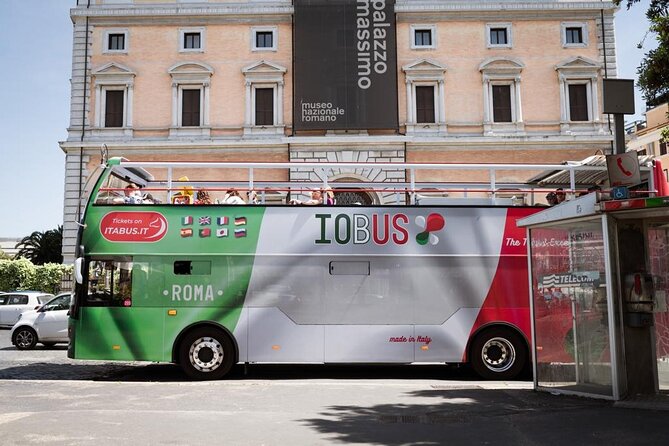
The biggest “upgrade” here is the free app. Instead of only relying on bus audio timing, you can listen on your mobile phone. That matters in Rome because your attention is constantly split between the street, the view, and the next place you want to walk.
You get:
- Commentary synced to the experience, accessed through the app
- 8 languages
- children’s commentary
- 6 free walking tours available through the app
My advice: before you start moving, put headphones in your day bag and give yourself one minute to test the audio. A few people reported audio problems, like limited speech or audio points not working. When audio fails, you feel it right away. When audio works, it turns the ride into a real “learning loop,” not background noise.
Also, keep your phone charged. The app experience is best when you can rely on your battery.



Audio quality and the onboard devices: what to watch for
Some passengers reported that audio points were not working correctly, or that what played felt more like music than clear commentary. Others mentioned issues with audio devices.
So here is what I recommend to protect your experience:
- Assume one device might fail. Use your phone app as the primary plan, and keep the onboard audio as backup.
- If something sounds off, ask staff. Small fixes, like swapping headphones or pointing you to the right audio feed, can save the moment.
- If you are sensitive to sound, be ready for the fact that devices can be noisy. Bring your own comfortable headphones if you have them.
This is not a reason to avoid the tour, but it is a reason to plan like a realist. Rome is worth it even when one tech element acts up.
Crowds, boarding lines, and doing it in a smart order
This tour is popular because it is convenient. Convenience usually means crowds at certain stops.
A few practical patterns show up:
- Boarding can get crowded, so expect some waiting, especially at the busiest times.
- One common tip from riders is to use the bus during the day. The service can run out in the early evening, with one note saying it ends around 6:30pm.
So I suggest this approach:
- Start early enough to do one full loop or most of it.
- Decide your “must hop off” stops, then treat the rest as optional.
- For the time you hop off, pick one main on-foot attraction or a walking tour, not five separate quick stops.
Rome is too spread out to win with frantic schedule math. You’ll do better with fewer, longer blocks.
Accessibility and who this tour suits best
The tour is designed for most travelers and allows service animals. It is also described as near public transportation, which is helpful if you want to stitch together bus rides with metro and walking.
One accessibility-positive detail from the real world is that a rider using a wheelchair reported excellent service and good accessibility from the company. That is encouraging for anyone who needs smoother boarding and reliable support.
Who tends to enjoy this most:
- First-timers who want to see the major highlights and decide next-day priorities
- Families who benefit from children’s commentary
- People who like planning with a simple route rather than reading maps every 10 minutes
Who should be cautious:
- If you specifically want long, multi-route coverage with the same expectations as other hop-on hop-off brands, double-check that your pass matches what you think you booked. Some people reported confusion when they expected a different route setup.
- If you want full museum ticket access included, you will still need to purchase entry separately.
Should you book the Get-On Get-Off bus in Rome?
Book it if you want an easy, low-stress way to get oriented and build a smart plan around the big sights. At around $20.74 per person, the value is strongest when you treat it as your first-day Rome framework: ride, listen, hop off where it clicks, then spend your time and money on entry tickets you actually care about.
Skip or rethink it if your main goal is strict, guaranteed audio quality or if you hate any uncertainty about finding the exact redemption location. If you do book, do one thing that prevents most headaches: confirm the redemption point before you go, then use the app and stop list as your guide once you are on the route.
If you want Rome to feel organized without feeling rushed, this is a good tool to have in your pocket.
FAQ
Where do I redeem my ticket?
You redeem your ticket at Piazza Papa Pio XII, 5, 00193 Roma RM, Italy.
How long is the tour?
The experience lasts 1 day, approximately.
How many stops are on the route?
There are 9 stops along the route where you can hop on and hop off.
What major sights does the bus cover?
The route highlights include the Colosseum, Circus Maximus, Piazza Venezia with its War Memorial, the Imperial Forums, and Renaissance Rome.
What is included with the price?
Included features are Wi-Fi on board, real-time bus information, an audio guide in 8 languages, children’s commentary, the free app, and 6 free walking tours.
Are entrance tickets included for attractions and museums?
No. Entrance tickets to attractions or museums are not included.
Do I need a hotel pickup?
No hotel pick-up service is included.
Is the audio guide available in multiple languages?
Yes. The audio guide is available in 8 languages, and you can also use the free app.
Can I cancel for a full refund?
Yes. Free cancellation is available up to 24 hours in advance for a full refund.
Our Wider Self-guided Tours File for Rome


Our Wider Tours File for Rome


Not quite the day you had in mind? The rest of our Rome write-ups sit below
- Rome: Guided Tour of St. Peter’s Dome Climb, Basilica & Vatacombs★ 5.0 · 167 reviews
- St. Peter’s Basilica Guided Tour with Reserved Entrance★ 4.0 · 168 reviews
- Golf Cart Driving Tour in Rome: 2.5 hrs Catacombs & Appian Way★ 5.0 · 168 reviews
- Rome: Trastevere Wine Tasting with Food Pairing and Gelato★ 4.9 · 168 reviews
- Guided Tour of the Colosseum Palatine Hill and Roman Forum★ 4.7 · 168 reviews
- Vatican Museums, Sistine Chapel & Saint Peter’s Semi-Private Tour★ 4.5 · 169 reviews
- Hidden Rome: Small Group E-Bike Tour with Street Food Stops★ 5.0 · 169 reviews
- Rome: Papal Audience with Pope Leo IV★ 3.9 · 169 reviews
- Rome Golf Cart Tour: Highlights & Must See★ 4.5 · 170 reviews
Self-Guided Tours, top to bottom.
 ★ 4.2Rome: Colosseum & Forum with Audio Guide App -Optional ArenaFrom $4124,770 reviews
 ★ 4.3Rome: Pantheon Fast-Track Ticket and Official Audio GuideFrom $621,008 reviews
 ★ 4.1Venice: Grand Canal Gondola Ride with App CommentaryFrom $3918,908 reviews
 ★ 4.2Pompeii: Entry Ticket with Optional Audio GuideFrom $2612,360 reviews
 ★ 4.6Venice: La Fenice Opera House Entry Ticket with Audio GuideFrom $1411,742 reviews
 ★ 4.4Rome: Colosseum, Forum, Palatine Hill Entry & Audioguide AppFrom $3010,957 reviews
 ★ 4.2Rome: St. Peter’s Basilica & Dome Entry Ticket & Audio TourFrom $177,537 reviews
 ★ 4.4Florence: Cathedral & Brunelleschi’s Dome Ticket & Audio AppFrom $706,973 reviews
Filed under