
Reviewed · UMBRIA: ASSISI, PERUGIA & ORVIETO
Small Group Tour of Assisi and St. Francis Basilica
Assisi hits different when you move on foot. This small-group tour strings together the town’s most important sights, from Roman leftovers to the UNESCO world of San Francesco frescoes, without wasting hours on logistics. You get an English guide and enough time to understand why the churches matter, not just what they look like.
I like two things most: the focus on Giotto and the fresco tradition that made the Basilica di San Francesco famous, and the way the route layers Assisi’s story city by city, with stops like St. Clare’s basilica and Minerva’s temple. Guides like Alessandra and Francesca are praised for making the art and faith context click, even if you are visiting for the first time.
The main thing to plan for is physical effort. Expect uphill walking and steep steps, and the day can be tough if you have mobility issues or a back problem.
In This Review
- Key Highlights You’ll Feel On This Walk
- How This Assisi Tour Fits a Tight Schedule
- Value at a Glance: $72.59 for a full mini-course
- The 10:30 Meet Point and the First Thing to Watch
- Roman Ruins, Medieval Reuse, and a Castle View
- What to expect on this part
- Cathedral Lanes, St. Clare’s Basilica, and the Pink Stone Connection
- Saint Rufino’s Cathedral
- Basilica di Santa Chiara (St. Clare’s)
- Piazza del Comune and Minerva’s Temple
- Why this stop is worth your attention
- Chiesa Nuova: Francis’ Presumed Birthplace Site
- Santa Maria sopra Minerva (The Minerva Temple Church)
- Basilica of San Francesco d’Assisi: Lower Silence, Upper Light
- Lower basilica: penance and silence
- Upper church: Gothic with French influences
- Frescoes and the Giotto connection
- The Guide Factor: Small Group, Real Questions, Clear Stories
- About audio and hearing the guide
- Walking Reality Check: Hills, Stairs, and Footwear
- Tickets, Included Entry, and What Might Cost Extra
- Best For Who? And When It Makes Sense
- So, Should You Book It?
- FAQ
- How long is the Assisi and St. Francis Basilica small group tour?
- What time does the tour start, and where do I meet the guide?
- Where does the tour end?
- Is the tour in English?
- Are the tickets included?
- What is the dress code?
- Are there days when the Basilica of St. Francis cannot be visited normally?
- How big is the group?
- Is the tour accessible for people with mobility problems?
- Are tips included in the price?
Key Highlights You’ll Feel On This Walk

- Small group, max 15 travelers, so your guide can actually answer questions along the way
- Two-part St. Francis visit with the contrast of a darker lower basilica and a brighter upper church
- St. Clare’s pink stone and fresco range, plus a famous tradition about a crucifix
- Assisi’s Roman layers, starting with the old amphitheater reuse for building stones
- Piazza del Comune and Minerva’s temple, one of the best-preserved Roman temples in Italy
How This Assisi Tour Fits a Tight Schedule

This is a fast, smart way to get oriented in Assisi. In about 2 hours 30 minutes, you cover the essentials: the medieval lanes, the big churches, and the key art connection that explains why the Basilica di San Francesco draws people from everywhere.
You also avoid a common mistake in Assisi, which is sightseeing without context. The route is built to give you the backstory in the order you encounter it. That means when you finally reach St. Francis, it feels less like a checklist and more like a payoff.
Kept in the same folder as this one, Umbrian hill town day trips in Assisi.
- Assisi: Walking Tour with St. Francis Basilica Visit
★ 4.8 · 259 reviews - Assisi: Panoramic Tuk Tuk Tour
★ 4.9 · 220 reviews - Small Group Tour of Assisi and St. Francis Basilica
★ 5.0 · 187 reviews
Value at a Glance: $72.59 for a full mini-course
At $72.59 per person for an English guide, this isn’t the cheapest way to “see Assisi.” But it is good value if you care about meaning. Admission to the St. Francis Basilica is included, and the guide time is what you are really paying for: the pacing, the art interpretation, and the way the walk ties together Roman, medieval, and early Renaissance influences.
If you already know a lot of Assisi and prefer slow wandering, you might skip a guided tour. But if you want a guided primer that also lets you keep moving at a realistic vacation pace, this one makes sense.
The 10:30 Meet Point and the First Thing to Watch
You meet at 10:30am at Parcheggio Saba Matteotti, Piazza Giacomo Matteotti, 06081 Assisi. The tour ends at Piazza Inferiore di S. Francesco, 2, 06081 Assisi, right by the Papal Basilica area.
Two practical notes matter:
- The Matteotti parking lot is closed for renovation, so you should not plan to drive and park there. The meeting point stays the same, but parking is not available.
- There is a dress code for places of worship and selected museums. No shorts or sleeveless tops. Knees and shoulders must be covered for both men and women, or you risk being turned away.
If you are arriving by bus or walking from elsewhere, you’re fine. If you are driving, plan ahead because the normal meeting-area parking situation may be disrupted.
Roman Ruins, Medieval Reuse, and a Castle View
Your first stretch is all about layers. The walk begins with the old Roman amphitheater ruins, which later got reused in the Middle Ages. Stones from the amphitheater were taken and used to build local houses, turning a public entertainment site into something far more private.
As you move from that history into the medieval parts of Assisi, you get one of the city’s best early impressions: the view toward Rocca Maggiore medieval castle. It is a small moment, but it sets the tone. Assisi looks like a postcard because it is, but it also looks the way it does because the city grew in the only way it could, up the hills and around old foundations.
What to expect on this part
This is a good place to bring comfortable shoes. You will not just stroll. Even the “easy” sections have uneven ground and angles that make you pay attention to your footing.
Cathedral Lanes, St. Clare’s Basilica, and the Pink Stone Connection

Next you move through narrow alleys and medieval squares. You reach Saint Rufino’s Cathedral and Saint Claire’s Basilica, then head toward the main civic heart of town.
Saint Rufino’s Cathedral
San Rufino (Rufinus of Assisi) is the city’s major saint, and the cathedral is where Assisi’s spiritual story anchors. Expect this stop to be brief, but meaningful. The guide’s job here is to help you understand who Rufinus was and why the cathedral matters to the local identity.
Basilica di Santa Chiara (St. Clare’s)
St. Clare’s basilica is a star stop, and for a reason. It is built with the typical pink stone extracted from the Subasio mountain quarry. If you’ve only seen Assisi from outside, this is when you start to notice the materials that make it feel specific and local.
You will also spend time with precious frescoes dating from the 12th to the 14th century. That range matters, because it shows how the church’s artistic role evolved over time rather than being a single “snapshot.”
In one chapel (on the right), you can admire a crucifix tied to a tradition about St. Francesco. The story goes that the crucifix invited him in Assisi, in a way that helped redirect the Church back toward its intended purpose. Even if you don’t follow the religious tradition, it gives you a human reason to slow down and look closely.
Piazza del Comune and Minerva’s Temple

You arrive at Piazza del Comune, a natural pause point where Assisi’s past meets its civic power. Here you see imposing medieval government buildings surrounding Minerva’s temple.
Minerva’s temple is one of the best-preserved Roman temples in Italy. In Assisi, that is powerful because it is not “somewhere else” you must travel to. It sits inside the medieval town fabric, which helps you understand how Rome did not vanish. It got absorbed.
Why this stop is worth your attention
It’s easy to see a temple and move on. This is different. Minerva’s temple shows you the physical inheritance Assisi sits on. Then, when you reach St. Francis, you’ll recognize a pattern: Assisi keeps building and reusing what came before, and art and architecture keep getting layered into daily life.
Chiesa Nuova: Francis’ Presumed Birthplace Site

After the major square, the route continues with Chiesa Nuova, built in 1615 on the site of the presumed birthplace of St. Francis, connected to the house of Pietro di Bernardone.
The church’s name, Chiesa Nuova, is straightforward. It was called new because it was the last church built in Assisi around that period. The quick stop here is useful because it gives you a tangible anchor for where stories started, not just where they ended up in the basilicas.
Santa Maria sopra Minerva (The Minerva Temple Church)

Next you visit Santa Maria sopra Minerva. This is the Roman Temple of Minerva, now housing the church of Santa Maria sopra Minerva, built in 1539 and renovated in Baroque style in the 17th century.
This stop is short, about 15 minutes, but it ties together a big theme of Assisi: religious sites evolve. The same core structure can hold different artistic layers as tastes, needs, and eras shift.
If you like architecture changes you can actually see with your own eyes, this part is a nice bridge between Roman design and later Christian reinterpretation.
Basilica of San Francesco d’Assisi: Lower Silence, Upper Light

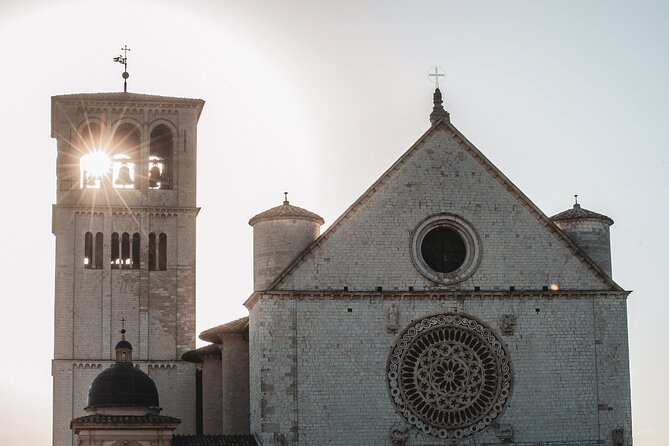
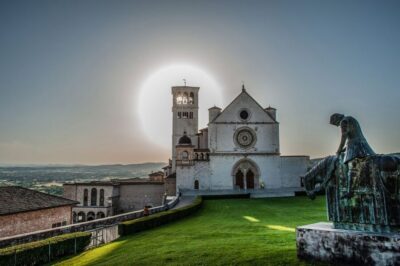
Now you reach the heart of the tour. The Basilica Papale e Sacro Convento di San Francesco d’Assisi is a UNESCO World Heritage site, begun in 1228 under Brother Elias, described as the vicar general and architect of the order, soon after St. Francis’s death.
Your guide builds the contrast before you even walk through it. It helps you look better once you are inside.
Lower basilica: penance and silence
The lower basilica is solemn and darker. It is the part that feels like gravity. Plan to go slower here, even if your time is limited, because this space is about atmosphere as much as it is about art.
Upper church: Gothic with French influences
The upper church is airy and bright, and the style is Gothic with French influences. You will see the nave with four bays and cross vaulting, plus a polygonal transept and apse.
This is where your brain starts to separate the basilica into design choices rather than just admiring paintings. The guide’s explanations are what make the architecture feel useful, not abstract.
Frescoes and the Giotto connection
The Basilica di San Francesco is famous for the 13th and 14th century frescoes by top painters of the time, with Giotto as the standout name. This tour is built to connect those frescoes to why they matter. Instead of just reading labels, you learn how the art fits into the story of St. Francis and the artistic ambitions of the era.
One practical note: your time inside can shift based on religious access rules. On Sundays, big Catholic holidays, and national holidays, guided tours inside the Basilica of St. Francis are not allowed. In those cases, your guide explains from outside and you enter alone in silence.
Also, plan around closures. On October 4th, the Basilica of St. Francis is closed. And during the period when access is suspended because of the public display of the relics of St. Francis, the guide will provide explanation from outside the basilica (Feb 15 to Apr 6, 2026). If any of those dates match your trip, I would treat the tour as still worthwhile, but adjust your expectations about what you see inside.
The Guide Factor: Small Group, Real Questions, Clear Stories
This is where the small group size pays off. With a maximum of 15, you’re not just being swept along. Guides like Alessandra and Francesca are repeatedly praised for being enthusiastic and for answering questions as you walk.
That matters in Assisi because the town is layered. Roman reuse, medieval devotion, Gothic architecture, fresco programs, and saint stories all show up in a short time. A good guide helps you keep it straight.
About audio and hearing the guide
Some visitors reported that you may need headsets at the Basilica of St. Francis to hear clearly. If you wear glasses or have sensitive ears, you might find the ear pieces uncomfortable. Bring this up if you are ordering or ask your guide on arrival what to expect so you can plan what to do if audio support is required.
Walking Reality Check: Hills, Stairs, and Footwear
Even though this is called a 2.5-hour tour, it does not feel like a flat city stroll. Assisi’s medieval lanes and views require climbing, and the basilica area includes steps.
If your legs are fine but you prefer gentle pacing, you’ll still enjoy it. If you have a bad back or mobility limits, this is the part I would think about first. One traveler dropped out toward the end due to back issues, and that’s a hint that the day is not built for wheelchair-style pacing.
The best practical advice is simple:
- Wear shoes you trust on uneven stone
- Bring water if you tend to get thirsty on walks
- Use the breaks at churches as recovery time, not just photo time
Tickets, Included Entry, and What Might Cost Extra
Here’s what is included:
- An official English speaking guide
- Entrance fee to the Basilica di St. Francis
Most other church stops in the walk include free admission, based on the tour details given for each site.
That said, I would keep a little flexibility in your budget. Some people were surprised by a small extra fee requested at entry to a sanctuary, for example €2.50 per person. If you have tight cash plans, it is smart to keep a few euros aside just in case.
Tips are not included. If the guide does a great job, tip according to your comfort and local custom.
Best For Who? And When It Makes Sense
This tour works best if you want:
- The big names of Assisi fast, but with context
- A guided explanation that helps you understand fresco art, not just see it
- A route that connects Roman ruins to medieval churches without hopping around by car
It may be less ideal if you:
- Want total quiet and total freedom with no walking pace
- Have mobility issues that make hills and stairs a struggle
- Are visiting on a Sunday or a national holiday, when inside access rules can change what happens inside the basilica
So, Should You Book It?
Yes, I’d book it if your goal is a guided, art-focused primer to Assisi in a half-day slot. The St. Francis component, including the lower and upper church contrast and the fresco context around Giotto, is the strongest reason. At $72.59 with guide time and St. Francis entry included, it is a solid value if you care about meaning, not just photographs.
If you are mainly shopping for independent wandering, you could skip the guide and do churches at your own pace. But if you want your first Assisi day to click quickly and not turn into a confusion of buildings and saints, this route is one of the most efficient ways to make that happen.
FAQ
How long is the Assisi and St. Francis Basilica small group tour?
It runs about 2 hours 30 minutes.
What time does the tour start, and where do I meet the guide?
You meet at 10:30am at Parcheggio Saba Matteotti, Piazza Giacomo Matteotti, 06081 Assisi.
Where does the tour end?
The tour ends at Piazza Inferiore di S. Francesco, 2, 06081 Assisi, at the Papal Basilica and Sacred Convent of Saint Francis in Assisi.
Is the tour in English?
Yes, it is offered in English.
Are the tickets included?
Entrance tickets to the Basilica of St. Francis are included.
What is the dress code?
You must cover knees and shoulders. No shorts or sleeveless tops are allowed for men and women. You may be refused entry if you do not comply.
Are there days when the Basilica of St. Francis cannot be visited normally?
Yes. On Sundays, big Catholic holidays, and national holidays, guided tours inside the basilica are forbidden, and you enter alone in silence after an outside explanation. The basilica is also closed on October 4th. From February 15 to April 6, 2026, access to the basilica is suspended due to a public display of relics, and the guide explains from outside.
How big is the group?
The tour has a maximum of 15 travelers.
Is the tour accessible for people with mobility problems?
The tour involves walking uphill and steep stairs. The information says most travelers can participate, but if you have mobility limits, you should consider whether the stairs and hill climbing are manageable.
Are tips included in the price?
No, tips are not included.
Our Wider Tours File for Assisi

Umbrian Hill Town Day Trips in Assisi That Made the Same Shortlist
Not quite the day you had in mind? The rest of our Assisi write-ups sit below
- Small Group Tour of Assisi and St. Francis Basilica★ 5.0 · 187 reviews
- Assisi: Panoramic Tuk Tuk Tour★ 4.9 · 220 reviews
- Assisi: Walking Tour with St. Francis Basilica Visit★ 4.8 · 259 reviews
Umbria: Assisi, Perugia & Orvieto, top to bottom.
 ★ 4.6From Rome: Bagnoregio & Orvieto Day Trip with Wines & LunchFrom $931,075 reviews
 ★ 4.0Assisi and Orvieto Guided Day Tour from Rome with LunchFrom $1981,031 reviews
 ★ 4.6Perugia: Entry Ticket and Guided Tour of Perugia UndergroundFrom $14579 reviews
 ★ 4.5Assisi & Orvieto Day Trip from RomeFrom $174341 reviews
 ★ 4.8Perugia: Old Town Walking Tour, Piazza IV NovembreFrom $35304 reviews
 ★ 4.0Heart of Italy Day Trip: Visit Perugia and Assisi from FlorenceFrom $111287 reviews
 ★ 4.55-Day Best of Italy: Assisi, Siena, Florence, Venice and moreFrom $1,031285 reviews
 ★ 4.8Assisi: Walking Tour with St. Francis Basilica VisitFrom $71259 reviews
Filed under