
Reviewed · POMPEII ARCHAEOLOGICAL SITE
Skip-the-Line Pompeii Guided Tour from Sorrento
Pompeii feels huge until someone maps it. This Sorrento tour pairs an air-conditioned coach ride with skip-the-line entry, so you get inside quickly and spend your time on the big, readable parts of the ruins.
One real consideration: Pompeii is rough underfoot, with steps and uneven stones, so bring sturdy shoes and be ready for a workout.
In This Review
- Key highlights worth your attention
- Why this skip-the-line Pompeii plan works from Sorrento
- Getting to Pompeii: coach comfort and timing choices
- Once inside: how the guide turns ruins into a city
- The Forum and Temple of Jupiter: where politics, faith, and commerce met
- Macellum and the idea of imperial food culture
- Via dell’Abbondanza: the main street that makes Pompeii feel alive
- Stabian Baths: daily life, not just ruins
- Lupanar: the official brothel and the messy realism of graffiti
- House of the Faun and the Alexander Mosaic: luxury you can walk past
- Basilica and Teatro Grande: order, justice, and performance
- Pacing, terrain, and what to plan so you enjoy it
- Value check: what you pay for and who it fits best
- Should you book this Pompeii skip-the-line tour from Sorrento?
- FAQ
- How long is the Pompeii skip-the-line guided tour from Sorrento?
- What is included in the price of the tour?
- Does this tour include skip-the-line entry to Pompeii?
- Where is the meeting point in Sorrento?
- How large is the group?
- Are food and drinks included?
- Is the tour wheelchair accessible?
Key highlights worth your attention
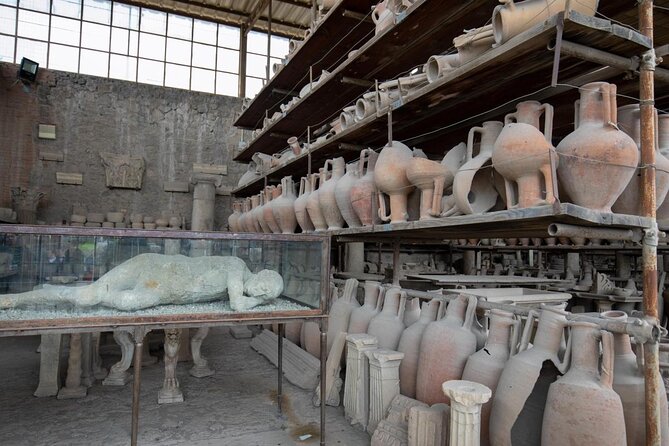
- Skip-the-line entry cuts the waiting so you start seeing right away
- Air-conditioned round-trip coach makes the ride from Sorrento comfortable
- Official guide plus headphones (for larger groups) helps you follow the story without straining
- Forum, baths, and the Lupanar give you daily life, not just famous views
- Careful timeboxing means you hit multiple areas in one half-day plan
- Max 29 travelers keeps the group from feeling out of control
Why this skip-the-line Pompeii plan works from Sorrento
Pompeii can swallow a day fast. If you try to wing it, you can end up wandering without context, or you lose chunks of time to the entry lines. This tour is built around saving those minutes, then using a guide to connect the ruins into a story you can actually follow.
The biggest value is the pairing of transport plus admission. You are paying for round-trip coach comfort from Sorrento and official guide time inside the site, not just a ticket. For many people, that combination turns Pompeii from overwhelming to organized, even when the park itself is enormous.
Also, this is typically booked well ahead. The average booking window is about 58 days, which tells me it runs frequently and sells out enough to matter. If Pompeii is a top priority for your trip, I would book early rather than hoping for last-minute luck.
Our reviewers also walked through other Pompeii site visits in Sorrento.
- Sorrento: Skip-the-Line Pompeii Express Tour by Train
★ 4.8 · 2,038 reviews - Priority Access Pompeii & Mt. Vesuvius Full day from Sorrento
★ 4.5 · 1,376 reviews - Pompeii Express Guided Tour by Train from Sorrento
★ 4.5 · 770 reviews - Skip-the-Line Pompeii Guided Tour from Sorrento
★ 4.5 · 722 reviews
Getting to Pompeii: coach comfort and timing choices
Your day starts in Sorrento at IAMME IA! on Piazza Torquato Tasso, 16. From there, you take a round trip in an air-conditioned coach, and you return to the same meeting point at the end. The ride matters more than it sounds. Pompeii is not next door, and a comfortable transfer makes the half-day feel less like logistics and more like sightseeing.
The tour offers morning or afternoon departures. If you want an easier experience on the ground, I recommend choosing the earliest option when you can. The early timing tends to mean fewer crowds and cooler temperatures, and it also helps you get your bearings before the site gets noisy and crowded.
This is a group tour with a maximum of 29 people. That size is big enough to be social, but small enough that a good guide can still keep everyone together. When a tour gets too large, you lose the chance to ask questions or hear details. Here, the guide and the headphones help protect that experience.
Once inside: how the guide turns ruins into a city
Entry is included, and the tour uses skip-the-line access. That means you head straight inside instead of burning time in queues. Once you arrive, you get about two hours at the Archaeological Park of Pompeii, which is enough time to get your eyes used to the scale.
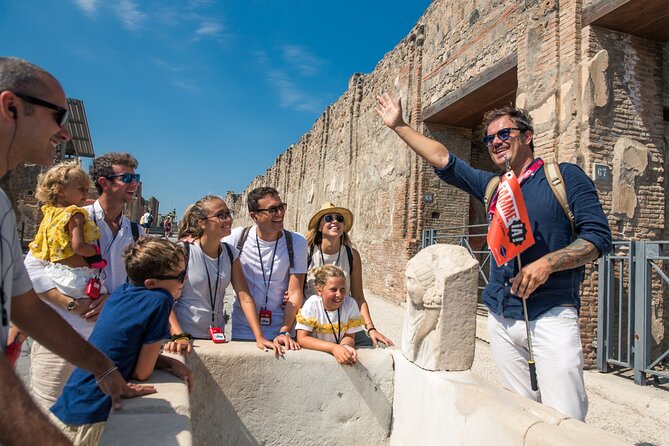
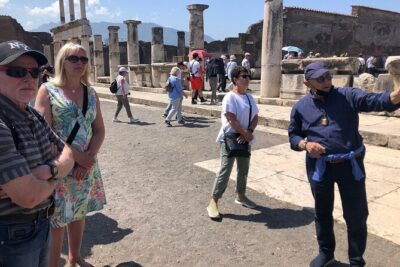
The guide’s job here is not to list facts like a textbook. It is to point out what you are looking at, explain how each area functioned, and show how the pieces connect. Without that guidance, Pompeii can feel like scattered stone. With it, you start to recognize streets, public spaces, and buildings that hint at how people lived day to day.
One practical bonus: if your group is larger than 10 passengers, you get headphones in Pompeii. That matters because Pompeii is open air, noise bounces around, and people stop to take photos. Headphones keep the commentary clear so you do not constantly ask the person next to you to repeat themselves.
The Forum and Temple of Jupiter: where politics, faith, and commerce met
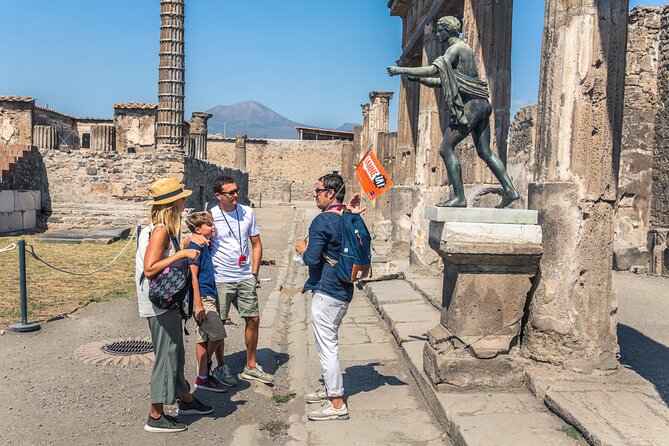
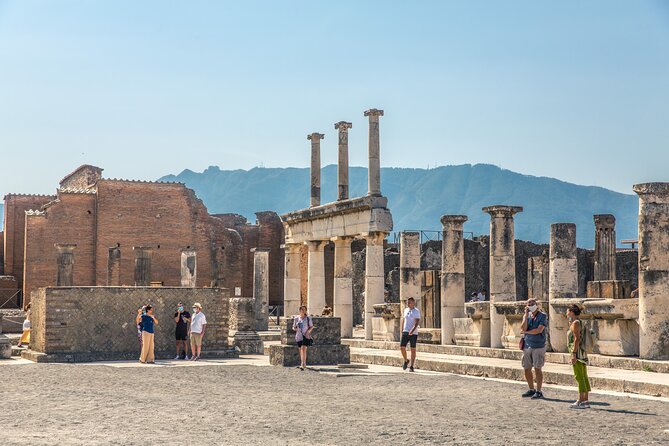
A key stop is the Civil Forum, described as the center of daily life and the focal point for major public activities. This is where you see the city’s “control room” in stone, with administration and justice, business management, trade activity like markets, and citizen worship all tied together.
On the north side, the Temple of Jupiter dominates the Forum. What makes it especially interesting is the way it was renovated after the colony was founded, and how it became a real Capitolium with statues of Jupiter, Juno, and Minerva. Even if you do not read every inscription, the guide’s explanation helps you understand why this spot mattered so much to the people of Pompeii.
Then comes the setting. Mount Vesuvius rises behind the Forum, so the scenery and the tragedy theme show up immediately. It is not just a view, it is part of the story: Pompeii was living in the shadow of a volcano.
If you have a downside here, it is simply time. Much of what makes the Forum fascinating happens in details, and the tour moves between highlights. If you like to linger, you may feel the pace a bit, but the upside is that you still cover multiple major zones in one half-day.
Macellum and the idea of imperial food culture
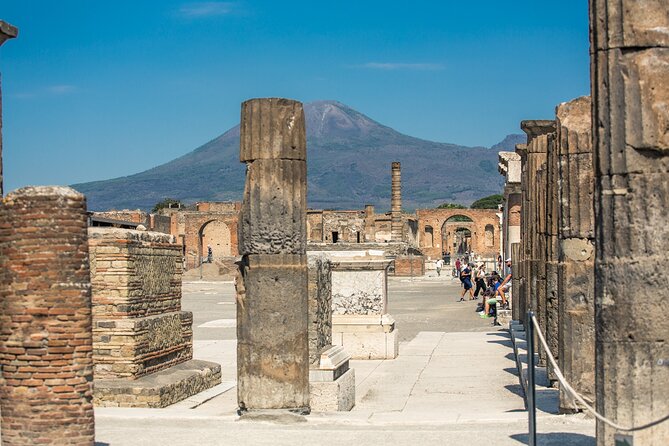
Next up is the Macellum, a marketplace area. The guide frames it as a tuff quadriporticus with an elevated hall for worship aligned with the entrance, plus niches on the side walls where you can see clues from the statue fragments. This is one of those Pompeii moments where architecture quietly tells you how power and everyday life mixed.
The Macellum also ties into the imperial cult, and the tour highlights that idea through references to statues and a room used for meetings of a sacred board. There is even mention of a masonry counter that may connect to fish being sold nearby. That kind of “how it worked” explanation is what turns a ruin into a place you can picture.
The practical takeaway for you is simple: when the guide points out these structures, slow down for a second and look around. Even if you only get a short stop, you will start noticing where people would have gathered, traded, prayed, and talked.
Via dell’Abbondanza: the main street that makes Pompeii feel alive
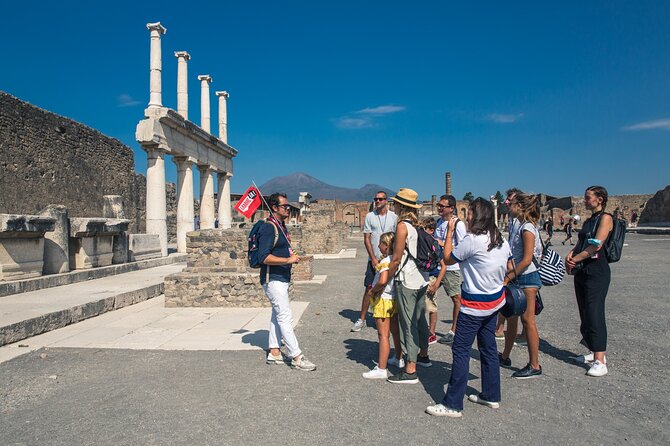
You then move to Via dell’Abbondanza, the ancient main street. It was a decumanus maximus, running east to west from the Forum toward Porta Sarno. In ancient times, it was crowded and noisy with shops, workshops, cafés, snack-bars, and places to eat and drink.
That is the best part of this stop: the guide gives you permission to see Pompeii as a functioning city, not a museum. You can imagine people moving through a commercial corridor, pausing for food, checking goods, and chatting at the edges of daily life.
The time here is short, around 10 minutes, so you cannot expect a deep read of every doorway. Instead, think of it as a “feel the city” stop. If you want a photograph, target the street perspective, then capture doorways or shop-fronts while the guide is explaining the street’s layout.
Our notebook holds other Sorrento peninsula outings in Sorrento if you are still weighing options.
- Sorrento Farm and Food Experience including Olive Oil, Limoncello, Wine tasting
★ 5.0 · 2,524 reviews





Stabian Baths: daily life, not just ruins
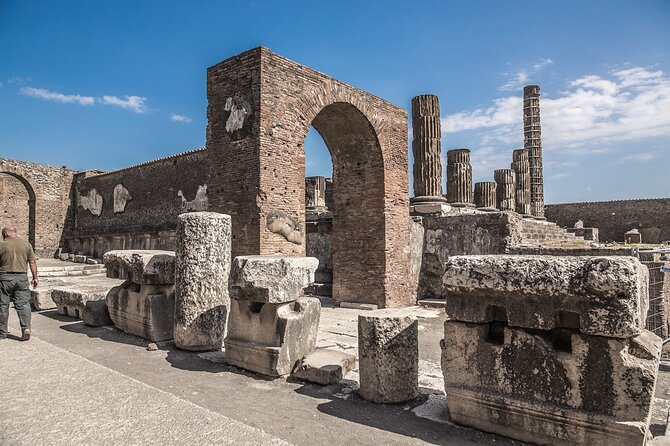
Behind the Temple of Jupiter, you visit the Stabian Baths, known as Terme Stabiane. The tour places them right after the founding of the veteran colony by General Silla, around 80 BC, and notes that the buildings were damaged by the earthquake of 62 AD.
What I like about this stop is that it makes Pompeii personal. Baths were routine. The guide explains the different zones, including men’s and women’s quarters with separate entrances, and the men’s area that included an apodyterium (dressing room), tepidarium (medium temperature baths), frigidarium (cold baths), and calidarium (hot baths).
You only get about 10 minutes here, so you will not walk through the full sense of scale. But it is still enough time to understand how a bath visit worked as a sequence. If you enjoy architecture that shows daily routine, this is one of the more satisfying highlights.
Wear shoes you trust on uneven stone. The baths area can include uneven ground and steps, and the quick stops mean you spend more time moving than studying.
Lupanar: the official brothel and the messy realism of graffiti
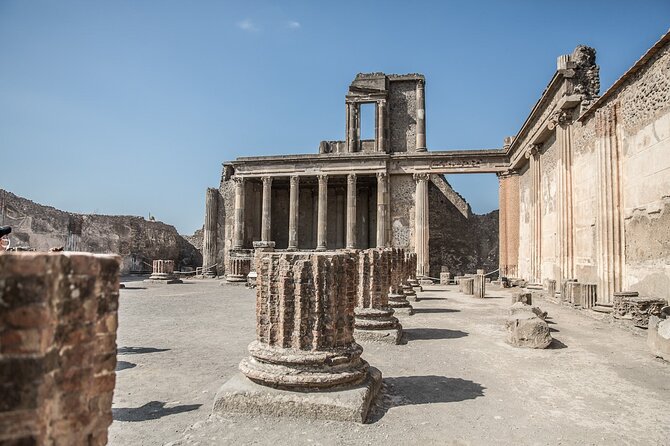
Then comes one of Pompeii’s most talked-about stops, the Lupanar. It is described as the most famous official brothel in Pompeii, located in a narrow side street near the city’s heart. The building is small and two-story, built of stone, with five rooms on the ground floor, each with built-in masonry beds.
What makes this stop so unforgettable is the mix of artwork and real human noise. The tour highlights well-preserved erotic frescoes above the doors, which likely functioned like a visual menu of services. It also points out the hundreds of graffiti left by visitors, giving a raw snapshot of social life and language among Roman plebeians.
The guide also connects the site to specific ownership. The building belonged to Quintus Poppaeus Sabinus of the Poppei family, with ties to the Empress Poppea Sabina, Nero’s second wife. That kind of detail helps you see the brothel not as a random scandal, but as a managed business within a larger urban economy.
A practical note: this is a quick stop, about 10 minutes. The conversation is often intense, and the subject can be uncomfortable for some. If that kind of topic is not your thing, know that the tour is structured to keep it short and move on.
House of the Faun and the Alexander Mosaic: luxury you can walk past
After the city-life stops, you reach the House of the Faun, one of the largest and most luxurious private residences. It occupies an entire block, and it is named after a bronze statue of a dancing faun found in the main atrium. The guide connects its Hellenistic influence and Roman architecture to the wealth of Pompeii’s elite.
The star is the Alexander Mosaic. The tour explains that it depicts the battle between Alexander the Great and Darius III of Persia. Even if you do not know the scene from memory, the guide’s framing helps you recognize why this mosaic became famous: it is art that signals status, taste, and cultural reach.
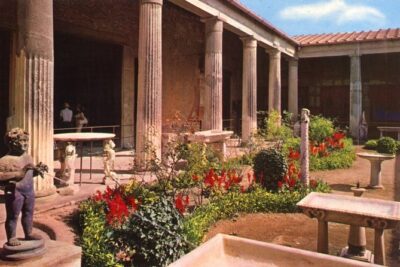
Then there are two peristyle gardens and intricate floor mosaics that show how carefully the wealthy arranged light, space, and decoration. This stop gives you a contrast to the Forum and street scenes. You get the sense that Pompeii included extreme differences in lifestyle, all within one city grid.
The drawback is timing again. With limited minutes, you might feel rushed around mosaic details. If you love art, I would plan to capture a few key shots and listen closely while the guide describes what you are seeing.
Basilica and Teatro Grande: order, justice, and performance
In the next set of highlights, you see the Basilica, described as the most sumptuous building of the Forum with an extension of about 1,500 square meters. The basilica’s space supported business and administration of justice. In other words, people came here to make decisions and settle disputes, not just to admire stone.
The Teatro Grande rounds out the experience. The large theater was built on a hill slope using the natural depression of the mountain to shape the auditorium, split into five sectors. The guide notes Greco-Roman tragedies performed on the stage.
This part of the tour is useful if you want Pompeii to feel broader than commerce and baths. It shows a city built for gathering, performance, and communal culture. Even with short timing, the guide helps you “read” the seating arrangement and the stage geometry.
Pacing, terrain, and what to plan so you enjoy it
Pompeii is famous, but it is also physically challenging. The tour covers multiple highlights and paths, and you will be walking over uneven stone with steps and inclines. You do not need to be an athlete, but you do need realistic expectations.
A few practical moves help a lot:
- Wear comfortable, grippy shoes. Sneakers with good traction beat sandals.
- Bring water. Food and drinks are not included, so you will want your own supplies.
- If you like photographs, be ready to capture quickly. The tour is timeboxed, often around 10 minutes per highlight.
- Consider the morning departure if possible. Cooler temps and fewer crowds make everything easier, especially when you are moving between stops.
Also, keep an eye on group logistics. The tour runs with a max of 29 people, and you are guided as one unit through the key zones. In several areas, you might feel tempted to lag behind for your own pace. That can make it harder to hear the guide or stay aligned for the next transfer.
Value check: what you pay for and who it fits best
At $90.70 per person and about 5 hours total, you are not just buying a ticket. You are buying a full day plan from Sorrento that includes:
- Round-trip transportation by air-conditioned coach
- Official guide time in Pompeii
- Skip-the-line admission access
- Admission to the Pompeii Archaeological Site
- Headphones in Pompeii when the group is larger than 10
That is good value for many people because Pompeii rewards context. The ruins are too big and too easy to misunderstand without a guide, and skipping the line is a real time saver. If you are short on time, a guided half-day lets you see more than you would likely manage solo.
This tour fits best if you:
- Want an organized Pompeii visit without planning every step
- Like guided explanations at real sites, not just in a museum room
- Are comfortable with moderate walking over uneven surfaces
- Prefer a group experience with structure, especially if it is your first time in Pompeii
If you are someone who needs long unstructured time in one spot, this might feel tight. The stops are designed for coverage, not lingering.
Should you book this Pompeii skip-the-line tour from Sorrento?
Yes, I think you should book it if you want a high-impact Pompeii visit with less friction. Skip-the-line entry plus coach comfort plus an official guide is a strong package, and the stop mix is smart. You get the Forum and Temple of Jupiter, then you move into street life, baths, the Lupanar, elite homes like the House of the Faun, and finish with civic and entertainment buildings like the Basilica and Teatro Grande.
I would only hesitate if you know you struggle with uneven, stepped terrain or you need lots of free time to wander without keeping pace with a group. In that case, you may enjoy a slower format more, even if it takes more time overall.
If Pompeii is the star of your Amalfi Coast trip and you want it organized, book this. Pick the earliest departure if you can, wear proper shoes, and you’ll come away with a Pompeii you can picture, not just one you have seen.
FAQ
How long is the Pompeii skip-the-line guided tour from Sorrento?
The tour runs about 5 hours (approx.).
What is included in the price of the tour?
The price includes round-trip air-conditioned coach transportation, an official guide in Pompeii, skip-the-line admission access to the Pompeii Archaeological Site, headphones in Pompeii for groups larger than 10 passengers, and a meeting point in Sorrento.
Does this tour include skip-the-line entry to Pompeii?
Yes. Skip-the-line access is included, and you head directly inside.
Where is the meeting point in Sorrento?
You meet at IAMME IA! – Gray Line Amalfi Coast, Piazza Torquato Tasso, 16, 80067 Sorrento NA, Italy.
How large is the group?
The tour has a maximum of 29 travelers.
Are food and drinks included?
No. Food and drinks are not included.
Is the tour wheelchair accessible?
The information provided notes that wheelchairs are not allowed, while strollers are okay. The tour says most travelers can participate, but Pompeii involves uneven terrain.
Also Written Up in Sorrento, Sorrento Peninsula Outings




The Rest of Our Pompeii Site Visits in Sorrento


Not quite the day you had in mind? The rest of our Sorrento write-ups sit below
- Amalfi Coast Kayak Tours from Marina del Cantone★ 5.0 · 167 reviews
- Amalfi Coast Small Group Day Boat Tour with Limoncello Onboard★ 4.5 · 169 reviews
- Capri Boat Tour from Sorrento with Limoncello★ 5.0 · 170 reviews
- Mt Vesuvius and Pompeii Tour by Bus from Sorrento★ 4.5 · 170 reviews
- Classic Amalfi Coast Tour★ 5.0 · 170 reviews
- Round-Trip Ferry Ticket from Salerno to Amalfi and Positano★ 3.7 · 173 reviews
- Authentic Pasta & Pizza Cooking Class with Sorrento Coast Pickup★ 5.0 · 175 reviews
- Private Sunset Boat Tour with Prosecco from Sorrento★ 5.0 · 176 reviews
- Capri Private Boat Tour★ 5.0 · 176 reviews
Pompeii Archaeological Site, top to bottom.
 ★ 4.8Pompeii: Entry Ticket and Guided Tour with an ArchaeologistFrom $3519,459 reviews
 ★ 4.2Pompeii: Entry Ticket with Optional Audio GuideFrom $2612,360 reviews
 ★ 4.8Pompeii: Small Group Tour with an ArchaeologistFrom $4012,264 reviews
 ★ 4.3From Naples: Pompeii Ruins & Mount Vesuvius Day TourFrom $12011,459 reviews
 ★ 4.6From Rome: Pompeii, Amalfi Coast, and Sorrento Day TripFrom $797,031 reviews
 ★ 4.6From Rome: Pompeii, Amalfi Coast and Positano Day TripFrom $996,620 reviews
★ 5.0Pompeii Small Group Tour with an ArchaeologistFrom $356,593 reviews
 ★ 4.5Pompeii, Amalfi Coast and Positano Day Trip from RomeFrom $1016,250 reviews