
Reviewed · POMPEII ARCHAEOLOGICAL SITE
Pompeii and Mount Vesuvius Small Group Tour
Two ancient worlds in one hard hike. You get the story of the eruption in scale, not as separate stops, with a small group plan that squeezes Pompeii ruins and a crater-trail climb into one day. It is the kind of tour where the guide helps you read the city, then shows you the mountain that erased it.
I really like the archaeologist-led Pompeii time. Stops like the Forum area and major houses work fast because you get explanations tied to what you are looking at. I also like that the Mount Vesuvius half includes a licensed hiking guide plus a plan for changing weather.
One heads-up: the Vesuvius walk has steep bits, and conditions can change fast. If the crater trail is closed, your plan may switch to Herculaneum instead.
In This Review
- Key Things to Know Before You Go
- Why This Combo Tour Makes Sense
- Meeting Point, Group Size, and the Pace of the Day
- Pompeii With an Archaeologist: What You Learn Fast
- Porta Marina to the Forum: The Start That Sets the City Map
- Foro de Pompeya, the ancient main square
- Pompeii’s main street
- The Forum Granaries, Menander, and Bathing Life
- Granaries of the Forum
- House of Menander
- Stabian Baths (Terme Stabiane)
- Lupanar, the most famous brothel in Pompeii
- Big Houses and Theaters: Pompeii’s Power and Leisure
- House of the Faun
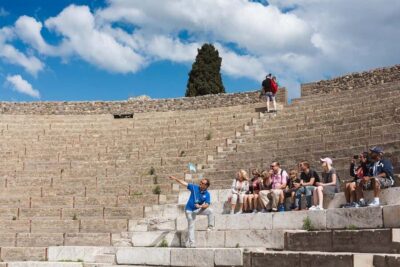
- Teatro Piccolo and Teatro Grande
- The Vesuvius Climb: What the Hike Really Demands
- Crater Views Over Naples, Capri, and the Sorrento Coast Edge
- When Weather Changes the Plan: Herculaneum Instead
- Transportation and Break Time: How You Avoid Feeling Rushed
- Price and Value: Is $119.77 Fair for What You Get?
- Who This Tour Fits Best (And Who Should Skip It)
- What to Pack for a Better Pompeii and Vesuvius Day
- Should You Book This Pompeii and Mount Vesuvius Tour?
- FAQ
- Where do we meet for the tour?
- How long is the Pompeii and Mount Vesuvius tour?
- Is the tour in English?
- What is included in the price?
- What is not included?
- How difficult is the hike to the crater?
- What happens if Vesuvius is closed?
- Can children join?
- Is free cancellation available?
Key Things to Know Before You Go
- Small group size (max 14) means less waiting around and more time actually looking.
- Pompeii is guided for 2 hours by an archaeologist, so you do not just wander.
- Crater-trail access has real climbing: expect steps at the start and steep uphill near the top.
- Views depend on weather, but the guide keeps the science and story going even when visibility is poor.
- If Vesuvius is closed, the tour includes Herculaneum as the backup.
Why This Combo Tour Makes Sense
Pompeii is not just impressive, it is confusing at first. Streets twist, buildings overlap, and each corner feels like it should come with a label. A guided format fixes that problem fast. You walk through key areas in a logical sequence and you learn what each site meant in daily life: gathering places, baths, homes, and even entertainment.
Then you go straight from the ruins to the volcano. That matters. When you stand on the crater edge, you can connect the human details you just saw with the physical reality of how the eruption worked and why the region changed. Even if clouds roll in, you still get a clear explanation of what you are looking at, and why Pompeii ended up the way it did.
Our reviewers also walked through other Pompeii site visits in Pompeii.
- Pompeii Small Group Tour with an Archaeologist
★ 5.0 · 6,593 reviews - Discover the Ancient Ruins of Pompeii: Day Trip from Rome
★ 3.5 · 2,247 reviews - Pompeii and Herculaneum Small Group Tour with an Archaeologist
★ 5.0 · 1,350 reviews - Skip the Line Guided Tour of Pompeii led by an Archaeologist
★ 5.0 · 703 reviews
Meeting Point, Group Size, and the Pace of the Day
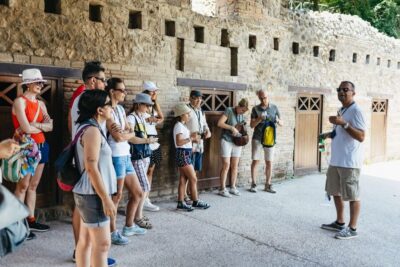
This is a small group operation. The Pompeii ruins portion runs with an archaeologist for a group up to 20 people, and the transportation is set up for small groups (minivan capacity up to 14). Practically, that means you are less likely to get lost in crowds and more likely to keep moving.
You meet at Via Villa dei Misteri, 2, 80045 Pompei NA, and the day ends back at the same place. The schedule is built around time-efficient viewing. Pompeii is not presented as a slow museum stroll. It is a guided circuit, with short stops that point you to the big moments.
If you like to linger, you might feel a little rushed in the ruins. The trade-off is you also get Vesuvius that same day, including the crater-trail hike.
Pompeii With an Archaeologist: What You Learn Fast
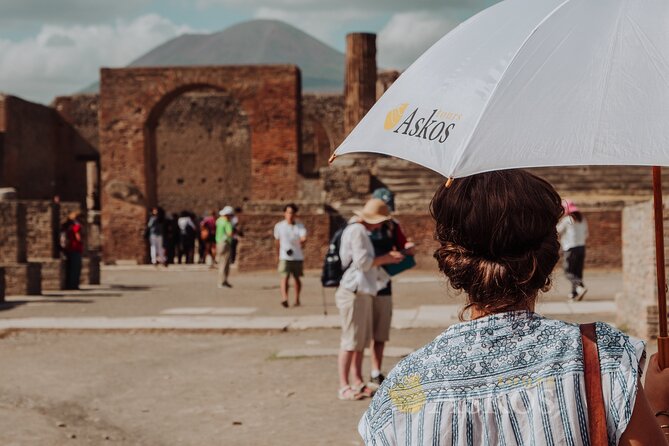
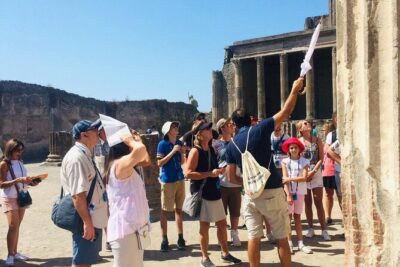
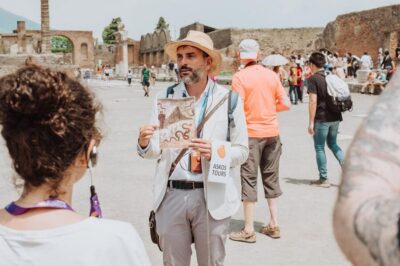
You start at the Pompeii entrance area called Porta Marina Superiore, with your guide holding an Askos Tours sign. The Pompeii portion includes a 2-hour archaeologist guide, which is the heart of the value. Without a guide, a lot of Pompeii feels like “oh, ruins.” With one, it turns into a functioning city you can map in your head.
And the guides are not just walking you from point to point. From the names that show up on this tour, you may be with archaeologists and expert interpreters like Raffaela, Teresa, Anna Sorrento, Sergio, Guilia, Antonella, or Daniela, and on the Vesuvius side you may meet guides like Mario. People consistently praise how the explanations tie to everyday life, layout, art, and the very human stories behind the stones.
Here is how the Pompeii route lands, in plain terms.
Porta Marina to the Forum: The Start That Sets the City Map

Your guided time begins with the main entrance at Porta Marina Superiore, so you get oriented early. From there you head toward the civic core.
Foro de Pompeya, the ancient main square
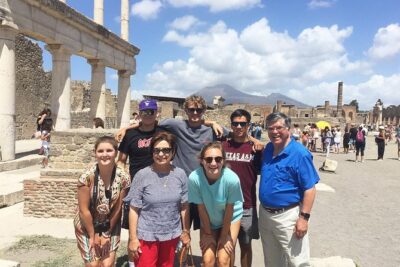
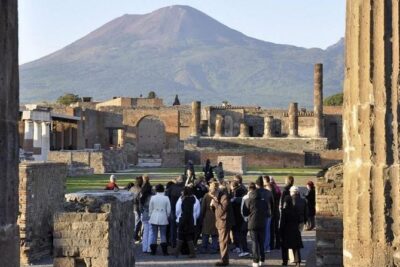
You get a quick look at Foro de Pompeya, Pompeii’s main square. In 10 minutes, you are not doing a full deep reading, but the guide gives you the bearings: where people gathered, where power showed itself, and why this space mattered.
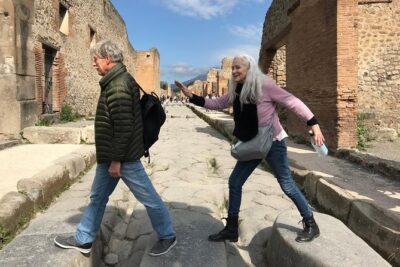
Pompeii’s main street
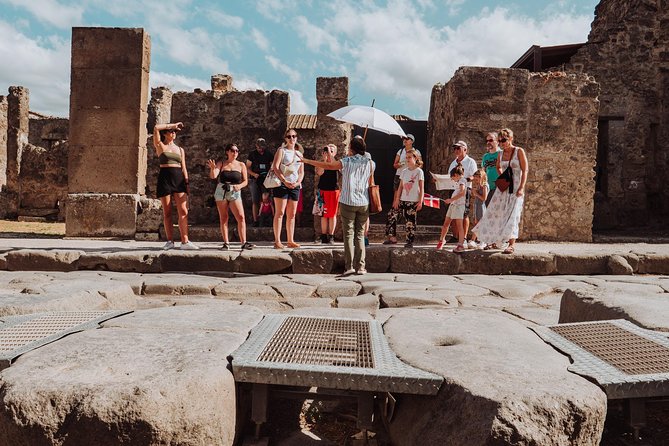
Then you walk through the main street area. This is one of those “speed stops” that still pays off. The goal is to help you understand how movement shaped the city. You start to see Pompeii as a place people moved through daily, not a collection of isolated rooms.
If you are the type who likes to take photos, you will appreciate the structure here. The guide keeps you moving between “this is what it is” moments instead of letting you drift into random spots.
Kept in the same folder as this one, Herculaneum and Vesuvius visits in Pompeii.
The Forum Granaries, Menander, and Bathing Life
Once you are in the Forum zone, the tour uses short visits to point you at key themes.
Granaries of the Forum
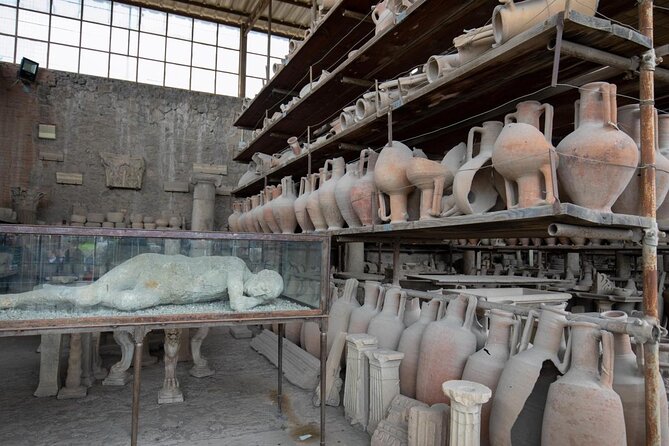
The Granaries of the Forum get a stop that is brief but memorable. You see marble tables and bathing features connected to fountains at house entrances, plus casts of eruption victims and even a dog and a tree. That mix can feel heavy, but it is also the point. Pompeii is a mix of public systems and private tragedy, and you see both.
House of Menander
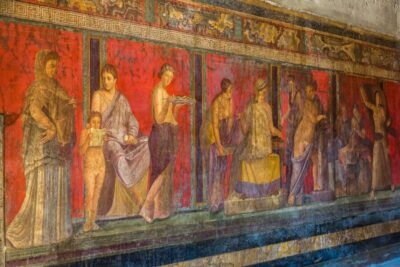
You then visit the House of Menander, known for being one of the richest houses, with architecture and decoration that shows how status was displayed through space and detail. A 15-minute stop here can feel short, but it is timed well. You are not stuck for an hour in one home. You get one strong example of elite life, then you move on to the everyday city.
Stabian Baths (Terme Stabiane)
At the Stabian Baths, you learn that baths were not just for hygiene. They were social infrastructure. This complex is described as the oldest thermal complex in the city, and that alone gives you a reason to pay attention.
Bath stops also work well in a time-saving tour. You can understand the layout in minutes because the functions are obvious: changing, bathing, and meeting.
Lupanar, the most famous brothel in Pompeii
You visit the Lupanar, the famous brothel site. It is not everyone’s favorite topic, but it is part of how Pompeii tells the full story of the city. You learn how commerce and sexuality were woven into daily life, and why Roman entertainment was not just theater and festivals.
If you prefer lighter topics, this is the stop that might feel like a jolt. It is also the stop where a clear guide explanation makes the difference between “shock” and understanding.
Big Houses and Theaters: Pompeii’s Power and Leisure
After that, the route shifts from civic and commercial life toward private space and public entertainment.
House of the Faun
The House of the Faun is one of the largest and most impressive private residences in Pompeii. Seeing a big house on a short tour is a good way to grasp scale. You start to notice how architecture and courtyards created status, airflow, and social space.
Teatro Piccolo and Teatro Grande
You get a look at the Teatro Piccolo and then the Teatro Grande, Pompeii’s most important theater. The time windows are small, but the value comes from comparison. You see how Pompeii handled leisure and public gatherings, and why theaters were central to the city’s rhythms.
Theater stops also help you emotionally connect with what you saw in the homes and baths. People were not living only for work. They lived with culture, performance, and public community moments.
The Vesuvius Climb: What the Hike Really Demands
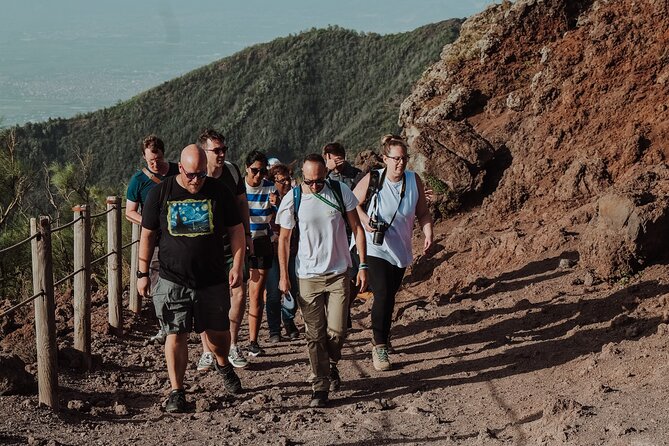
Now we get to the part people remember long after they forget the details. Mount Vesuvius is not presented as a casual walk. The tour includes a drive to the crater area, then you hike.
A few specifics matter:
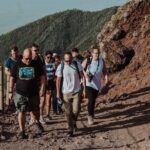
- You have the first 30 minutes of step walking to reach the crater area.
- The last 500 meters include a very steep uphill walk.
- Closed-in shoes are essential, and the tour is listed for people with moderate physical fitness.
So if you are thinking, I can do stairs but I do not like hills, this is where you decide. The hike is described as doable, and guides often pace the group. But you should still plan your energy. Heat, wind, and loose volcanic ground can wear you down.
From the guide approach, people report strong encouragement on the climb. If you know you get slow, you will likely appreciate that style. The guides focus on keeping everyone moving at a manageable pace.
Crater Views Over Naples, Capri, and the Sorrento Coast Edge
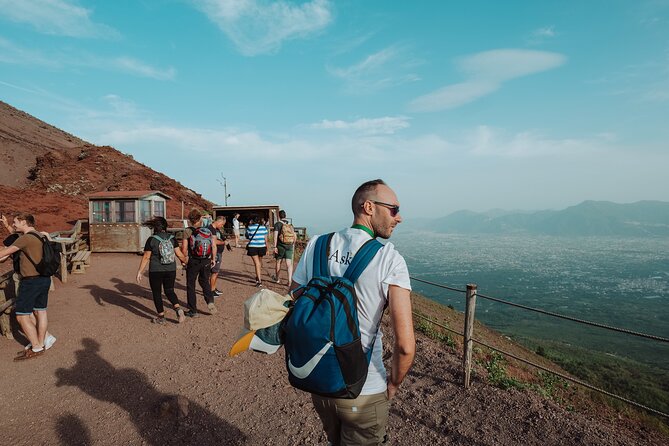
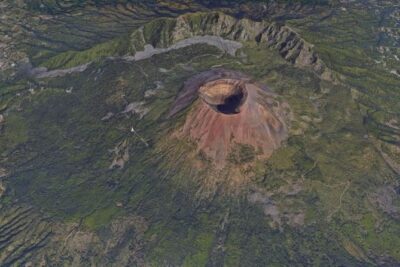
When the weather cooperates, the payoff is big. From the crater trail and the top, you can see the Bay of Naples, Capri, Ischia, and the edge of the Sorrento coast, plus more.
And the crater can still show slight activity. The tour description notes that the crater still smokes slightly, so you might catch that cue when you get close. Even when visibility is poor, your guide explains what you would be seeing and why the geography matters.
One of the practical surprises on this tour is that your guide does not treat the summit as just a photo stop. People mention that there is often a volcanologist or expert at the top who explains the eruption mechanism. That turns the whole day into something more than sightseeing.
When Weather Changes the Plan: Herculaneum Instead
Vesuvius weather can turn fast. Fog, rain, and closure decisions can happen once you are already on the mountain.
The tour handles this in a clear way: if Vesuvius is not accessible due to force majeure, you visit Herculaneum instead. That matters because it protects your day from feeling like a cancellation that leaves you stranded.
In practice, people report that the guides pivot quickly and keep the experience meaningful, even when crater visibility is poor. So if you are worried about the weather, understand this: the plan can change, but the tour is built to keep you exploring.
Transportation and Break Time: How You Avoid Feeling Rushed
This tour uses a modern minibus for transportation from Pompeii and back. That is a big deal because it removes the hassle of getting to the crater trail access point on your own.
Food is not included. So you need a plan for lunch and snacks. Many people build in a quick stop around the transfer time, and there are places nearby where you can grab sandwiches or drinks. If you want to buy anything at the top, keep some cash in mind, since there are shops and a refreshment stand.
What you should not do is arrive thinking you will be able to eat slowly and still make the hike on a relaxed timeline. This is a full-day rhythm. If you want a more leisurely pace, you might prefer separate Pompeii and Vesuvius tours.
Price and Value: Is $119.77 Fair for What You Get?
At $119.77 per person, this is not a budget stroll, but it is also not “pay for nothing.” The value comes from the combination of guided time and guided logistics.
You get:
- A 2-hour Pompeii guide by an archaeologist (small group)
- Mount Vesuvius admission fees included, with the Vesuvius entry ticket listed at 11.00 euros
- Transportation by minibus from Pompeii and back
- A licensed hiking guide for the Vesuvius portion
What you do not get:
- Food and drinks
So the money is paying for interpretation plus transport plus the practical need for an expert on the hike. In my view, that is where the savings happen. You save time on routing, you save energy on navigation, and you get context so you do not leave Pompeii feeling like you missed the plot.
If your goal is only photos and you are confident navigating Pompeii on your own, you might find cheaper options. But if your goal is understanding why the ruins look the way they do and how the volcano connects to the city, this price starts to make sense.
Who This Tour Fits Best (And Who Should Skip It)
This works best for you if:
- You want both Pompeii and Vesuvius in one day
- You like getting a guided story instead of wandering ruins alone
- You are comfortable with a moderate fitness hike and steep uphill sections
- You prefer small-group pacing rather than big-bus chaos
You should think twice if:
- You have mobility or walking limitations. It is explicitly not recommended for mobility issues.
- You dislike uneven ground or steep stairs. Vesuvius requires it.
- You want a long, slow Pompeii day with extra museum time. This route is fast by design.
For families, it can work in the right season and with the right expectations. The hike can be tiring, but guides are used to adapting pace to mixed fitness levels.
What to Pack for a Better Pompeii and Vesuvius Day
Bring the practical stuff and you will enjoy the day more.
- Comfortable shoes. Vesuvius needs closed-in support for steep, loose ground.
- Sunglasses and sunscreen for summer brightness.
- In cooler or windy conditions, consider a light layer. People report it can get chilly at the top.
- Water and snacks on your terms, since food and drinks are not included.
- A little cash if you want souvenirs or a drink at Vesuvius.
Also, if weather looks iffy, keep your expectations flexible. The crater views are the goal, but the learning and the volcano context are still the point, even if visibility is limited.
Should You Book This Pompeii and Mount Vesuvius Tour?
Book it if you want a guided, efficient day where Pompeii becomes understandable and the volcano climb has a clear payoff. The archaeologist-led Pompeii time is the best part for most people, and the Vesuvius guide helps the hike feel less like a chore and more like a lesson.
Skip it if you hate steep uphill walking or you need a slow pace with lots of downtime. Pompeii is big, and this format trades lingering for coverage plus a crater hike.
If you are on the fence, my advice is simple: if you can handle a real climb and you want the eruption story in one continuous experience, this is a solid value for $119.77.
FAQ
Where do we meet for the tour?
You meet at Via Villa dei Misteri, 2, 80045 Pompei NA, Italy. The tour ends back at the same meeting point.
How long is the Pompeii and Mount Vesuvius tour?
The duration is about 8 hours.
Is the tour in English?
Yes. The tour is offered in English.
What is included in the price?
Included are a 2-hour archaeologist guidance at Pompeii ruins, transportation by modern minibus, Pompeii Express and Mount Vesuvius admission fees, and a licensed hiking guide for Mount Vesuvius.
What is not included?
Food and drinks are not included.
How difficult is the hike to the crater?
You should have moderate physical fitness. The route includes step walking early on, plus a very steep uphill walk for the last 500 meters. Closed-in shoes are essential.
What happens if Vesuvius is closed?
If Vesuvius is not accessible due to force majeure, the tour includes a visit to Herculaneum instead of Vesuvius.
Can children join?
Children under 6 years old are not allowed.
Is free cancellation available?
Yes. You can cancel for a full refund up to 24 hours in advance of the experience start time.
Herculaneum and Vesuvius Visits in Pompeii That Made the Same Shortlist

The Rest of Our Pompeii Site Visits in Pompeii

Not quite the day you had in mind? The rest of our Pompeii write-ups sit below
- Ancient Pompeii Private Tour: Skip the Line & Kid-Friendly Option★ 5.0 · 167 reviews
- Pompeii 2-hour Private Tour with an Archaeologist-Ticket included★ 5.0 · 181 reviews
- Pompeii Private Tour with an Archaeologist Guide★ 5.0 · 184 reviews
- Mount Vesuvius Tour from Pompeii Led by an Expert Guide★ 5.0 · 185 reviews
- Stories of Pompeii: Small Group tour with archeology expert guide★ 5.0 · 191 reviews
- Pompeii: 2 Hour Private Tour with an Archeologist Guide★ 5.0 · 214 reviews
- Pompeii and Mount Vesuvius Small Group Tour★ 4.5 · 233 reviews
- Pompeii Guided Group Tour with Entry Ticket and Archaeologist★ 4.5 · 269 reviews
- Pompeii: Guided Small Group Tour Max 6 People with Private Option★ 5.0 · 269 reviews
Pompeii Archaeological Site, top to bottom.
 ★ 4.8Pompeii: Entry Ticket and Guided Tour with an ArchaeologistFrom $3519,459 reviews
 ★ 4.2Pompeii: Entry Ticket with Optional Audio GuideFrom $2612,360 reviews
 ★ 4.8Pompeii: Small Group Tour with an ArchaeologistFrom $4012,264 reviews
 ★ 4.3From Naples: Pompeii Ruins & Mount Vesuvius Day TourFrom $12011,459 reviews
 ★ 4.6From Rome: Pompeii, Amalfi Coast, and Sorrento Day TripFrom $797,031 reviews
 ★ 4.6From Rome: Pompeii, Amalfi Coast and Positano Day TripFrom $996,620 reviews
★ 5.0Pompeii Small Group Tour with an ArchaeologistFrom $356,593 reviews
 ★ 4.5Pompeii, Amalfi Coast and Positano Day Trip from RomeFrom $1016,250 reviews