
Reviewed · POMPEII ARCHAEOLOGICAL SITE
Pompeii: Guided Small Group Tour Max 6 People with Private Option
Pompeii becomes easier when you walk it with a plan. I like the small-group size (max 6) because it keeps the pace human, questions quick, and the stories clear. I also love the skip-the-line setup, so you spend your energy on ancient streets, not waiting in the sun. One drawback to plan for, though, is time, the tour clocks in around 2 hours 30 minutes, so you will see the big highlights, not every single corner of the site.
You can also match it to your day with a morning or afternoon departure, and there is an upgrade to a private tour if you want more control over questions and pacing. The tour runs in several languages (English plus others), and since Pompeii is an ongoing excavation site, the exact route can shift depending on what the archaeologist is handling that day.
In This Review
- Key highlights to know before you go
- Pompeii in 2.5 hours, and why that time window works
- Small-group pacing (max 6) and what it changes for you
- Skip-the-line entry and choosing a good time of day
- The Pompeii route: forum, theatre, baths, and key villa houses
- Forum of Pompeii: public life in stone
- Pompeii theatre: entertainment and social rhythm
- Roman bath house and suburban baths: hygiene, status, and routine
- Major villa houses: how households actually worked
- Mt Vesuvius viewpoint: the geography payoff
- Guides that turn ruins into daily life (Mario, Francesca, Luigi, Imma, Mariana)
- Price and value: what $168.17 buys you (and when private makes sense)
- What’s included, what’s not, and what to bring
- Who should book this Pompeii tour
- Should you book: my practical take
- FAQ
- How long is the Pompeii guided tour?
- What is the group size?
- Is a private tour available?
- Does the tour include skip-the-line tickets?
- What stops and highlights are included?
- Is food included?
- What language options are available?
Key highlights to know before you go
- Max 6 people means you get real back-and-forth, not a loud scramble for attention
- Skip-the-line tickets are included, plus admission covers major areas you will visit
- Expert archaeologist-style guidance ties buildings to daily life in 79 AD
- Forum, Roman bath house, and Pompeii theatre are built into the route, not optional add-ons
- Major villa houses like the House of Menander and House of Julia Felix help you understand how households worked
- Mt Vesuvius viewpoint adds the big-picture geography at the end
Pompeii in 2.5 hours, and why that time window works
Pompeii is huge, and it can feel like a lot, fast. The streets are laid out, but the meaning can be fuzzy if you just wander from doorway to doorway. This kind of guided tour is valuable because it gives you a tight loop of the most important areas, with explanations that connect the dots.
The best part of the 2.5-hour format is that it fights fatigue. Even in cooler months, Pompeii usually feels warm because you are walking through open-air spaces and sunlit stone. A shorter tour also helps you keep the experience from turning into a blur. You leave with a clear mental map, then you can decide if you want extra time on your own later.
Just know the tradeoff up front: you will not see every preserved house, every niche, or every room. Instead, you get a curated set of major stops that are designed to give you the broad “how did they live” picture. If you are the type who likes to linger, take photos for long minutes, or read every sign, you might want to plan a longer self-guided visit after the tour.
Also, Pompeii is still being excavated. That means there can be day-to-day changes, depending on the archaeologist’s duties. That is normal here, and it is actually a sign the site is alive and working, not frozen in time.
Our reviewers also walked through other Pompeii site visits in Pompeii.
- Pompeii Small Group Tour with an Archaeologist
★ 5.0 · 6,593 reviews - Discover the Ancient Ruins of Pompeii: Day Trip from Rome
★ 3.5 · 2,247 reviews - Pompeii and Herculaneum Small Group Tour with an Archaeologist
★ 5.0 · 1,350 reviews - Skip the Line Guided Tour of Pompeii led by an Archaeologist
★ 5.0 · 703 reviews
Small-group pacing (max 6) and what it changes for you
A max group of 6 people may sound like a small detail, but it changes your day. With fewer people, you can actually hear what matters. Explanations about everyday life, household routines, and how certain spaces were used land better when you are not competing with a crowd.
It also matters for movement. Pompeii has bottlenecks, especially near major areas like the forum zone or popular villa entrances. A guide can manage timing so you are not stuck for long periods, while still keeping things comfortable. And because you have a smaller group, you are more likely to get answers to your specific questions, like why certain rooms existed or what a feature meant in daily life.
If you prefer more control, there is a private tour upgrade. That can be a smart option if you are traveling with someone who needs a slower pace, if you have mobility constraints that make crowd navigation stressful, or if you want the guide to slow down at the parts you care about most.
For solo travelers, this setup can be a relief. You still get expert guidance, but you are not stuck in a big group where you spend half the tour trying to hear and the other half trying to stay oriented.
Skip-the-line entry and choosing a good time of day
This tour includes skip-the-line entry, and that is not just a convenience line item. Pompeii lines can eat hours, and wasting daylight here is a real problem. When you are ready to start, you want to start, period.
You also have the choice of tour timing, morning or afternoon. That matters because Pompeii’s open-air layout makes the weather a major character in your itinerary. Morning tours often feel more manageable for walking, while afternoon tours can work well if you want a slower start to your day and can handle warmer temperatures.
The tour uses a mobile ticket, which tends to be straightforward. You also meet at a specific address near Via Villa dei Misteri, 80045 Pompei NA, Italy, and the tour ends back at the meeting point. That round-trip structure means you are not re-routing yourself through the city afterward, which helps on busy days.
One practical point: bring a hat and water if you can. Pompeii is exposed. In guidance styles shared by guides like Maria, hot-weather awareness shows up in how they pace stops, and that is exactly what you want from a good guide.
The Pompeii route: forum, theatre, baths, and key villa houses
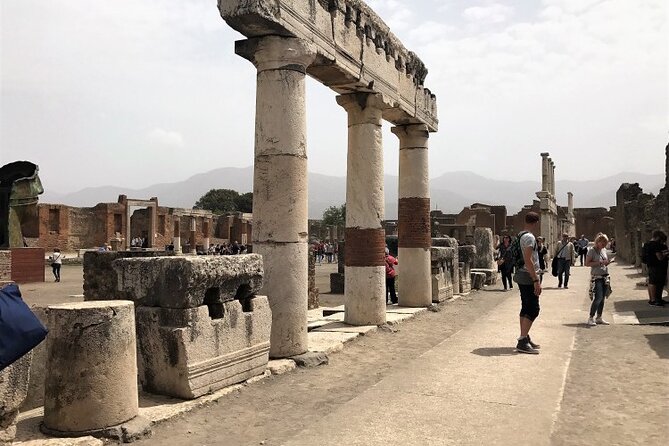
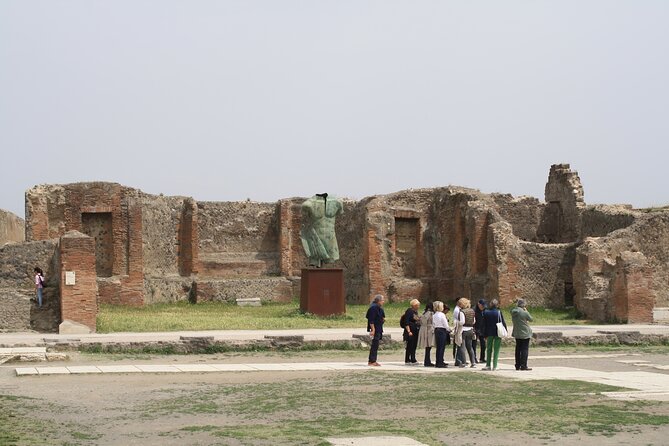
The route is built around a simple idea: if you understand the public spaces and then the household spaces, Pompeii makes sense fast. The tour covers the main highlights in about 2.5 hours, including the Forum, Pompeii theatre, and a Roman bath house.
Forum of Pompeii: public life in stone
The Forum of Pompeii is where you understand the city as a civic machine. This is not just a pretty square of ruins, it is where public life happened, where people gathered, and where power and routine were on display. A good guide helps you read the layout so you can imagine what it was doing for residents day to day.
Pompeii theatre: entertainment and social rhythm
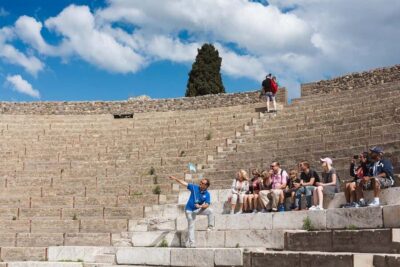
Next, the Pompeii theatre helps you understand leisure and community culture. Even if you are not a “theatre person,” it still tells you something about who sat where, how crowds moved, and what kinds of gatherings mattered. The guide’s job here is to connect the structure to human behavior, not just describe stonework.
The same shortlist carries more private tours in Pompeii.






Roman bath house and suburban baths: hygiene, status, and routine
The route includes Roman bath house elements, plus suburban baths as part of the wider highlight set. Baths were about more than washing. They were social spaces, places for conversation, and part of daily routine for many people. If you want Pompeii to feel like real life, baths are a huge clue, because you are seeing how people spent time.
Major villa houses: how households actually worked
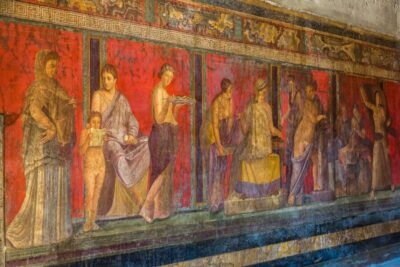
Pompeii is famous for its villas and house interiors, and this tour includes several key ones to help you build a mental picture of daily domestic life. Here are the notable houses and spaces that show up on this tour style:
- House of Menander
A standout for decorative and lifestyle clues. This type of house helps you see how wealth and taste expressed themselves in daily surroundings.
- House of the Gladiators
As the name suggests, it gives you a path into how entertainment and identity showed up in art and design.
- House of Julia Felix
This is one of the named stops, and it is a strong anchor for understanding household structure. You get a clearer idea of rooms, function, and flow.
- House of Loreius Tiburtinus
A useful stop for the broader “what did people notice and prioritize” approach that guides use here.
- House of Sallust
Another named stop, and one that typically stands out for how it frames the idea of prosperity and public image.
- House of the Tragic Poet
Great for thinking about how art and storytelling lived side by side with work and home routines.
- House of the Vettii and Lupanar
This part helps you understand the mixed reality of ancient life, not just the polite tourist version. You see how everyday society included very different spaces and purposes.
- Temple of Isis
A religious stop that adds spiritual context, helping you see how belief systems shaped daily life.
- Temple and baths zones as a pair
When these sit near each other in your route, you start to see the city as connected systems, public, private, and spiritual.
One thing to watch: because Pompeii is excavated in real time, not every doorway or corner is always accessible in the same way. That is why it is smart to stay flexible. Your guide can often adapt the order while still keeping the most important landmarks covered.
Mt Vesuvius viewpoint: the geography payoff
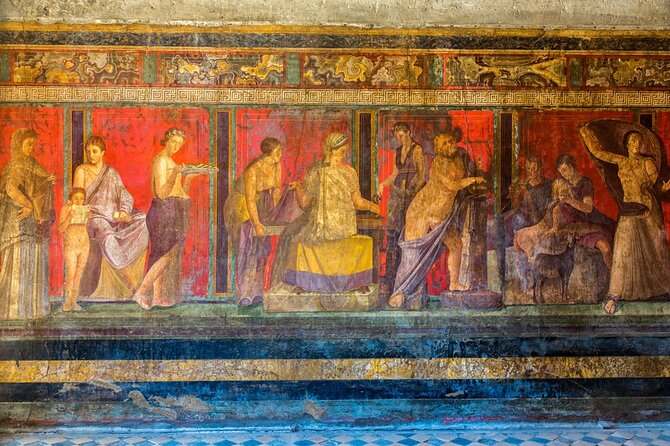
By the time you reach the Mt Vesuvius view, you usually have enough context to appreciate what you are looking at. Earlier stops explain daily life. The Vesuvius viewpoint then puts the city back into its setting, the volcano that shaped the story of Pompeii forever.
This is one of those “small added time, big mental impact” moments. Without it, Pompeii can feel like a museum of rooms. With it, it feels like a real place with a real environment, close enough to disaster that it shaped everything.
If you are visiting with kids or first-time visitors, this viewpoint can be the easiest part to connect to. It is also a strong end marker, the moment you feel like the tour gave you the full arc: life, city, public rhythm, and then the landscape.
Guides that turn ruins into daily life (Mario, Francesca, Luigi, Imma, Mariana)
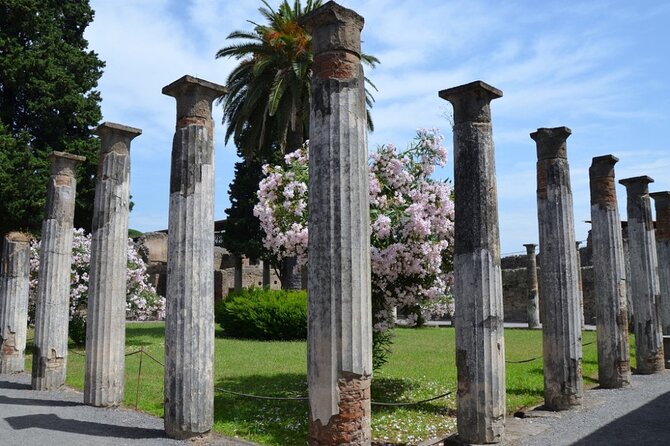
The tour’s value hinges on the guide style. And the guides attached to this experience often get high praise for doing exactly what you want in Pompeii, making the site readable.
You will notice names showing up in the guide feedback that reflect different personalities but consistent strengths. For example, Mario is praised for taking people to places like bath houses and the theatre, then explaining what Roman culture looked like in 79 AD. Francesca and Carla come up for being friendly, pleasant, and able to give a digestible account, so you are not overwhelmed by details.
Luigi is noted for moving through the ruins with ease and sharing stories that make the place feel less like stone and more like people. Mariana gets credit for pointing out details you might otherwise miss, with professional, calm teaching. Imma is praised for strong English and excellent knowledge over a 2.5-hour highlights route.
One detail that stands out as practical is heat management. Maria is described as checking for water and hats and finding shade where possible. That is not a lecture topic, but it makes a real difference. If you want a Pompeii day that stays enjoyable, you want a guide who plans for comfort, not just facts.
Also, the small group setting helps the guide do this well. When you have fewer people, it is easier to keep everyone together while still allowing short pauses and question moments.
Price and value: what $168.17 buys you (and when private makes sense)
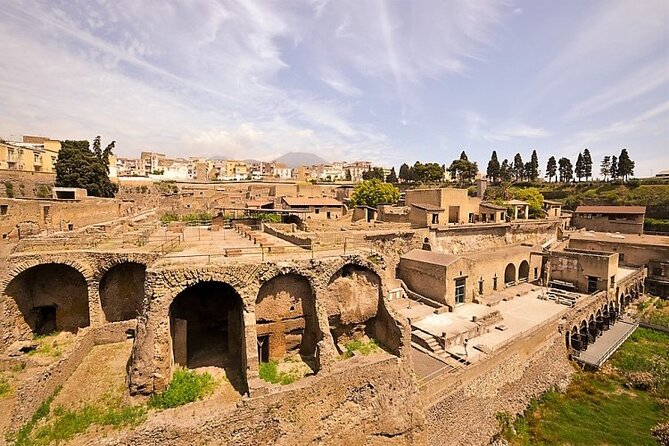
At $168.17 per person, you are paying for three main things: a pro expert guide, skip-the-line access, and admission coverage that aligns with a highlight route. You are also buying a “no wasted time” structure that helps on a site where delays and heat can quickly drain your day.
That price can feel steep if you are comparing it to a self-guided ticket only. But Pompeii punishes slow planning. A guide’s time saves you from aimless wandering, helps you avoid missing major areas, and adds meaning that you cannot always get from signs. In other words, you are paying to convert ruins into understanding.
The small-group format adds value. It is not just about comfort, it is about learning quality. In a larger group, explanations often become one-direction and fast. Here, the size supports better pacing and question time.
A private option can be worth considering if:
- you are traveling as a pair or family who wants a slower, more personal pace
- you care deeply about architecture or daily life and want extra Q and A
- you want the guide to tailor where to linger
But if you just want the best essentials without overthinking your schedule, the small group option is already strong value.
Also, this kind of tour tends to be booked well in advance, with an average booking window of about 55 days. If your dates are fixed, it is smart to plan early rather than assume last-minute availability.
What’s included, what’s not, and what to bring
Included features are where the tour stays practical:
- Professional expert guide
- Guaranteed skip-the-line
- Small group up to 6, or private upgrade
- Admission tied to major stops (including Pompeii theatre, Forum, Roman bath house, House of Sallust, House of Julia Felix)
- A Mt Vesuvius view
Not included:
- Food and drinks
For what to bring, think simple. Pompeii is open-air and often hot. A hat and water are smart. Comfortable walking shoes matter more here than you might expect because the ground can be uneven and you will be moving for hours.
Also, because the tour length is fixed, plan a meal around it. If food is important to you, choose something nearby after the tour so you do not end up stopping mid-walk unless you genuinely need it.
Who should book this Pompeii tour
This experience is a good fit if you want Pompeii’s highlights in a manageable time frame. The “most travelers can participate” guidance suggests the tour works for a broad range of visitors, but it still requires walking through a major archaeological park.
You will especially enjoy it if:
- you are a first-timer and want the fastest way to understand what you are seeing
- you want a tight loop through the forum, theatre, baths, and major houses
- you like the idea of a small group and better question time
- you want a Vesuvius viewpoint to tie the story together
If you are a hardcore Pompeii devotee who wants every room and every detail, you may prefer adding extra time after the tour. This is built for “see the essential things with a guide, then choose your next move,” not for checking off everything.
Should you book: my practical take
If your goal is to leave Pompeii with a clear mental map and a strong sense of daily life in 79 AD, this is an easy yes. The combination of skip-the-line entry, small-group size, and a route that hits the forum, theatre, baths, and top houses is exactly how you avoid the common Pompeii problem, getting lost and losing the meaning.
I would especially book it if you value guides who can explain details you would miss on your own. The standout guide feedback names you might see, like Mario, Francesca, Luigi, Mariana, and Imma, all point to the same theme: smart storytelling and good pacing.
Only reconsider if you know you want a very slow, deep, room-by-room experience for longer than 2.5 hours. In that case, plan for a second, self-guided walk afterward. For most people, though, this tour is a strong, efficient way to get the most out of your time in Pompeii.
FAQ
How long is the Pompeii guided tour?
The tour lasts about 2 hours 30 minutes.
What is the group size?
It is a small group with a maximum of 6 travelers.
Is a private tour available?
Yes, there is an option to upgrade to a private tour.
Does the tour include skip-the-line tickets?
Yes, skip-the-line tickets are included.
What stops and highlights are included?
The tour includes Pompeii theatre, the Forum of Pompeii, a Roman bath house, House of Sallust, House of Julia Felix, and a Mt Vesuvius view, along with visits to major villa houses and other highlighted areas in the park.
Is food included?
No, food and drinks are not included.
What language options are available?
The tour is offered in English, French, Spanish, Portuguese, and Italian. You need to specify a language other than English when booking.
Our Wider Tours File for Pompeii

The Rest of Our Pompeii Site Visits in Pompeii

Not quite the day you had in mind? The rest of our Pompeii write-ups sit below
- Ancient Pompeii Private Tour: Skip the Line & Kid-Friendly Option★ 5.0 · 167 reviews
- Pompeii 2-hour Private Tour with an Archaeologist-Ticket included★ 5.0 · 181 reviews
- Pompeii Private Tour with an Archaeologist Guide★ 5.0 · 184 reviews
- Mount Vesuvius Tour from Pompeii Led by an Expert Guide★ 5.0 · 185 reviews
- Stories of Pompeii: Small Group tour with archeology expert guide★ 5.0 · 191 reviews
- Pompeii: 2 Hour Private Tour with an Archeologist Guide★ 5.0 · 214 reviews
- Pompeii and Mount Vesuvius Small Group Tour★ 4.5 · 233 reviews
- Pompeii Guided Group Tour with Entry Ticket and Archaeologist★ 4.5 · 269 reviews
- Pompeii: Guided Small Group Tour Max 6 People with Private Option★ 5.0 · 269 reviews
Pompeii Archaeological Site, top to bottom.
 ★ 4.8Pompeii: Entry Ticket and Guided Tour with an ArchaeologistFrom $3519,459 reviews
 ★ 4.2Pompeii: Entry Ticket with Optional Audio GuideFrom $2612,360 reviews
 ★ 4.8Pompeii: Small Group Tour with an ArchaeologistFrom $4012,264 reviews
 ★ 4.3From Naples: Pompeii Ruins & Mount Vesuvius Day TourFrom $12011,459 reviews
 ★ 4.6From Rome: Pompeii, Amalfi Coast, and Sorrento Day TripFrom $797,031 reviews
 ★ 4.6From Rome: Pompeii, Amalfi Coast and Positano Day TripFrom $996,620 reviews
★ 5.0Pompeii Small Group Tour with an ArchaeologistFrom $356,593 reviews
 ★ 4.5Pompeii, Amalfi Coast and Positano Day Trip from RomeFrom $1016,250 reviews
Filed under