
Reviewed · POMPEII ARCHAEOLOGICAL SITE
Pompeii Private Tour with an Archaeologist Guide
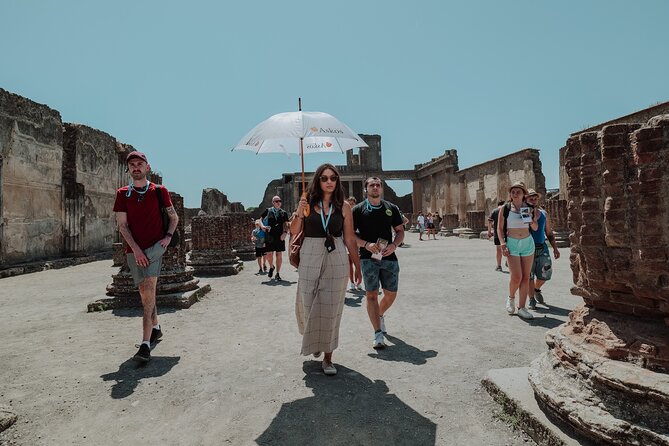
Pompeii feels different when an archaeologist leads. On this private Pompeii tour with Askos Tours, I love the undivided attention your guide gives, plus the way guides such as Rossana, Mena, Mimma, and Paolo translate everyday Roman life into something you can actually picture.
You also get a tight route that helps you see the big highlights fast, including the Stabian Baths and the Forum area, without being swallowed by crowds. The one consideration is that the Pompeii entrance ticket is not included in the tour price, so you should budget extra if you are expecting everything to be covered.
In This Review
- Key points before you go
- Porta Marina Superiore start: where the tour actually begins
- The 2-hour route: a fast, smart orientation of Pompeii
- Casa dei Vettii: private wealth and painted-room details
- Lupanar and the street-level city: public spaces you can read
- Termopolium and House of Faun: commerce and status in stone
- Teatro Grande: entertainment without the guesswork
- Stabian Baths and Forum Baths: where daily routines lived
- Via dell’Abbondanza, Macellum, and market life you can picture
- House of Menander and the Granaries of the Forum
- Forum time: seeing the center without losing the thread
- Crowd-smart touring: how guides help you actually see things
- Shoes, walking, and what to do with your 2-hour sprint
- Price of $178.45: is it worth it for Pompeii?
- Who this tour fits best
- Should you book this Askos Tours Pompeii private tour?
- FAQ
- Is the Pompeii entrance ticket included?
- How long is the Pompeii private tour?
- Is this a private tour?
- What language is the tour offered in?
- Where do we meet the guide?
- Does the tour include transportation?
- What footwear should I wear, and are service animals allowed?
- Can I cancel for a full refund?
Key points before you go
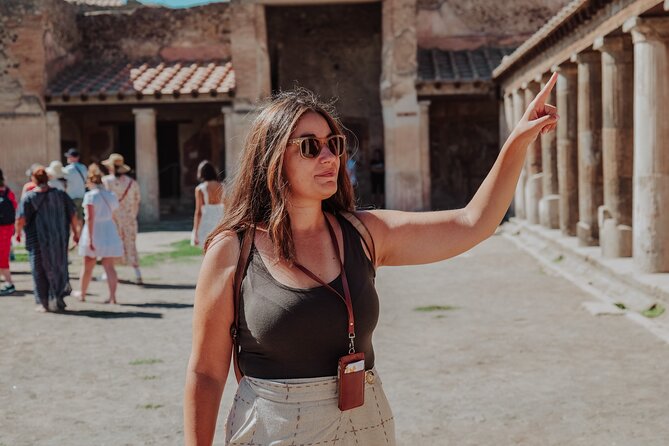
- Private, English-led archaeologist guidance for just your group, with time for questions
- A highlight-focused route in about 2 hours, built for first-time visitors who want results
- Not just monuments, your stops include homes, baths, theaters, and market spaces
- Crowd-aware pacing so you can spend more time looking and less time waiting
- You walk in closed shoes, because Pompeii’s stones do not forgive flip-flops
- Park admission is separate, so confirm your ticket plan before you arrive
Porta Marina Superiore start: where the tour actually begins
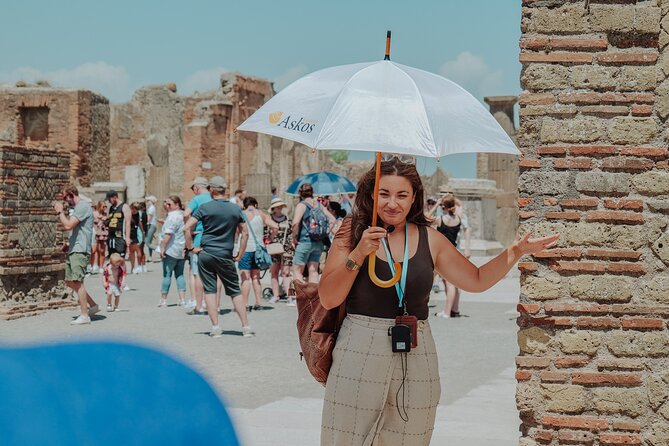
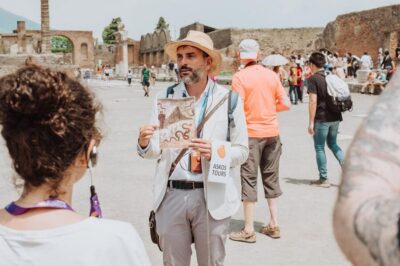
This tour is designed to get you oriented quickly, and it starts right at the Pompeii Archaeological Park entry point called Porta Marina Superiore. Your guide holds an Askos Tours sign at the main entrance, so you can find them without playing guessing games with the crowd.
I like this approach because Pompeii is big, and it is easy to waste your first minutes wandering. With a guide like Vito or Jolanda, you are not just hearing facts, you are getting practical context, so you start looking at the right things from the beginning.
One small but useful detail: the tour ends with the guide leaving you at the ruins, and they are willing to help you with directions back to your accommodation or the nearest train station. That matters, because once you are done, the logistics can be the part that steals your energy.
Our reviewers also walked through other Pompeii site visits in Pompeii.
- Pompeii Small Group Tour with an Archaeologist
★ 5.0 · 6,593 reviews - Discover the Ancient Ruins of Pompeii: Day Trip from Rome
★ 3.5 · 2,247 reviews - Pompeii and Herculaneum Small Group Tour with an Archaeologist
★ 5.0 · 1,350 reviews - Skip the Line Guided Tour of Pompeii led by an Archaeologist
★ 5.0 · 703 reviews
The 2-hour route: a fast, smart orientation of Pompeii
Think of this as a concentrated “greatest hits plus meaning” tour. The stops are short, often around 5-10 minutes, so you are not settling into one room for an hour. That can be perfect if you only have a day, or if you want a guide to show you what to notice before you explore on your own.
You will move through a sequence of places that cover different sides of city life. Pompeii is not only temples and big views, it is also private houses, entertainment spaces, bath culture, and street-level commerce. This tour keeps pulling those threads together, so the ruins stop feeling like random walls.
If you prefer slow travel, 2 hours might feel like a sprint. The upside is that your guide can also help you decide what to revisit later, especially since many guides end by steering you toward good areas to spend more time.
Casa dei Vettii: private wealth and painted-room details
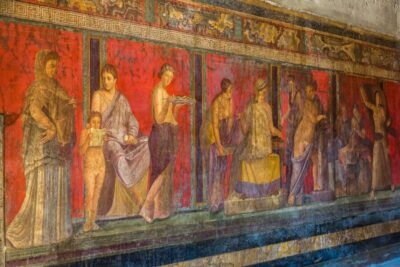
One of the early stops is Casa dei Vettii. This is a classic kind of Pompeii visit because a home gives you a window into how people arranged daily life, from how rooms connected to how the house functioned as a social and economic space.
What makes this stop valuable on a private tour is the interpretation. Guides such as Rossella, Maria, and Antonella tend to explain what you are looking at, not just what it is called. You get time to ask questions, which is huge when you see painted surfaces, decorative fragments, or evidence of daily routine.
A drawback to know: the time at each stop is limited, so you will not get an ultra-long “study session” inside this house. Still, it is a strong way to see why Pompeii feels personal, not distant.
Lupanar and the street-level city: public spaces you can read
Next up is the Lupanar, a reminder that Pompeii included spaces for adult entertainment. Right after that, you also walk through the area tied to daily movement on the Via dell’Abbondanza, the kind of street you can imagine as traffic, conversation, and commerce.
These stops are quick, but they help you build the full picture of a Roman city, not only the glamorous or formal parts. On this private format, you can ask practical questions like how spaces worked together, or why certain places were where they were.
If you are sensitive about subject matter, you should know the Lupanar is included as a named highlight. For many visitors it is still worth it because it adds honesty to the story, but it is good to go in prepared.
Termopolium and House of Faun: commerce and status in stone
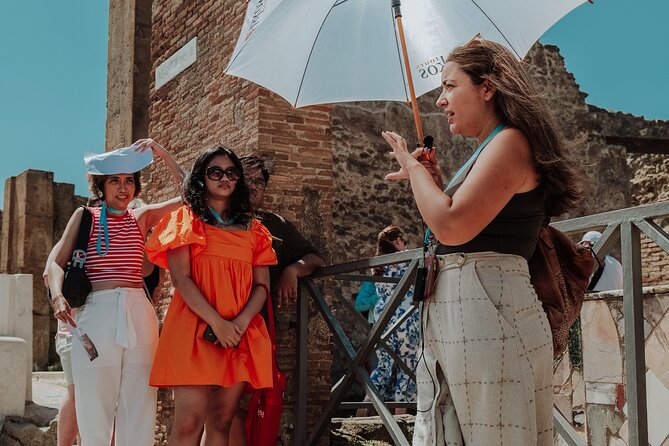
The itinerary includes the House and Thermopolium of Vetutius Placidus. A termopolium is the kind of place associated with food and drink service, so this stop naturally connects architecture with everyday needs. You also get a home stop later at the House of Faun, which helps shift from street life back to elite domestic space.
The value here is how your guide ties it together. People often want Pompeii to be either a city of emperors or a city of rubble. This route shows the in-between, the places where people ate, met, worked, and lived in different social lanes.
You might also notice how Pompeii’s layout makes movement feel logical, even when you are staring at broken sections. That is one reason a guide helps: you can walk the same path, but with someone pointing out what you would otherwise miss.
Teatro Grande: entertainment without the guesswork
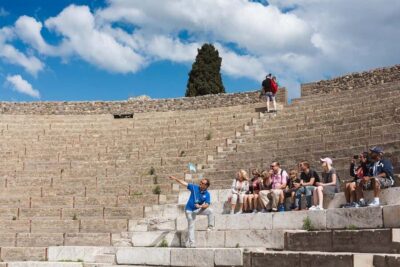
You will also see Teatro Grande, Pompeii’s theaters. This is one of those places where the shape matters, and it helps to have someone explain how entertainment spaces fit into city life.
On a private tour, the theater stop is not just a photo moment. Your guide can help you understand what to look for, like the relationship between seating areas and sightlines, or how theaters were central to public gatherings.
The trade-off is time. Theater visits tend to feel best when you can pause and look slowly, but here it is handled as a snapshot. If this is a top interest for you, plan to do a bit of independent time after the tour.
The same shortlist carries more private tours in Pompeii.


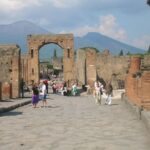




Stabian Baths and Forum Baths: where daily routines lived
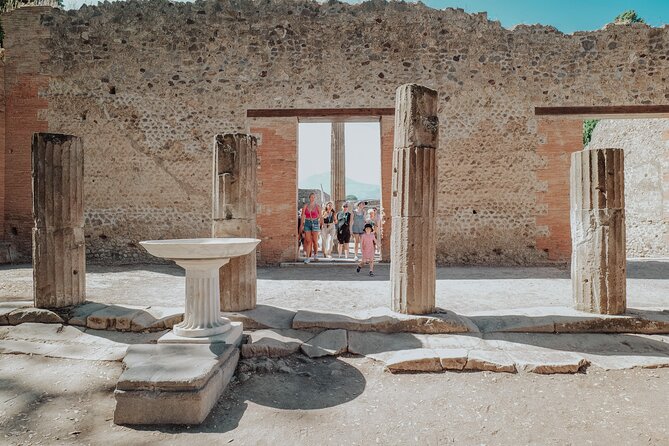
Now we get to the big crowd-pleaser: the Stabian Baths (Terme Stabiane). You also see Forum Baths later. These bath areas are important because bathing was social, not only hygienic, and it gives you a powerful sense of what people did beyond work and home.
What I like about having an archaeologist in front of you here is the ability to connect the spaces to routines. Guides like Michele, Paolo, and Vito often explain the idea of public facilities in Roman life, and they help you make sense of how rooms and zones would function.
One practical tip from real-world walking: bath areas tend to have uneven ground and lots of steps or slopes around viewing points. So, your choice of footwear matters more than you think. Closed shoes are the move here, especially if the weather is warm and you are tempted to wear sandals.
Via dell’Abbondanza, Macellum, and market life you can picture
You walk along Via dell’Abbondanza, then you stop at the Macellum. This is the Pompeii version of a marketplace, and it matters because it puts money and daily needs back into the story.
On a private tour, this part can surprise you. Market spaces can feel like nothing but walls if you only know the names. But when your guide explains how these places fit into city rhythms, you start seeing movement, not just ruins.
You might especially enjoy this section if you like everyday history, because it is the most street-level of the stops. It is also a good contrast after the baths, since one is about social bathing routines and the other is about shopping, food, and meeting people.
House of Menander and the Granaries of the Forum
Two more Forum-area stops close out the tour’s “city systems” view: House of Menander and the Granaries of the Forum. This pairing is clever because it toggles you between a domestic setting and a supply setting.
The House of Menander is another home stop, which keeps the tour balanced between private and public life. The granaries, on the other hand, point you to the infrastructure side of the city, the practical storage that helps feed people and keep the system running.
If you like history that answers the question of how people lived day to day, these stops tend to land well. Guides can also help you notice how the city’s layout supports both social spaces and logistics, so you are not only impressed, you understand.
Forum time: seeing the center without losing the thread
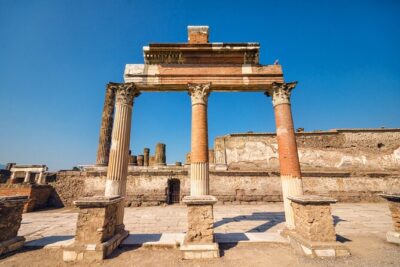
Finally, you reach the Foro de Pompeya and round out the major Forum area view. The Forum is where so many “big picture” stories connect, and your guide helps you connect what you saw earlier into one coherent mental map.
This is the moment when Pompeii stops feeling like a checklist. With an archaeologist guide, you start reading the city as a living place rather than a museum exhibit. You can ask questions about what you noticed in the homes, then bring those ideas back to the public spaces you just visited.
And because this is private, your pace is yours. If you want to slow down for one last look, you can. If you want to speed up, you can too, within reason and depending on timing.
Crowd-smart touring: how guides help you actually see things
Pompeii can overwhelm your eyes fast. Heat can drain patience, and crowds can turn your attention into navigation. That is why this format feels like value, even though it is not a cheap ticket.
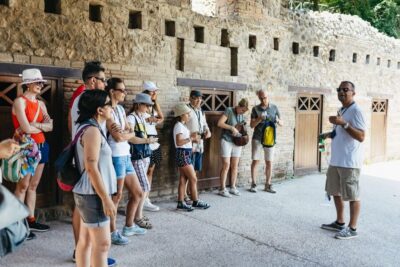
Guides in the past have been praised for navigating around crowds and keeping a sensible pace, so you spend your time looking instead of standing. Some guides also manage expectations well, which helps a lot when you are trying to see a huge site in a short window.
This also helps families and mixed-age groups. One guide experience highlighted the ability to keep kids engaged, and the private structure makes that easier than in a big group.
If you are visiting on a tight schedule, you will likely leave with a clearer sense of where to wander next. Many visitors find they enjoy their solo time more after the tour because they know what to target.
Shoes, walking, and what to do with your 2-hour sprint
Pompeii ruins mean uneven ground and real walking time. The tour strongly suggests closed shoes and not flip-flops, because it can be difficult to walk around the site in open footwear.
I agree with that advice. Even if you are only doing 2 hours, you might do more walking than you expect once you account for entrances, transitions, and finding your way to the next stop. Closed shoes also keep you comfortable enough to ask questions without constantly shifting your feet.
Also, the tour is near public transportation, which is helpful if you are planning to combine Pompeii with other stops in the area. If you are using transit, it is worth keeping your timing realistic, because your return plans depend on your arrival and your walking speed.
Price of $178.45: is it worth it for Pompeii?
At $178.45 per person for a private 2-hour tour, you are paying for three things: an archaeologist or archaeology-focused guide, a private group setup, and a focused route through Pompeii highlights.
If you are tempted to skip a guide because Pompeii looks impressive from maps, I would push back. The site is huge, and without orientation it is easy to miss what makes certain places click. A good guide turns the ruins from scenery into a story you can follow.
That said, you should budget for the Pompeii entrance ticket separately. The tour details explicitly list park admission as not included, and in practice many visitors end up paying the park fee on top of the tour. So, your true cost is the tour price plus the entry ticket.
The value sweet spot is this: you want the highlights, you want questions answered, and you only have about half a day. If you already plan to spend many hours alone and you are comfortable reading the site yourself, you might save money by going without a private guide. But if you want fewer regrets, this route can be money well spent.
Who this tour fits best
This private Pompeii tour is a good match if:
- You have limited time and want a structured path to the most important spots
- You care about how people lived, not only dramatic ruins
- You want a guide who can adjust pace for your group
- You are visiting with family or teens who still need a bit of engagement
It might be less ideal if:
- You want a slow, sit-and-stare museum approach
- You want admission fully bundled with the tour price
- You are allergic to paying extra for park entry after booking
Should you book this Askos Tours Pompeii private tour?
I would book it if you want an efficient, question-friendly introduction to Pompeii with an archaeologist guide and you like having someone point out what matters. This is the kind of tour that can make your later self-guided wandering more satisfying, because you start with context.
Before you confirm, do two sanity checks. First, plan for the Pompeii park ticket since it is not included in the tour price. Second, wear closed shoes and assume you will walk more than you expect.
Also, if you can, book ahead. This tour is typically reserved about 27 days in advance on average, so last-minute availability may be tighter than you want.
FAQ
Is the Pompeii entrance ticket included?
No. The Pompeii entrance ticket is not included in the tour price, so you should plan to buy park admission separately.
How long is the Pompeii private tour?
It runs about 2 hours.
Is this a private tour?
Yes. It is private, and only your group participates.
What language is the tour offered in?
The tour is offered in English.
Where do we meet the guide?
The start point is Via Villa dei Misteri, 1, 80045 Pompei NA, Italy. The guide meets you at the main entrance of the archaeological site called Porta Marina Superiore, holding a sign with the company name Askos Tours.
Does the tour include transportation?
No transportation is included.
What footwear should I wear, and are service animals allowed?
Wear closed shoes, not flip-flops, since walking through Pompeii can be difficult with open footwear. Service animals are allowed.
Can I cancel for a full refund?
Yes. You can cancel up to 24 hours in advance for a full refund. If you cancel less than 24 hours before the start time, the amount paid is not refunded.
Our Wider Tours File for Pompeii
The Rest of Our Pompeii Site Visits in Pompeii

Not quite the day you had in mind? The rest of our Pompeii write-ups sit below
- Ancient Pompeii Private Tour: Skip the Line & Kid-Friendly Option★ 5.0 · 167 reviews
- Pompeii 2-hour Private Tour with an Archaeologist-Ticket included★ 5.0 · 181 reviews
- Pompeii Private Tour with an Archaeologist Guide★ 5.0 · 184 reviews
- Mount Vesuvius Tour from Pompeii Led by an Expert Guide★ 5.0 · 185 reviews
- Stories of Pompeii: Small Group tour with archeology expert guide★ 5.0 · 191 reviews
- Pompeii: 2 Hour Private Tour with an Archeologist Guide★ 5.0 · 214 reviews
- Pompeii and Mount Vesuvius Small Group Tour★ 4.5 · 233 reviews
- Pompeii Guided Group Tour with Entry Ticket and Archaeologist★ 4.5 · 269 reviews
- Pompeii: Guided Small Group Tour Max 6 People with Private Option★ 5.0 · 269 reviews
Pompeii Archaeological Site, top to bottom.
 ★ 4.8Pompeii: Entry Ticket and Guided Tour with an ArchaeologistFrom $3519,459 reviews
 ★ 4.2Pompeii: Entry Ticket with Optional Audio GuideFrom $2612,360 reviews
 ★ 4.8Pompeii: Small Group Tour with an ArchaeologistFrom $4012,264 reviews
 ★ 4.3From Naples: Pompeii Ruins & Mount Vesuvius Day TourFrom $12011,459 reviews
 ★ 4.6From Rome: Pompeii, Amalfi Coast, and Sorrento Day TripFrom $797,031 reviews
 ★ 4.6From Rome: Pompeii, Amalfi Coast and Positano Day TripFrom $996,620 reviews
★ 5.0Pompeii Small Group Tour with an ArchaeologistFrom $356,593 reviews
 ★ 4.5Pompeii, Amalfi Coast and Positano Day Trip from RomeFrom $1016,250 reviews
Filed under