
Reviewed · POMPEII ARCHAEOLOGICAL SITE
PompeiI Exclusive Tour with your Archaeologist in a Small Group
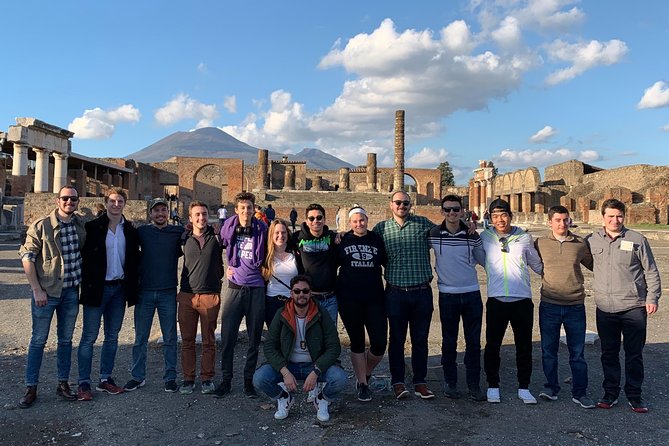
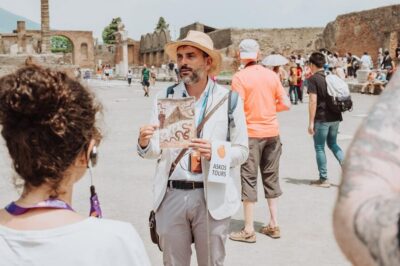
Pompeii starts to make sense fast. This small-group, archaeologist-led walk turns scattered ruins into a story you can actually follow, from Porta Marina to the Forum core. I especially liked how guides such as Ricardo and Rafael focused on what mattered most, not just what you could technically see.
Two things I really liked were the priority-style entrance approach and the pace for a site that can feel overwhelming. You move as a group, but you still get personal attention, and guides like Ornella were patient about questions while keeping the flow moving.
One consideration: your Pompeii park entry ticket is not included in the tour price. The tour cost is listed at $30.25 per person, and the Archaeological Park admission is an additional €19 for adults, so your day budget should include that up front.
In This Review
- Key tour highlights in plain English
- Entering Pompeii at Porta Marina Superiore, the Pompeii VIP way
- The “priority line” advantage, and the ticket reality
- How a 2-hour route works when Pompeii is huge
- Porta Marina, then Venus, the Forum, and the power center of the city
- The Forum main square and the Temple of Jupiter, with Vesuvius in the background
- Macellum, body casts, and what markets tell you about daily life
- Forum Baths and a Thermopolium stop for the city’s real routines
- Houses on the route: Casa del Fauno, House of the Vettii, and seasonal reality
- Via dell’Abbondanza and Teatro Grande, ending with the city’s stage life
- Price and value: what $30.25 buys, and what you should plan to add
- Guide style matters, and this tour tends to bring the right energy
- Practical tips before you go, so the ruins feel easier
- Who should book this Pompeii VIP archaeologist tour
- Should you book this tour?
Key tour highlights in plain English
- Archaeologist guide: you get more than labels, you get how archaeologists interpret what you’re seeing
- Pompeii VIP check-in: meet at Porta Marina Superiore with a sign, and use a faster access route
- Priority line to save time: a separate line helps you avoid a long wait at the gate
- Big sights in 2 hours: Forum center, baths, a market space, and a theater stop all make the cut
- Small group limit of 15: easier questions, less rushing, and a calmer experience
Entering Pompeii at Porta Marina Superiore, the Pompeii VIP way
The tour meets at Via Villa dei Misteri, 1, 80045 Pompei NA and then starts walking into the Archaeological Park. The key moment comes at Porta Marina Superiore, the western entrance, where the guide waits outside the park with a Pompeii VIP sign.
Why that matters in real life: Pompeii is popular, gates get slow, and the ruins are spread out. A planned entrance and a clear meeting point help you avoid the common trap of arriving ready to see everything, then getting stuck in line while your energy drains.
If you want one practical move, it is this: arrive a few minutes early, so you are not scrambling in front of the group. The tour runs about 2 hours, so shaving time at the start matters.
Our reviewers also walked through other Pompeii site visits in Pompeii.
- Pompeii Small Group Tour with an Archaeologist
★ 5.0 · 6,593 reviews - Discover the Ancient Ruins of Pompeii: Day Trip from Rome
★ 3.5 · 2,247 reviews - Pompeii and Herculaneum Small Group Tour with an Archaeologist
★ 5.0 · 1,350 reviews - Skip the Line Guided Tour of Pompeii led by an Archaeologist
★ 5.0 · 703 reviews
The “priority line” advantage, and the ticket reality
This experience is built around priority access to reduce gate waiting, but it does not replace the need for a park entry ticket. The tour price covers the guided component, while the Pompeii Archaeological Park admission is separate.
Here is the budgeting math that helps:
- Tour price: $30.25 per person
- Pompeii park ticket: €19 per adult (free under 18)
Also watch for this detail: the skip-the-line link you receive is meant to help you save time, but the ticket tied to the booking is not the same as the entry ticket for the archaeological site. The tour uses that distinction to keep things simple once you are on-site, with staff support to help you with what you need to buy.
One more small tip from experience with guided tours here: if you are issued an audio device, test it early. In at least one case tied to this style of tour, the earpiece failed and the guide did not resolve it fast enough. If audio is part of the setup on your date, a quick check at the start can prevent a lot of frustration.
How a 2-hour route works when Pompeii is huge
Pompeii covers a lot of ground, and most people wander in circles because they do not know what they are looking at. This tour solves that with a tight route and frequent short stops.
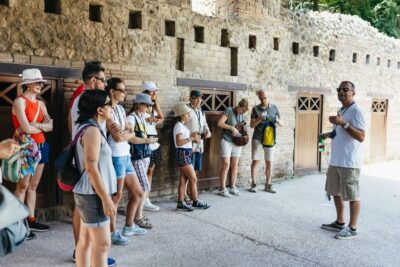
The group stays small, with a maximum of 15 travelers, which changes the feel of the visit. It is easier to ask questions. It is easier for the guide to correct misconceptions before they stick. And it is easier to keep moving without losing the meaning of each place you pass.
Expect roughly 10 minutes per stop for the main sights, which is exactly long enough to connect the dots and snap a few photos. It is not a “touch every building” tour. You come out with a working map of Pompeii’s big themes: religion, public life, markets and daily needs, and the way wealthy houses shaped the street.
Porta Marina, then Venus, the Forum, and the power center of the city
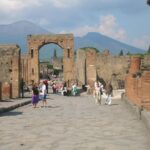
Your walk starts at Porta Marina Superiore, the western entrance. Even that first stop has context. Guides explain that the “Marina” name connects to the old road that led toward the sea, which helps you picture the city’s geography instead of just seeing a gate in isolation.
From there, you head to the Tempio di Venere (Temple of Venus). Venus was the patron goddess of Pompeii, so this is not just “a temple.” It is a clue to how Pompeii framed identity, protection, and civic pride.
Next comes the Basilica, described as the most lavish building in the Forum. This is one of those places where the guide approach really pays off. You are not only looking at architecture. You are learning what the space did: business management and administration of justice. In other words, the guide helps you see the Forum as the city’s operating system.
Then you visit the Sanctuary of Apollo near the route from Porta Marina toward the heart of town. If you care about “when was this built,” this stop is compelling because it is among the older places of worship in Pompeii, which gives the city a longer timeline than you might assume.
The Forum main square and the Temple of Jupiter, with Vesuvius in the background
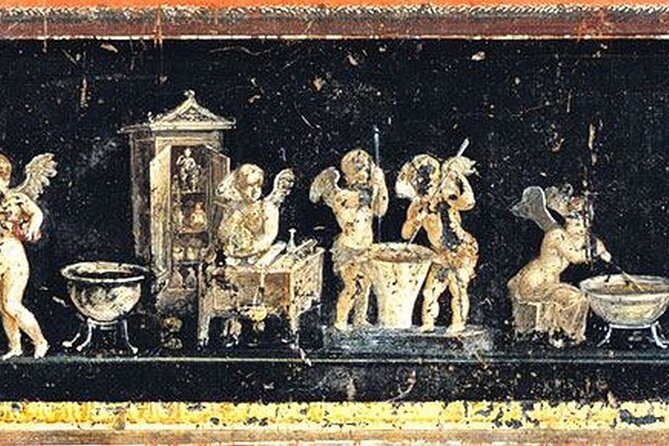
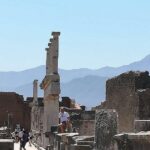
The Foro di Pompeya (Forum) is the public core, the center of daily life. In a short visit, the Forum is where you learn the rhythm: where people gathered, where decisions were made, and where the city showed off its status.
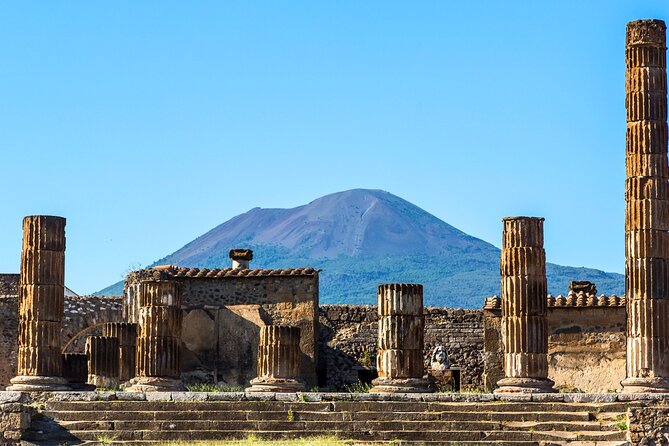
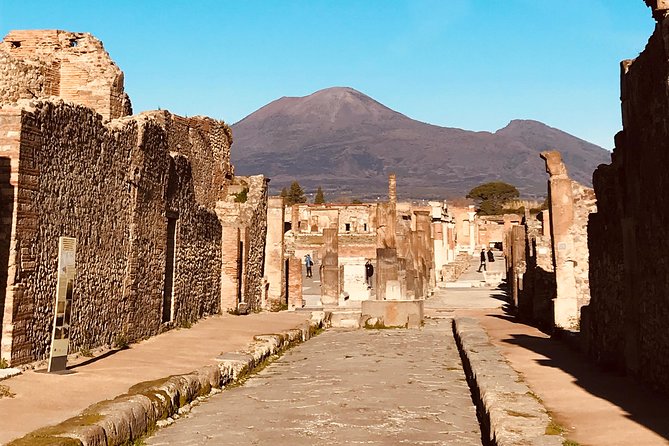
The stop at the Tempio di Giove Capitolino (Temple of Jupiter) is also practical for understanding layout. It dominates the northern side of the Forum, and behind it rises Vesuvius. That sightline makes the historical drama feel real. You start seeing Pompeii not as a museum, but as a city built under a volcano’s shadow.
If you like photo stops, this is where you can get the most “I get it now” images. But be ready to keep walking. Pompeii reveals things best when you move in order, and this tour does that.
Macellum, body casts, and what markets tell you about daily life
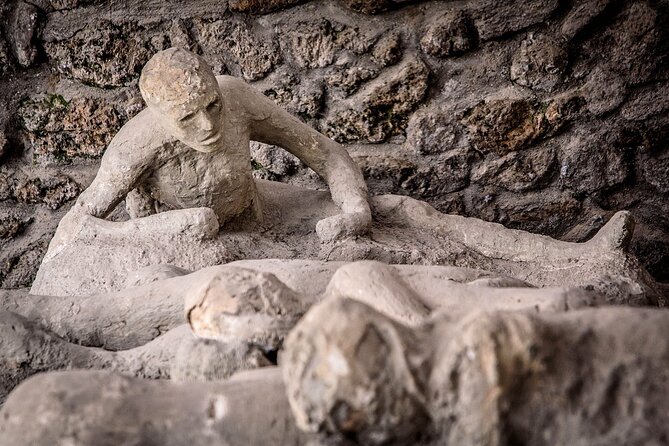
After the civic center, the route shifts into daily needs and consumer life with the Macellum, a monumental market building. This is a key Pompeii topic because markets show how regular people lived, ate, and bought essentials.
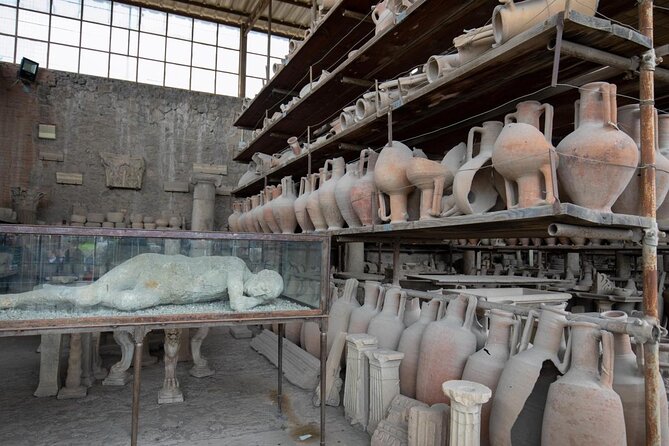
This stop is also where you might see plaster casts connected to the famous preservation method, often referred to as the way archaeologists found bodies and how they were at the moment of the eruption. The guide framing is important here. Without interpretation, you might read it as a grim attraction. With interpretation, it becomes evidence of a catastrophe and a human timeline you can actually understand.
One reason the Macellum stop gets so much value on a guided walk: it helps you stop thinking that Pompeii is only villas and temples. It gives you the “what people did every day” side of the story.


Forum Baths and a Thermopolium stop for the city’s real routines
Next up are the Forum Baths, one of the best-preserved elements of Pompeii. Guides explain that the baths had separate areas for women and men, each with separate entrances. That detail sounds simple, but it actually changes how you imagine social life in the city.
Following that is the Thermopolium of Vetuzio Placido, which was essentially an ancient diner. Thermopolia were refreshment stops, and seeing the space on-site helps you picture quick meals and street-level commerce.
If you are thinking about food, do not expect a meal. But you will get something more useful: you get how Pompeii worked day to day, not just how the wealthy lived.
Houses on the route: Casa del Fauno, House of the Vettii, and seasonal reality
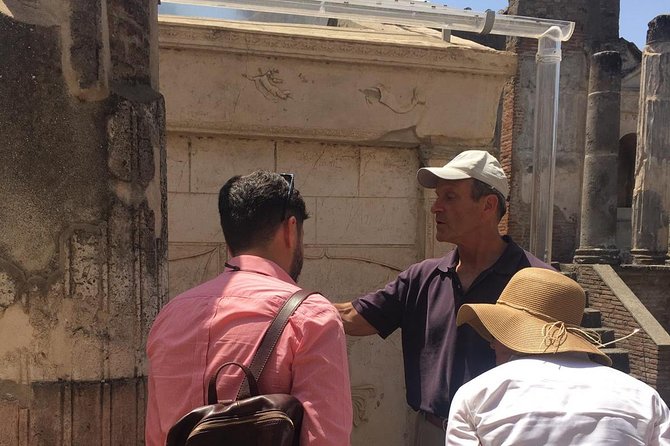
Pompeii’s houses can be the hardest part to plan because some are large and some are seasonal. This tour includes two standout homes: Casa del Fauno and the House of the Vettii.
At Casa del Fauno, you can see the welcoming inscription written in Latin as HAVE. The house itself is one of the largest in Pompeii, which makes it a good anchor stop if you want to understand what “wealthy” meant in physical space.
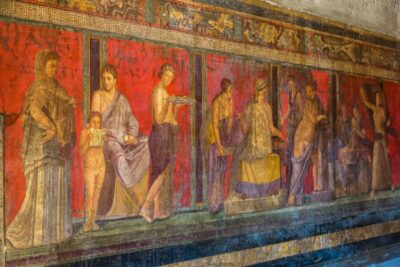
Then comes the House of the Vettii, one of Pompeii’s richest and most famous homes, connected to Priapus, the god tied to prosperity. The key practical note here is seasonal access. The houses can have openings and closings depending on when you visit, so your guide keeps expectations realistic.
This is also where I like having a guide who can point out what matters even when a room is limited. The route is built so you still come away with a clear impression of elite life and street presence.
Via dell’Abbondanza and Teatro Grande, ending with the city’s stage life
The tour ends with the Via dell’Abbondanza, Pompeii’s main street, known as the decumanus maximus. Even in a quick stop, it is one of the best ways to understand city planning. You start seeing how storefronts, houses, and public spaces lined up along a central axis.
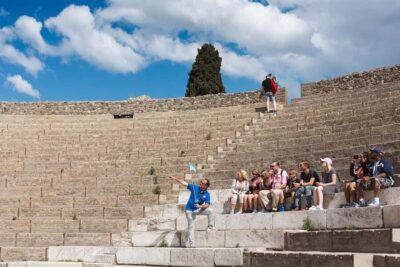
Finally, you reach the Teatro Grande, the large theater where comedies and tragedies in the Greco-Roman tradition were performed. You do not just stand in ruins. With the guide’s framing, you connect the theater to civic culture, entertainment, and how public life expanded beyond politics and worship.
Then you are done, and the big benefit is this: you now know where to go next. The two hours act like a primer, not a full replacement for exploring longer.
Price and value: what $30.25 buys, and what you should plan to add
On paper, $30.25 for a guided Pompeii visit sounds like a deal. In practice, the value comes from what is included and what is not.
Included value:
- Authorized archaeology guide
- A small group format
- A priority-style entrance approach to reduce gate delays
- A route that targets the most important sights in about 2 hours
Not included:
- Pompeii Archaeological Park entry: €19 for adults
If you are traveling as a couple, a family, or a small group, the guide cost is spread across the experience, but the Pompeii ticket still has to be bought for each adult. Still, a good archaeologist-led explanation usually saves you from the “I stared at a wall, then moved on” feeling.
One more value point: some guides keep you moving while also answering questions. In this tour’s history of guides, people have singled out guides like Ricardo for explaining not only what you see, but how archaeologists learned it. That difference turns ruins into a lesson instead of a checklist.
Guide style matters, and this tour tends to bring the right energy
A Pompeii guide can make or break the day. The best ones treat Pompeii like a case study.
On this route, guides such as Ornella and Antonio have been praised for storytelling and for staying fun while being factual. Ricardo and Rafael have been praised for answering questions with clarity, including how archaeologists reach conclusions from evidence. One guide also handled weather well, knowing where to wait for shelter when conditions turned wet and windy, so the tour kept its rhythm.
I also like that the tour often includes time-sensitive realities, such as where excavation is ongoing. In at least one case associated with this experience, the guide showed where preservation and current work happen, and photography restrictions were mentioned for certain areas, with photos later shared after the stop. That kind of context is what separates a basic walkthrough from a real archaeology perspective.
Practical tips before you go, so the ruins feel easier
Here are the small things that matter on a Pompeii walk like this:
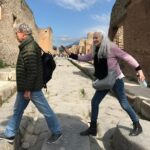
- Wear comfortable walking shoes. Pompeii is uneven and you will be on your feet for most of the 2 hours.
- Plan for sun, wind, or rain. The experience is described as requiring good weather, and the route is outdoors.
- Bring a phone with some battery. You will want photos, but remember that some zones may restrict pictures, especially where archaeological work is underway.
- If you care about seeing specific houses, keep in mind seasonal openings can affect what is accessible at Casa del Fauno and the House of the Vettii.
And one pro move: book earlier if you can. This experience is typically booked around 25 days in advance, which tells you it fills up.
Who should book this Pompeii VIP archaeologist tour
This tour fits best if you:
- Want a guided visit that turns Pompeii into a coherent story
- Prefer a small group pace over crowded bus tours
- Like public spaces as much as famous houses
- Would feel lost without interpretation, especially around the Forum and market areas
It is also a solid pick if you want a first visit. After 2 hours, you will likely know what to revisit on your own.
If you already studied Pompeii deeply and want to focus on very specific neighborhoods or major sites like other big-ticket buildings not covered in this route, you might feel constrained. But for most people, the route hits the “why it mattered” points.
Should you book this tour?
I think this is a smart booking if your goal is understanding, not just checking boxes. The tour’s value comes from an archaeologist-led explanation, a small group size, and a route that targets the Forum power center, markets, baths, everyday food spaces, and major architecture cues along the main street.
Book it if:
- You want priority access so your day starts strong
- You are okay adding the €19 adult park ticket to the tour price
- You want the easiest way to get oriented quickly before exploring more on your own
Skip it if:
- You only want one or two specific sites and are confident navigating Pompeii without guidance
- You expect the tour price to include Pompeii entry (it does not)
If you want a Pompeii day that feels organized, meaningful, and not overwhelming, this one is built for that.
Our Wider Tours File for Pompeii
The Rest of Our Pompeii Site Visits in Pompeii

Not quite the day you had in mind? The rest of our Pompeii write-ups sit below
- Ancient Pompeii Private Tour: Skip the Line & Kid-Friendly Option★ 5.0 · 167 reviews
- Pompeii 2-hour Private Tour with an Archaeologist-Ticket included★ 5.0 · 181 reviews
- Pompeii Private Tour with an Archaeologist Guide★ 5.0 · 184 reviews
- Mount Vesuvius Tour from Pompeii Led by an Expert Guide★ 5.0 · 185 reviews
- Stories of Pompeii: Small Group tour with archeology expert guide★ 5.0 · 191 reviews
- Pompeii: 2 Hour Private Tour with an Archeologist Guide★ 5.0 · 214 reviews
- Pompeii and Mount Vesuvius Small Group Tour★ 4.5 · 233 reviews
- Pompeii Guided Group Tour with Entry Ticket and Archaeologist★ 4.5 · 269 reviews
- Pompeii: Guided Small Group Tour Max 6 People with Private Option★ 5.0 · 269 reviews
Pompeii Archaeological Site, top to bottom.
 ★ 4.8Pompeii: Entry Ticket and Guided Tour with an ArchaeologistFrom $3519,459 reviews
 ★ 4.2Pompeii: Entry Ticket with Optional Audio GuideFrom $2612,360 reviews
 ★ 4.8Pompeii: Small Group Tour with an ArchaeologistFrom $4012,264 reviews
 ★ 4.3From Naples: Pompeii Ruins & Mount Vesuvius Day TourFrom $12011,459 reviews
 ★ 4.6From Rome: Pompeii, Amalfi Coast, and Sorrento Day TripFrom $797,031 reviews
 ★ 4.6From Rome: Pompeii, Amalfi Coast and Positano Day TripFrom $996,620 reviews
★ 5.0Pompeii Small Group Tour with an ArchaeologistFrom $356,593 reviews
★ 4.6From Rome: Pompeii, Amalfi Coast and Positano Day TripFrom $996,620 reviews
★ 5.0Pompeii Small Group Tour with an ArchaeologistFrom $356,593 reviews
 ★ 4.5Pompeii, Amalfi Coast and Positano Day Trip from RomeFrom $1016,250 reviews
Filed under