
Reviewed · POMPEII ARCHAEOLOGICAL SITE
Pompeii Private Tour with an Archaeologist and Skip The Line – 3 hours
Pompeii gets easier when you have a plan. This private archaeologist tour is a tight 3-hour walk with skip-the-line entry at the ticket office on request, led in English. You’ll see key sights plus the street-level stuff that makes 79 AD feel real. The main catch is the Pompeii admission ticket is not included, so adults still need to budget 19 euros.
I like that the route is structured and the pacing feels built for real looking, not sprinting. You meet at Hortus Pompei and the tour ends back at the same spot, which makes the logistics painless. Just know the site involves plenty of walking, uneven ground, and steps, so you’ll want solid shoes.
In This Review
- Key highlights you’ll care about
- Why a private archaeologist-led walk works at Pompeii
- Starting at Hortus Pompei and sorting your tickets fast
- The 3-hour route: theaters, the forum, and the city spine
- Odeon and Teatro Piccolo, then Teatro Grande
- Main street energy and the grain storage
- Stabian Baths: the social center of everyday life
- Forum and Basilica court spaces
- Temple of Jupiter and the theater-adjacent structure
- Gladiators, the Lupanar, and the homes that show real personality
- Gladiators’ barracks and the theater zone
- The Lupanar, then the Temple of Venus
- Casa del Poeta Tragico and the Cave Canem mosaic
- Market life, wool trade, laundry, and quick meals
- Macellum: meat and fish market
- Edificio di Eumachia: the wool market building
- Termopolio di Vetuzio Placido: takeaway food
- Fullonica di Stephanus: laundry and cleaning
- A final temple stop to close the loop
- Guide pace, comfort, and how to plan for Pompeii walking
- Price and value: what $302.32 covers, and what it does not
- Who should book this Pompeii private tour
- Should you book this Pompeii private tour?
- FAQ
- How long is the Pompeii private tour with an archaeologist?
- Where does the tour start, and where does it end?
- Is the tour offered in English?
- Are Pompeii admission tickets included in the price?
- Does this tour include skip the line?
- Is the tour private?
- Do I get a mobile ticket?
- Are meals or private transportation included?
- Are service animals allowed?
- What if the weather is bad?
Key highlights you’ll care about
- Skip-the-line at the ticket office, if requested in advance
- A focused 3-hour circuit from Porta Marina Superiore to Porta Marina Inferiore
- Theaters, baths, the forum, and markets in one run, so you do not miss the big themes
- Every stop connects to daily life, from food and laundry to public games and religion
- Private, English-speaking guide with time for questions
Why a private archaeologist-led walk works at Pompeii
Pompeii can feel like a maze if you wander on your own. The streets are still there, the buildings have bones, but without guidance it is easy to miss the relationships between things, like how the baths connect to the neighborhood life, or how the forum ties into politics and public business.
With this tour, you get a story thread. The guide is not just pointing at stones, you get an order to the visit and a sense of what mattered to everyday people in the city before the eruption. That alone saves time and frustration.
Second, this is a true private setup, so your pace is your pace. In the experiences shared with this operator, guides like Amadeo, Luisa, Eliana Sandretti, Roberto, Maria, and Mariagrazia are repeatedly described as friendly, patient with questions, and tuned to small-group needs. That matters in Pompeii, where you often want to stop, look again, and ask one more thing.
The one downside is physical. Pompeii is not flat, and surfaces can be slippery. If you have limited mobility, you will likely want to go in with a careful mindset and expect slower moments.
Our reviewers also walked through other Pompeii site visits in Pompeii.
- Pompeii Small Group Tour with an Archaeologist
★ 5.0 · 6,593 reviews - Discover the Ancient Ruins of Pompeii: Day Trip from Rome
★ 3.5 · 2,247 reviews - Pompeii and Herculaneum Small Group Tour with an Archaeologist
★ 5.0 · 1,350 reviews - Skip the Line Guided Tour of Pompeii led by an Archaeologist
★ 5.0 · 703 reviews
Starting at Hortus Pompei and sorting your tickets fast
The meeting point is clear and central: Hortus Pompei, Restaurant & Garden Bar, on Via Villa dei Misteri, Piazza Porta Marina Superiore 1 (also listed around Piazza Esedra, 1), in Pompeii. The tour starts there and ends back at the same meeting point.
For tickets, here is the practical part. The Pompeii admission fee is not included. Adults pay 19 euros per person, and entry is free for under 18. The tour does include help with the logistics, including a link to buy entrance tickets in advance, and the option of skip-the-line at the ticket office on request in advance.
That skip-the-line detail is worth taking seriously. If you want the ticket office line reduced, make sure you follow the instructions for the skip-the-line request early enough. The point is simple: Pompeii is popular, and lines happen even when you have a guide.
Also, you will get a mobile ticket for the tour. That helps on the day, since you are not hunting for paper confirmations while walking.
The 3-hour route: theaters, the forum, and the city spine
This is not a two-day sprint. It is a 3-hour private loop that starts at Porta Marina Superiore and finishes at Porta Marina Inferiore. You hit the “what is this place” essentials quickly, then you move into the “how people lived here” details.
Odeon and Teatro Piccolo, then Teatro Grande
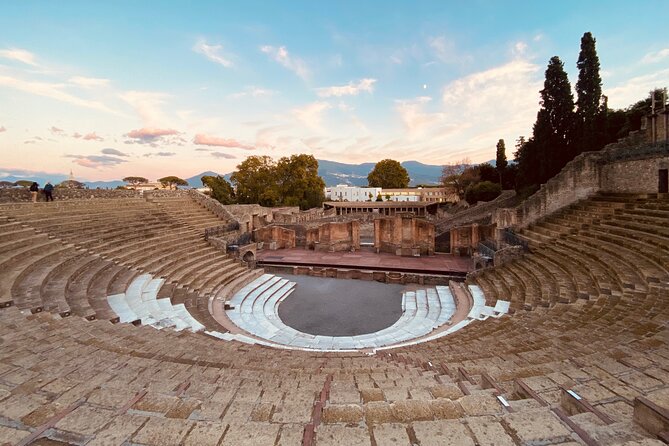
You begin with a theater stop that sets the tone. The Odeon or Teatro Piccolo is quick, but it gives you a feel for the performance culture Pompeii enjoyed. Then you move to the Teatro Grande, the larger theater.
What I like about doing the theaters early is that they give you a reference point. Once you understand where the crowds would gather and how the space works, later stops feel more connected.
Main street energy and the grain storage
Next comes the main street of Pompeii, followed by Granai del Foro, the archaeological deposit tied to grain storage and the forum area.
This is where you start learning how the city functioned. Pompeii was not just temples and murals, it was also supplies, storage, and everyday economic systems. Seeing grain-related structures helps you visualize what had to keep moving to feed people.
Stabian Baths: the social center of everyday life
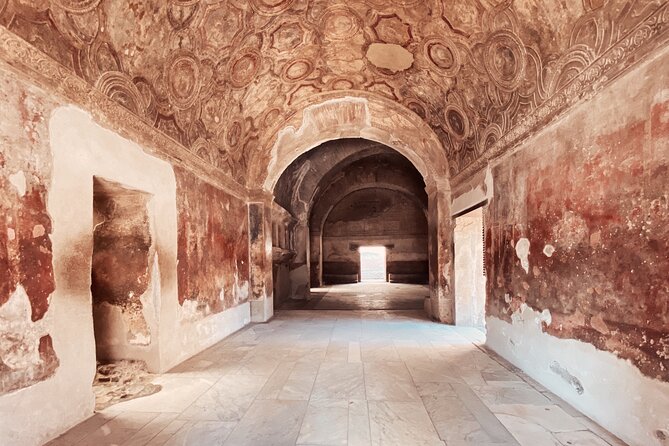
Then the tour heads to the Stabian Baths (Terme Stabiane), described as the first baths of Pompeii on the route.
Bathhouses were a big deal in Roman cities. Even if you only have a few minutes here, the guide context helps you imagine what these spaces were for, the routines, and why they were social as much as practical.




Forum and Basilica court spaces
After that, you reach the Forum (Foro di Pompei), then Pompei’s Basilica, tied to the court of justice.
In Pompeii, the forum is a must because it anchors the city’s public life. The Basilica courtyard area is also a strong “now I get it” moment, since it shows how law and administration were woven into the urban layout.
Temple of Jupiter and the theater-adjacent structure
The route then includes a Temple of Jupiter stop, plus the Quadriporticus of the theatres, which is linked to gladiator spaces later.
Even if you only pause briefly, you learn to read Pompeii’s design like a system: entertainment spaces, sacred spaces, and public routes all connect.
Gladiators, the Lupanar, and the homes that show real personality
Pompeii does not shy away from human life. This tour includes some of the most talked-about social locations, handled in a matter-of-fact way.
Gladiators’ barracks and the theater zone
You’ll stop at the gladiators’ barracks (described on the route as a gladiators’ barracks / Quadriporticus area). Even in a short visit, you pick up how intense the training and staging environment was around the theaters.
That theater connection makes the later brothel stop land better, because you see how the city’s entertainment culture spilled into other parts of daily life.
The Lupanar, then the Temple of Venus
Next is Lupanar, the brothel or prostitution area. After that you visit the Temple of Venus.
This is one of the places where I strongly recommend going with a practical mindset. You are not there for scandal, you are there to understand Roman social life, including how the city marketed services and how religion fit into public space.
The Temple of Venus stop then gives a contrasting lens. It reminds you that Pompeii’s streets mixed sacred and everyday, entertainment and devotion, all in walking distance.
Casa del Poeta Tragico and the Cave Canem mosaic
Then you get one of the most famous picture-stops: Casa del Poeta Tragico and the Cave Canem mosaic.
A mosaic like this does more than impress. With a guide’s explanation, you start seeing how domestic spaces communicated identity and attitudes, even at the front steps where visitors were greeted.
Market life, wool trade, laundry, and quick meals
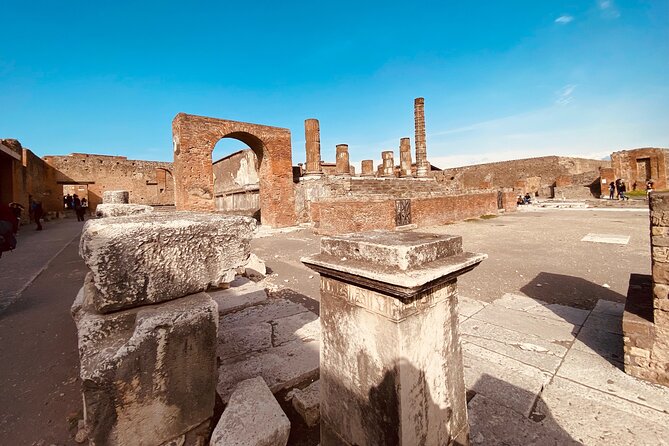
The second half of the route leans heavily toward how people shopped, ate, and handled work. That is where Pompeii stops feeling like a museum and starts feeling like a city with routines.
Macellum: meat and fish market
You’ll visit the Macellum, described as Pompeii’s meat and fish market. This stop is short, but it is a clear reminder that food supply was organized and visible.
Even if you are not staring at every corner, you’ll come away knowing what kinds of goods were sold and how the market space fit into daily movement.
Edificio di Eumachia: the wool market building
Next is Edificio di Eumachia, labeled as the wool market.
Wool tells you about production and trade, not just consumption. It helps connect the city to wider supply chains, and it clarifies why commercial buildings were prominent.
Termopolio di Vetuzio Placido: takeaway food
You also stop at Termopolio di Vetuzio Placido, a takeaway shop and fast food spot.
This is a fun stop because it is so human. People needed quick meals, not just long dinners. When you see a termopolium area in context, it suddenly makes sense why there were snack-style options packed into neighborhoods.
Fullonica di Stephanus: laundry and cleaning
Then you move to Fullonica di Stephanus, described as the laundry.
Laundry and cleaning were not optional. When you see this kind of workplace in Pompeii, it changes the whole mental picture. You begin understanding the city’s “behind the scenes” labor that kept daily life running.
A final temple stop to close the loop
The route includes another Temple stop near the end of the walk. The timing and placement are useful because it reinforces the city’s blend of worship spaces and daily life.
Guide pace, comfort, and how to plan for Pompeii walking
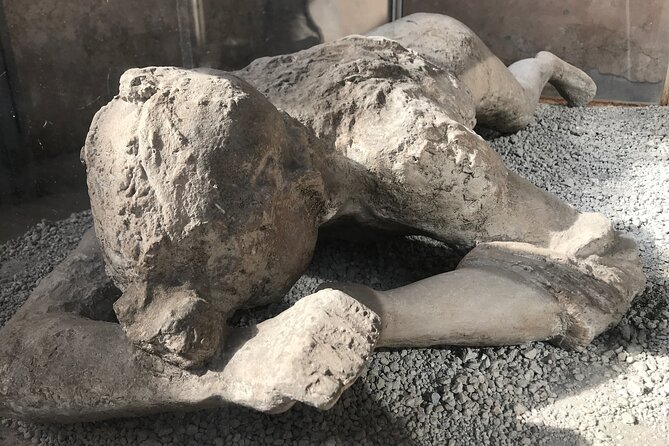
This is a walking tour, with real outdoor terrain. The site involves steps and surfaces that can be slippery, so bring footwear with grip.
Good news: in the experiences shared for this operator, guides are often described as helpful when someone needs extra time or a slower approach. For example, Mariagrazia is praised for adapting the tour pace for mobility challenges, and Luisa is noted for finding shaded spots during warmer moments.
So yes, you should plan for effort. But you also should not feel left to struggle. A private archaeologist guide can adjust.
One more practical note: this is structured enough that you are not lost, but it still gives space to linger. That balance is what makes the 3 hours feel like more than just a checklist.
Price and value: what $302.32 covers, and what it does not
The price is $302.32 per group, and the listing notes up to 1. That means you’re paying for a private guide experience even if it is just you.
Then add the part that surprises people: Pompeii admission tickets are not included. Adults pay 19 euros per person, under 18 is free. So your all-in cost for an adult is essentially the tour price plus the entry ticket.
Is it worth it? In my view, it is a strong value if:
- you want a focused route in a limited timeframe
- you care about context, like how theaters, baths, markets, and homes connect
- you prefer not to waste time figuring out what you are seeing
- you are traveling solo or as a small group and want real flexibility
If you are two or three friends who would still wander and read on your own, a private guide might feel pricier. But if you want the city explained as you walk, this price structure lines up with what you get.
Who should book this Pompeii private tour
This tour is a good fit if you:
- like archaeology but also want everyday-life explanations
- prefer a guided route over wandering and hoping
- want skip-the-line ticket office help, but you will follow the advance request and ticket purchase steps
- enjoy questions and conversation during your visit
It is also ideal if you want a solid Pompeii hit without turning it into a whole-day ordeal. Three hours is enough to get oriented and see the core themes.
Should you book this Pompeii private tour?
If you want Pompeii to make sense quickly, I think you should book it. The private archaeologist guide angle, the structured walk from Porta Marina Superiore to Porta Marina Inferiore, and the mix of theaters, forum life, baths, markets, and domestic details is a smart combination for a first or second visit.
Just do not forget the key detail: you still need to pay the Pompeii admission ticket for adults (19 euros). And plan for walking, steps, and uneven surfaces with shoes that handle slippery spots.
If that works for you, this is the kind of tour that turns Pompeii from scenery into a lived-in city.
FAQ
How long is the Pompeii private tour with an archaeologist?
The tour lasts about 3 hours.
Where does the tour start, and where does it end?
It starts at Hortus Pompei, Restaurant & Garden Bar in Pompeii (near Piazza Porta Marina Superiore). The tour ends back at the meeting point.
Is the tour offered in English?
Yes, the tour is offered in English.
Are Pompeii admission tickets included in the price?
No. The Pompeii entrance ticket fee is not included. Adults pay 19 euros per person, and entry is free for under 18.
Does this tour include skip the line?
Skip the line at the ticket office is available, but it is only done on request in advance.
Is the tour private?
Yes. It is a private tour/activity, and only your group participates.
Do I get a mobile ticket?
Yes, the tour includes a mobile ticket.
Are meals or private transportation included?
No. Meals and private transportation are not included.
Are service animals allowed?
Yes, service animals are allowed.
What if the weather is bad?
This experience requires good weather. If it is canceled due to poor weather, you will be offered a different date or a full refund.
Our Wider Tours File for Pompeii
The Rest of Our Pompeii Site Visits in Pompeii

Not quite the day you had in mind? The rest of our Pompeii write-ups sit below
- Ancient Pompeii Private Tour: Skip the Line & Kid-Friendly Option★ 5.0 · 167 reviews
- Pompeii 2-hour Private Tour with an Archaeologist-Ticket included★ 5.0 · 181 reviews
- Pompeii Private Tour with an Archaeologist Guide★ 5.0 · 184 reviews
- Mount Vesuvius Tour from Pompeii Led by an Expert Guide★ 5.0 · 185 reviews
- Stories of Pompeii: Small Group tour with archeology expert guide★ 5.0 · 191 reviews
- Pompeii: 2 Hour Private Tour with an Archeologist Guide★ 5.0 · 214 reviews
- Pompeii and Mount Vesuvius Small Group Tour★ 4.5 · 233 reviews
- Pompeii Guided Group Tour with Entry Ticket and Archaeologist★ 4.5 · 269 reviews
- Pompeii: Guided Small Group Tour Max 6 People with Private Option★ 5.0 · 269 reviews
Pompeii Archaeological Site, top to bottom.
 ★ 4.8Pompeii: Entry Ticket and Guided Tour with an ArchaeologistFrom $3519,459 reviews
 ★ 4.2Pompeii: Entry Ticket with Optional Audio GuideFrom $2612,360 reviews
 ★ 4.8Pompeii: Small Group Tour with an ArchaeologistFrom $4012,264 reviews
 ★ 4.3From Naples: Pompeii Ruins & Mount Vesuvius Day TourFrom $12011,459 reviews
 ★ 4.6From Rome: Pompeii, Amalfi Coast, and Sorrento Day TripFrom $797,031 reviews
 ★ 4.6From Rome: Pompeii, Amalfi Coast and Positano Day TripFrom $996,620 reviews
★ 5.0Pompeii Small Group Tour with an ArchaeologistFrom $356,593 reviews
★ 4.6From Rome: Pompeii, Amalfi Coast and Positano Day TripFrom $996,620 reviews
★ 5.0Pompeii Small Group Tour with an ArchaeologistFrom $356,593 reviews
 ★ 4.5Pompeii, Amalfi Coast and Positano Day Trip from RomeFrom $1016,250 reviews