
Reviewed · POMPEII ARCHAEOLOGICAL SITE
Pompeii Private Tour with an Archaeologist and Skip The Line
Two hours, and Pompeii feels personal. This private Pompeii tour pairs you with an archaeologist guide and a skip-the-line entry flow, so you can get started right away and focus on the details that matter. I especially like how the guide explains what you’re looking at, not just what happened long ago.
You’ll also like the way the route hits the big emotional moments without wasting your time. The plan mixes famous stops with lesser-known angles, like the Odeion’s sound tricks and the daily-life texture of Via dell’Abbondanza, with enough breathing room to ask questions.
One catch to plan for: the Pompeii entrance ticket is not included. The tour price covers the guide and the visit, but you still pay the official site entry ticket (19 euros per person).
In This Review
- Key things to know before you go
- Why a private archaeologist is the real upgrade in Pompeii
- Price and value: what $375.05 per group really buys
- Meeting at Piazza Esedra and getting oriented fast
- The skip-the-line reality: tickets are separate, but the process is supported
- Pompeii Archaeological Park: the route starts with the city in miniature
- Teatro Grande: the big stage and why size matters
- Via dell’Abbondanza and Granai del Foro: street life plus the work behind it
- Stabian Baths (Terme Stabiane): the spa part that feels oddly modern
- Forum, Basilica, Jupiter, and the Temples: where the city spoke in public
- Quadriporticus, Gladiator barracks, and the practical side of spectacle
- Vicolo del Lupanare and Temple of Venus: the city’s darker corner
- Casa del Fauno: seeing wealth without losing the human scale
- Who this tour fits best, and who should think twice
- Should you book this Pompeii private archaeologist tour?
- FAQ
- How long is the Pompeii private tour?
- Is the Pompeii entrance ticket included?
- Does skip the line mean I do not need a ticket?
- What is the meeting point for the tour?
- What is the group size for this private tour?
- What language is the tour offered in?
- Are food and drinks included?
- Are tips included?
- What if the weather is bad?
- Are service animals allowed?
Key things to know before you go

- Private group up to 10: your archaeologist guide can tailor pacing to your interests
- Skip-the-line after you buy tickets: you get help with an online ticket link in advance
- Stops built around daily life: theaters, baths, shops, the Forum, and elite homes
- Casts of the 79 AD victims: the tour includes key “filled-in” moments of the eruption
- English-only unless requested otherwise: language flexibility depends on prior request
- Two hours means highlights, not everything: you’ll see a lot, but not every corner of the park
Why a private archaeologist is the real upgrade in Pompeii
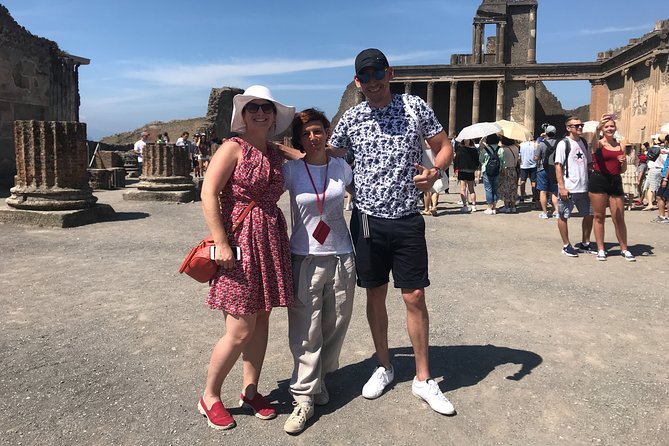
Pompeii is overwhelming fast. Even when you’re trying hard, it’s easy to miss what a room or street sign is telling you. This format fixes that by putting an archaeologist in your orbit, guiding you through the park with clear context, not random wandering.
I like private tours because the guide can slow down when something grabs your group, then speed up when you’re ready to move. One review theme that matches the experience: guides like Eliana Sandretti, plus names such as Luisa, Antonio, and Mattia, were praised for passion and for turning ruins into a place with people inside them. That matters in Pompeii, where the stones look still, but the stories do not have to feel distant.
This tour is also a good match if you’re traveling with mixed ages. Some guides in the feedback were noted for adjusting pace and finding practical ways to keep families comfortable during the walk between major sites.
Our reviewers also walked through other Pompeii site visits in Pompeii.
- Pompeii Small Group Tour with an Archaeologist
★ 5.0 · 6,593 reviews - Discover the Ancient Ruins of Pompeii: Day Trip from Rome
★ 3.5 · 2,247 reviews - Pompeii and Herculaneum Small Group Tour with an Archaeologist
★ 5.0 · 1,350 reviews - Skip the Line Guided Tour of Pompeii led by an Archaeologist
★ 5.0 · 703 reviews
Price and value: what $375.05 per group really buys
The headline price is $375.05 per group for up to 10 people, for an experience of about 2 hours in English. That’s not cheap. But the value comes from two things you don’t get with a basic walking tour: (1) a private archaeologist-led route and (2) the time saved by the skip-the-line approach once tickets are sorted.
Your real budget math should include the Pompeii admission ticket, which is 19 euros per person (and free for under 18 with ID or passport). So you’re paying two layers:
- the tour fee (guide + private time + skip-the-line flow)
- the official site entry (paid separately)
If you have a full group of 10, the tour portion works out to roughly $37.50 per person before the entry ticket. If you’re fewer than 10, the per-person tour cost rises, but the private advantage stays the same: you’re not stuck in a big herd line, and your guide can manage your pace.
Meeting at Piazza Esedra and getting oriented fast
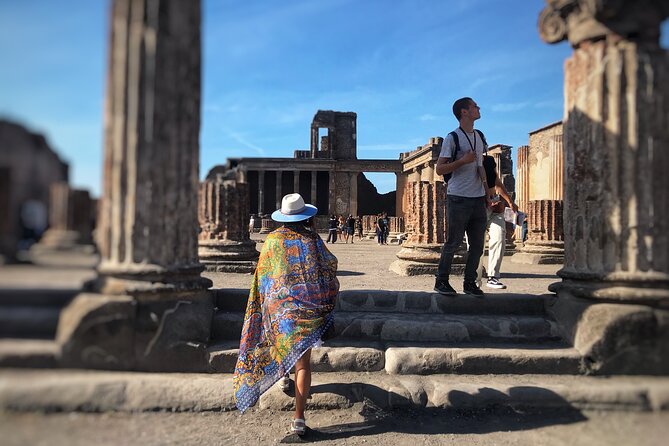
You meet at Piazza Esedra, 10, 80045 Pompei NA, Italy, and the tour ends back at the same meeting point. That matters more than it sounds. Pompeii’s entrance and internal routes can feel like a maze, and a clear start point keeps your first minutes from turning into stress.
You should also know this tour runs as a private group only. That means you’re not competing with strangers for your guide’s attention, and the stops are timed for your group’s flow.
On timing: the visit is listed at about 2 hours. In Pompeii, “about two hours” usually means the guide will hit the most meaningful stops and use smart sequencing so you can see the variety of the city, theaters, baths, Forum, and elite houses, without spending all your time just crossing the park.
The skip-the-line reality: tickets are separate, but the process is supported
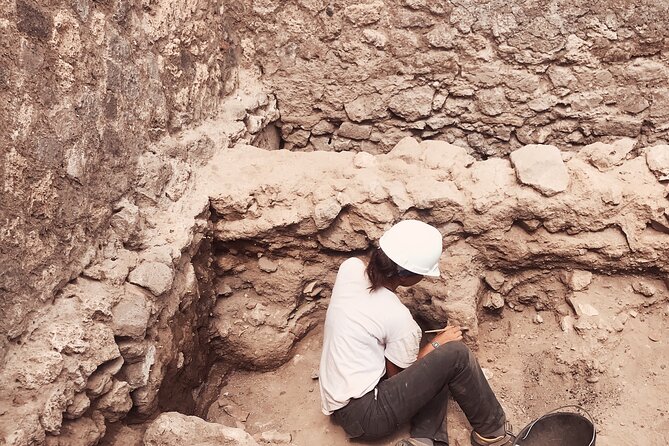
Here’s the part that caused confusion for some people: the tour does skip the line, but the entrance ticket to the Pompeii archaeological park is not included. That means you still need the official ticket first.
What helps you here is that the company sends you a link one day before the tour to buy online tickets in advance, aimed at skipping the ticket office line too. So the best move is simple: use the link, get your official Pompeii admission sorted, then show up ready for the guided entry flow.
A couple of reviews point to the same lesson: if you arrive without tickets purchased, the skip-the-line benefit can feel less like a shortcut and more like extra steps. Plan ahead, and it works the way you want.
Pompeii Archaeological Park: the route starts with the city in miniature
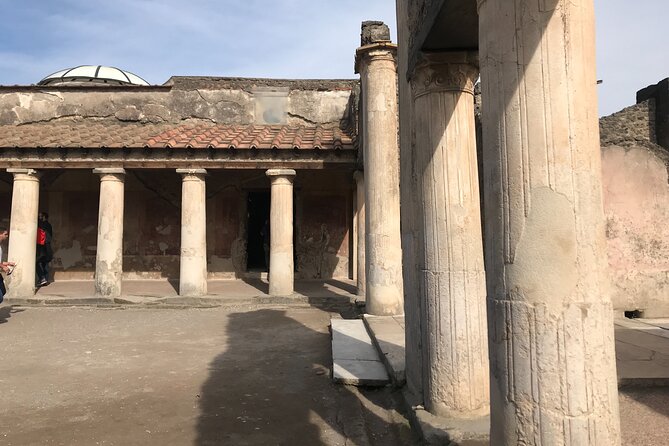
Your first big phase begins inside Pompeii Archaeological Park. The guide uses the main spine of the site to introduce major zones quickly, including:
- the theaters and temple areas
- a rich house (an elite residence)
- Stabian baths
- shops and even spaces described as fast-food style venues
- the Lupanar area (the brothel district)
- the Forum, plus the Area of the Gladiators
- and the casts (the preserved plaster figures of people who died in 79 AD)
This is a lot for two hours, and the value is in how it’s organized. Instead of seeing random buildings, you’re shown a working cross-section of Pompeii: entertainment, worship, commerce, public life, and the human impact of the eruption.
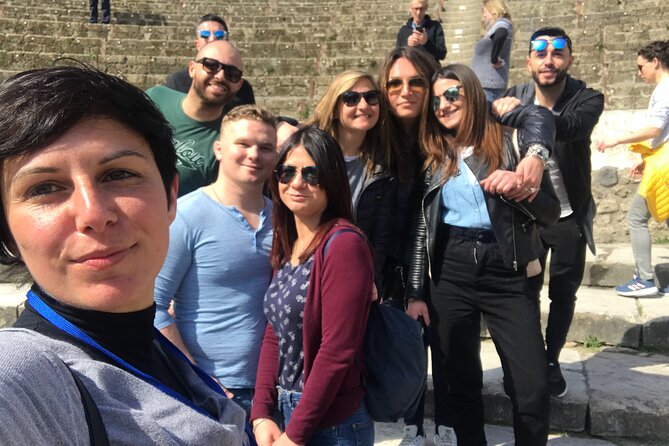
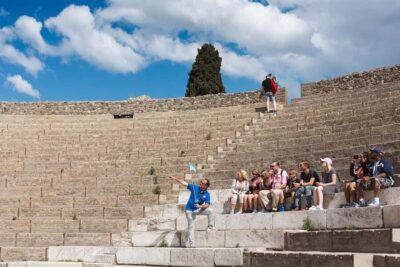
One standout stop early on is the Small Theater (Odeion), where the guide explains how Romans recreated strong acoustics. It’s the kind of detail that makes a theater stop more than a photo spot. You begin to understand how the design served the experience.
Teatro Grande: the big stage and why size matters
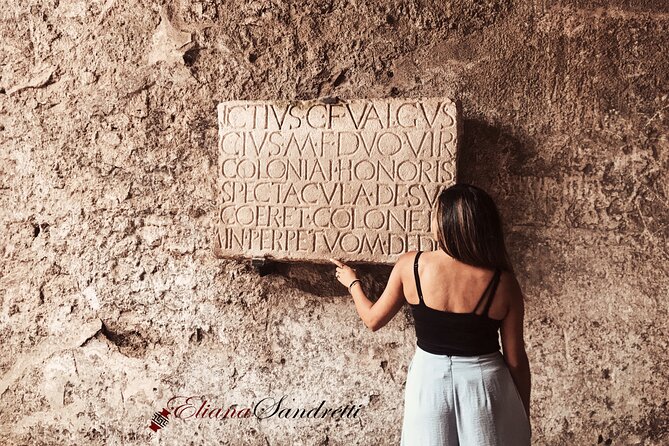
Next comes Teatro Grande, the Great Theater. This is listed for about 15 minutes, and it’s a key anchor because it shows Pompeii’s public culture at full scale. The Great Theater is described as the most important theater in the archaeological site.
In practice, this stop is ideal because it gives you a reference point. After you’ve heard the Odeion story about sound, Teatro Grande lets you see what Rome scaled up when it wanted major entertainment to land across the city.
Also, a private setting helps here. You can get closer to the right viewpoints and spend your time watching the space, not just maneuvering around other groups.
If the dates do not line up, these skip-the-line tickets in Pompeii are reviewed too.



Via dell’Abbondanza and Granai del Foro: street life plus the work behind it
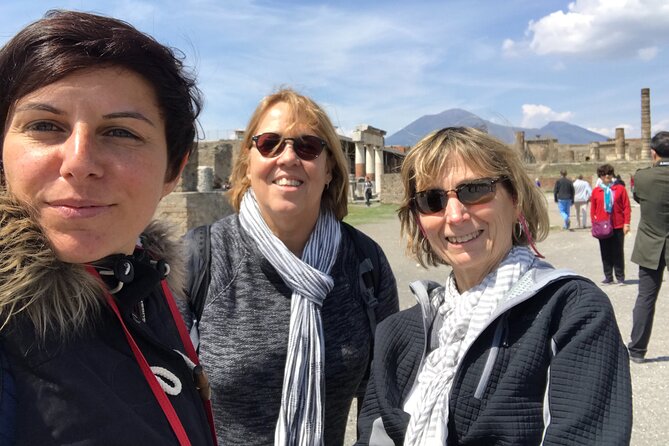
After the theater section, you cross Via dell’Abbondanza, Pompeii’s main street. This is where the tour shifts from the “public wow” buildings to the daily rhythms of commerce and movement.
Then you move to Granai del Foro (Granaries of the Forum). This stop runs about 15 minutes and is one of the most emotionally specific segments because it includes:
- casts of people who died in 79 AD
- an archaeological deposit full of amphorae
- and work tools
Granaries sound dry until you stand near them. The Roman economy depended on storage, distribution, and the infrastructure behind food and trade. Seeing the amphorae and tool deposit alongside the casts makes it harder to treat the eruption as an abstract disaster. It becomes a moment that interrupted real work.
If you only do one “non-obvious” stop in Pompeii, I’d lean toward this one. It helps you understand Pompeii as a functioning city, not just a stage set.
Stabian Baths (Terme Stabiane): the spa part that feels oddly modern
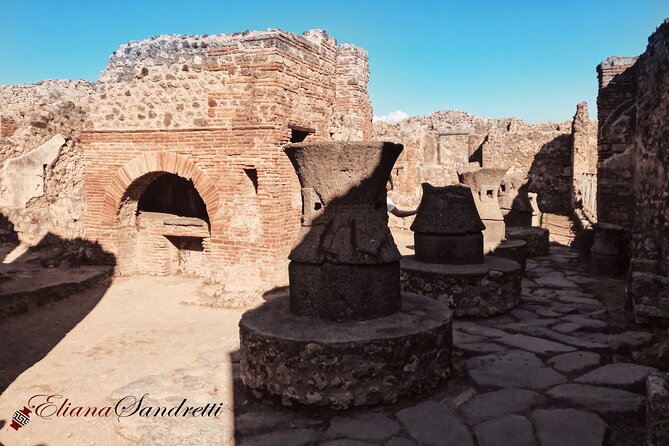
Next is the Stabian Baths (Terme Stabiane), about 15 minutes. The description calls it the best spa of the Roman Empire in Pompeii, and even if you treat that as marketing hype, the baths are still the kind of place where Pompeii feels human.
Bath complexes were social spaces, and they were about routine. Your guide’s job here is to translate the layout so it makes sense. You’re not just moving past stone rooms. You’re learning what bathing and relaxation looked like as a daily activity.
One nice perk of a private tour is how the route can account for comfort. In the feedback you can see guides working to find shady spots when conditions are hot, and bath stops can also be a natural break in the day.
Forum, Basilica, Jupiter, and the Temples: where the city spoke in public
The tour then moves into the heart of civic life. You’ll visit:
- Foro di Pompei (the ancient Forum, markets and temples)
- Pompei La Basilica (the court and justice area)
- and the Temple of Jupiter, present in the main square
- plus later, the Temple of Venus
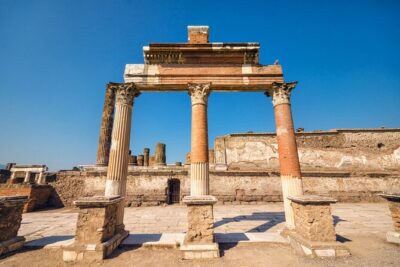
The Forum and Basilica are where Pompeii stops being a collection of buildings and becomes a political and social system. In a two-hour tour, this cluster is especially valuable because it anchors everything you saw earlier: entertainment, shopping, and homes all connect back to public authority and shared spaces.
For me, the key is how a guide frames it: justice administered in a central court tells you something about order. Jupiter in the main square tells you something about belief tied to power. Venus later gives you another layer, tying divinity to everyday identity.
Quadriporticus, Gladiator barracks, and the practical side of spectacle
Next comes Quadriporticus of the theatres, where you’ll also see the Gladiator Barracks. This stop is around 15 minutes.
Gladiators are often imagined as fighters only. But the barracks area highlights training, living space, and the behind-the-scenes structure that made the spectacle possible. In other words, Pompeii shows you the machine that produced entertainment.
This part of the tour is a good example of why private guiding matters. Without help, you might spot the buildings but not connect them to the roles inside. With a guide, it clicks into place.
Vicolo del Lupanare and Temple of Venus: the city’s darker corner
The tour includes Vicolo del Lupanare, described as the ancient red district light area, with about 15 minutes allocated. This is a charged stop, but it’s part of the full Pompeii picture.
You also then visit the Temple of Venus. The pairing makes sense. One area shows public moral and civic life, while the other touches the city’s taboo side. Together, they show that Pompeii’s society was not one-note. People had desires, routines, rules, and outlets.
If your group prefers to move quickly through sensitive zones, a private guide gives you that flexibility. You can adjust the pace without feeling like you’re breaking the tour’s rhythm.
Casa del Fauno: seeing wealth without losing the human scale
Finally, you visit Casa del Fauno, the House of the Faun. This is listed for about 15 minutes and is described as one of Pompeii’s richest and most luxurious residences.
This stop is your “contrast” moment. After theaters, baths, and Forum spaces, you get a taste of domestic luxury: how elite families lived, displayed status, and organized space in a city that still shared many public services.
The best way to get value here is to listen for what the guide points out. Pompeii’s elite homes can feel like another set of stones unless someone helps you connect layout to lifestyle. With a good archaeologist guide, the house becomes an argument for how class shaped daily life.
Who this tour fits best, and who should think twice
This is a strong fit if:
- you want a guided highlights route in about 2 hours
- you care about the eruption story and want the casts explained in context
- you want less crowd friction than a large group walk
- you’re traveling with family and want pace and stops adjusted to the group
Think twice if:
- you’re expecting the official Pompeii ticket to be included in the tour price
- you have a fixed budget that does not allow for an additional 19 euros per person
- you need a fully flexible multilingual experience, since English is the default
If your goal is to see everything at your own speed, Pompeii can take days. This tour is about smart selection and expert interpretation, not exhaustion-by-ruins.
Should you book this Pompeii private archaeologist tour?
I’d book it if you want Pompeii with structure. The private format, archaeologist-led explanations, and the route that mixes theaters, baths, Forum spaces, and the casts make it a high-value way to turn a famous place into a place you understand.
Just go in with one clear expectation: the site entrance ticket is separate. Once you buy that ticket using the advance link they provide, the skip-the-line part is much more likely to feel like the shortcut you imagined.
If you want Pompeii to be more than photos, this tour is built for that exact payoff.
FAQ
How long is the Pompeii private tour?
The tour is about 2 hours.
Is the Pompeii entrance ticket included?
No. The entrance ticket to the Pompeii archaeological park is not included. The ticket cost is 19 euros per person, and it is free for under 18 with ID or passport.
Does skip the line mean I do not need a ticket?
Skip the line is part of the tour, but you still must purchase the official Pompeii admission ticket separately. The company also provides a link to buy tickets online in advance.
What is the meeting point for the tour?
The tour starts at Piazza Esedra, 10, 80045 Pompei NA, Italy, and ends back at the meeting point.
What is the group size for this private tour?
This is a private tour. Only your group will participate, and it is priced per group up to 10 people.
What language is the tour offered in?
The tour is offered in English. Multiple languages are only available on request.
Are food and drinks included?
No. Food and drinks are not included.
Are tips included?
No. Tips are not included.
What if the weather is bad?
The experience requires good weather. In case of storm, you can choose another date or receive a full refund.
Are service animals allowed?
Yes, service animals are allowed.
Our Wider Tours File for Pompeii
The Rest of Our Pompeii Site Visits in Pompeii

Not quite the day you had in mind? The rest of our Pompeii write-ups sit below
- Ancient Pompeii Private Tour: Skip the Line & Kid-Friendly Option★ 5.0 · 167 reviews
- Pompeii 2-hour Private Tour with an Archaeologist-Ticket included★ 5.0 · 181 reviews
- Pompeii Private Tour with an Archaeologist Guide★ 5.0 · 184 reviews
- Mount Vesuvius Tour from Pompeii Led by an Expert Guide★ 5.0 · 185 reviews
- Stories of Pompeii: Small Group tour with archeology expert guide★ 5.0 · 191 reviews
- Pompeii: 2 Hour Private Tour with an Archeologist Guide★ 5.0 · 214 reviews
- Pompeii and Mount Vesuvius Small Group Tour★ 4.5 · 233 reviews
- Pompeii Guided Group Tour with Entry Ticket and Archaeologist★ 4.5 · 269 reviews
- Pompeii: Guided Small Group Tour Max 6 People with Private Option★ 5.0 · 269 reviews
Pompeii Archaeological Site, top to bottom.
 ★ 4.8Pompeii: Entry Ticket and Guided Tour with an ArchaeologistFrom $3519,459 reviews
 ★ 4.2Pompeii: Entry Ticket with Optional Audio GuideFrom $2612,360 reviews
 ★ 4.8Pompeii: Small Group Tour with an ArchaeologistFrom $4012,264 reviews
 ★ 4.3From Naples: Pompeii Ruins & Mount Vesuvius Day TourFrom $12011,459 reviews
 ★ 4.6From Rome: Pompeii, Amalfi Coast, and Sorrento Day TripFrom $797,031 reviews
 ★ 4.6From Rome: Pompeii, Amalfi Coast and Positano Day TripFrom $996,620 reviews
★ 5.0Pompeii Small Group Tour with an ArchaeologistFrom $356,593 reviews
★ 4.6From Rome: Pompeii, Amalfi Coast and Positano Day TripFrom $996,620 reviews
★ 5.0Pompeii Small Group Tour with an ArchaeologistFrom $356,593 reviews
 ★ 4.5Pompeii, Amalfi Coast and Positano Day Trip from RomeFrom $1016,250 reviews
Filed under